Historic Statewide Trauma System Milestone
Amid one of Minnesota’s top five weather events of 2025—a determined group of stakeholders traveled through snow, sleet, and freezing rain to attend an extraordinary State Trauma Advisory Council (STAC) meeting.
That day marked STAC’s 20th anniversary, celebrating two decades of collaboration behind Minnesota’s statewide trauma system. From its beginning, the trauma system’s strength has rested on broad clinical and stakeholder input. Over the years, real-world experience has informed key legislative improvements, and performance improvement has been a continuous focus ever since.
By the Numbers: System Growth
-
2005: Only 58% of Minnesotans lived within 30 minutes of a trauma hospital
-
2006–2007: First Level 3 and Level 4 hospitals designated
-
2010: 100th hospital joined the trauma system
-
2011: 95% of Minnesotans lived within 30 minutes of a designated trauma hospital
-
Past 2.5 years: More than 1,400 critical trauma cases reviewed by the trauma system during designation site visits (excluding Levels 1 & 2)
Looking Ahead
While the anniversary warranted the celebration at the December meeting, the central accomplishment was STAC’s final approval of new Level 3 and Level 4 trauma designation criteria. This milestone reflects 21 months of multidisciplinary workgroup discussions, community engagement, STAC review, and public input. The final product streamlines criteria requirements, expands surgical capacity statewide, and addresses persistent post-COVID transfer delays.
January 1, 2027, is the date that these new criteria must be implemented. A series of virtual training and Q&A sessions will support hospitals as they transition to the new criteria.
Current resources and training information are available HERE.
There are no grants and funding opportunities open currently. Continue to monitor the Office of Rural Health and Primary Care's funding web page: ORHPC Grants and Funding - MN Dept. of Health in addition to the Rural Health Transformation Program's funding web page: Rural Health Transformation Program Funding - MN Dept. of Health for future opportunities.
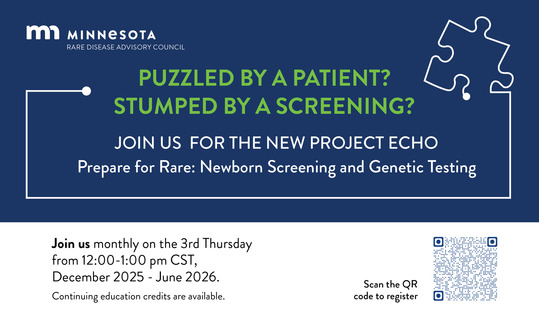
Rare Disease ECHO
Sharpen skills, engage with community, and discuss complex situations with Project ECHO: Prepare for Rare: Newborn Screening and Genetic Testing. The Minnesota Rare Disease Advisory Council is proud to partner with Stratis Health and the Minnesota Department of Health to offer a new Project ECHO for providers caring for patients with rare diseases. Prepare for Rare: Newborn Screening and Genetic Testing will prepare clinicians for patients with positive or puzzling symptoms who may be appropriate for genetic testing. This telementoring and educational program helps clinicians connect with one another to learn, review interesting case examples, and share valuable insights for quality care delivery in Minnesota.
MN HOSA-FHP State Leadership Conference
You're invited to be part of the MN HOSA-Future Health Professionals State Leadership Conference, taking place Monday, March 9 – Wednesday, March 11, in St. Cloud. MN HOSA–Future Health Professionals prepares and inspires the next generation of healthcare leaders through education, competition, and hands-on experiences.
We are seeking Exhibitors, Judges, Sponsors, and Volunteers to support this premier student leadership and healthcare career exploration event. With over 1,200 high school students expected from across Minnesota, this is a powerful opportunity to showcase your brand, network with healthcare and education professionals, and build your future talent pipeline.
We would love to have you involved; thank you for supporting Minnesota’s future healthcare workforce!
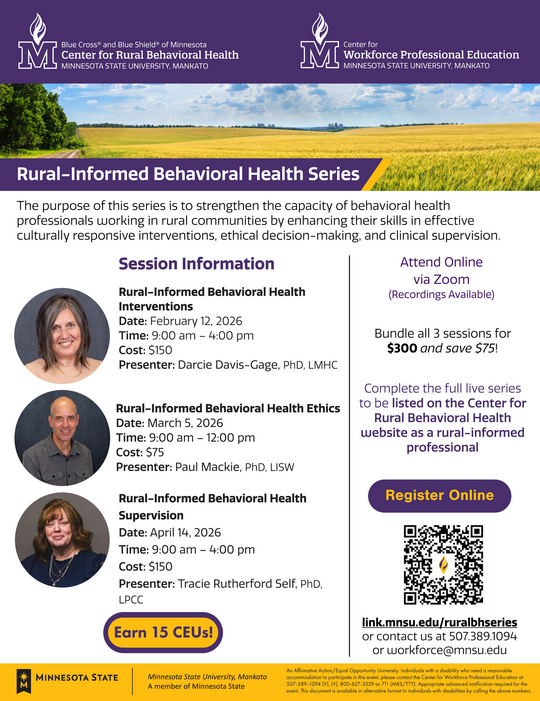
Rural-Informed Behavioral Health Series
The Blue Cross and Blue Shield of Minnesota Center for Rural Behavioral Health and the Center for Workforce Professional Education at Minnesota State University, Mankato are hosting a rural-informed behavioral health series.
The purpose of this series is to strengthen the capacity of behavioral health professionals working in rural communities.
For registration and more information, visit Rural-Informed Behavioral Health Series – Spring 2026 | Minnesota State University, Mankato.
National Association of Rural Health Clinics 2026 Rural Health Clinic Policy Survey
As policymakers continue to make decisions that directly impact rural health clinics (RHCs), it is critical that we can point to real, nationwide data that reflect true experiences of RHCs like yours. This survey helps ensure that RHC voices continue to drive NARHC's advocacy efforts on Capitol Hill and with federal agencies.
Participants are encouraged to review the survey questions ahead of time. With the requested information prepared, the survey should take fewer than ten minutes to complete.
Please click here to review the survey questions in advance and gather the information needed to complete the survey.
To ensure data accuracy, we kindly ask that one representative from each organization complete the survey by Feb. 25. As a reminder, please complete the survey using 2025 data.
Please click here to complete NARHCs 2026 Policy Survey.
With any questions, please contact NARHC’s Deputy Director of Government Affairs, Mo Sullivan, at Mo.Sullivan@narhc.org.
|