Updated Refugee Health Domestic Guidance for Cancer Screening
On Jan. 14, 2026, the Domestic Team issued updated CDC: Cancer Screening Refugee Health Domestic Guidance. Key updates include:
- Clinicians should use the domestic medical exam (DME) visit to educate newly arrived refugees about cancer risks and to discuss the age-based United States Preventive Services Taskforce (USPSTF) Recommendations for Cancer Screening carefully.
- It is acceptable for DME providers to refer refugees to primary care providers for cancer screening visits since cancer screening may require longer-term follow-up and coordination.
- Tables:
- Key Risk Factors Associated with Infection-Related Cancers to Consider in Newly Arrived Refugees.
- Special Considerations for Cancer Screening in Refugees.
- In addition to a detailed medical history, clinicians should conduct a thorough head-to-toe physical examination during the DME to evaluate for signs or risk factors for cancers.
- Clinicians should refer patients with significant risk factors and abnormal physical examination findings to a specialist for further evaluation and management.
Newly Approved IGRA Test: Standard E TB-Feron Elisa
On Dec. 30, 2025, the Migration Health Information Nexus (MHINx) Team issued an update to the approved list of interferon-gamma release assay (IGRA) tests panel physicians may use for tuberculosis screening overseas. The following IGRA tests are currently accepted and being used:
- QuantiFERON (FDA-approved)
- T-Spot (FDA-approved)
- Wantai (WHO-approved)
- STANDARD E TB-Feron ELISA (WHO-approved)
Read the CDC: Panel Physician Tuberculosis Technical Instructions.
Refugee Health Domestic Guidance for Lead Screening
On Dec. 17, 2025, the Domestic Team issued an update to the CDC: Lead Refugee Health Domestic Guidance. Key updates include:
- Initial screen should occur for every refugee ≤ 16 years old.
- Follow up for testing for everyone changed from <7 to <17 years.
- For any children under the age of 18 years who are pregnant, they recommend clinicians follow CDC children's guidance.
Reference the CDC website for additional guidance on screening and follow up recommendations.
Keeping Kids Safe: An Orientation Guide for Newcomer Children

The MN COE in collaboration with our colleagues at the University of Minnesota created a book for children of all ages and places who are new to the United States. It will help them learn about their new home and how to stay safe and healthy. We encourage you to distribute this guide to parents and caregivers. Encourage them to talk with their child about the different lessons in this book, print it out, and help them to complete the activities.
Download and share:
Keeping Kids Safe: A Fun Activity Book
|
Newcomer Education for Wellness Video Series: DME and LTBI
Tetanus and diphtheria vaccination coverage
Tetanus and diphtheria vaccination coverage and electronic health record alerts for immigrants and refugees at three United States health systems, 2017–2023
Steiner, A., Settgast, A., DeSilva, M., Payton, C., Knuti Rodrigues, K., Nolan, M., Chrenka, E., Frumholtz, M., Michel, J. J., Stein, A., Mamo, B., & Young, J. (2025). Vaccine, 67, 127881. DOI:10.1016/j.vaccine.2025.127881
Our MN COE partners at Denver Health, HealthPartners, Children’s Hospital of Philadelphia, University of California – San Diego, and Thomas Jefferson University have recently published an article about the need for tetanus/diphtheria vaccines for immigrant and refugee adults that may be missed by electronic health records (EHRs). From their evaluation, they advise clinicians to identify under-vaccination risks not detected by EHRs.
This analysis compared documented completion of tetanus/diphtheria three-dose vaccination series with EHR-generated recommendations for immigrant and refugee patients at three U.S. health systems seen during 2017–2022. After reviewing electronic health records, the team found that EHRs did not identify 2/3 of those needing tetanus/diphtheria vaccination.
Among 50,829 adult immigrants and refugees across three large health systems, only 28% had documentation of a complete three-dose primary or catch-up tetanus/diphtheria vaccine series by Dec. 31, 2023. This gap may reflect the failure of the EHR's algorithm to identify overdue adults, with potential public health implications as clinicians increasingly rely on EHR decision support for immunizations.
MN COE featured in the World Health Organization’s Dashboard
The World Health Organization recently updated their Dashboard on Global Experiences in Promoting Refugee and Migrant Health with new case study publications. Per the WHO: “This dashboard illustrates the positive steps taken by countries all over the world towards better health outcomes for the one billion people on the move. Based on voluntary submissions by governments and partners, the dashboard showcases how countries with varying health systems and challenges have implemented policies in line with the WHO Global Action Plan (WHO GAP) on promoting the health of refugees and migrants 2019-2030.” Read more at Advancing health equity for people on the move.
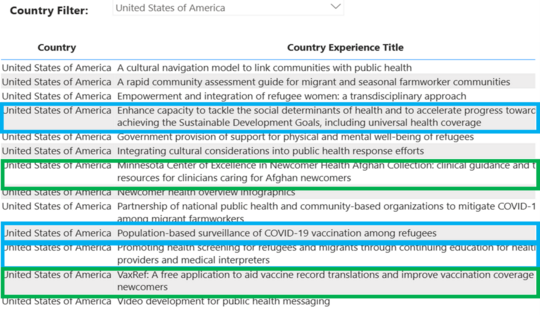
The Minnesota COE has multiple case studies featured in the United States Country Case Examples, found in the bottom left box of the dashboard. In addition to the 2024 case studies (blue), the 2025 case studies (green) are now featured on the dashboard:
2024
- Enhance capacity to tackle the social determinants of health and to accelerate progress towards achieving the Sustainable Development Goals, including universal health coverage
- Population-based surveillance of COVID-19 vaccination among refugees
- Promoting health screening for refugees and migrants through continuing education for health care providers and medical interpreters
2025
- Minnesota Center of Excellence in Newcomer Health Afghan Collection: Clinical guidance and training resources for clinicians caring for Afghan newcomers
- VaxRef: A free application to aid vaccine record translations and improve vaccination coverage for newcomers
New microlearning: Latent tuberculosis infection (LTBI)
Missed a webinar? Don’t sweat it!
The following recordings have recently been approved for accessibility and are posted on our website:
The International Refugee and Migration Health Conference is just around the corner…

The Society of Refugee Healthcare Providers’ annual conference, the International Refugee and Migration Health Conference (formerly known as the North American Refugee Health Conference, or NARHC) will be held June 26-28, 2026, in San Diego, California.
The abstract submissions due date of Feb. 15 is fast approaching!
Children’s Hospital of Philadelphia: 2026 Short Course on Multilingual Approaches to Research Studies (MARS)

Expand Your Research Impact: Apply for Multilingual Methods Training
Now in its fifth year, the Short Course on Multilingual Approaches to Research Studies helps prepare health researchers to recruit and engage children, youth, and families who prefer a language other than English.
Hosted on June 1-3, 2026, at Children’s Hospital of Philadelphia, course programming includes dynamic lectures from expert faculty as well as interactive sessions comprising case studies, small group work, workshops, and consultations.
New for 2026: A virtual attendance track for those unable to travel to Philadelphia.
Applications are accepted on a rolling basis and scholarships are available. Apply by May 22, 2026: Short Course on MARS: Application.
|