|
Children and Youth with Special Health Needs News |
|
|
View this as a webpage
February 2026
Recruiting for cannabis and substance misuse prevention program
The Minnesota Department of Health (MDH) and its partner, Tunheim, will be creating a cannabis and substance misuse prevention program, and MDH needs your help! MDH is looking for Minnesotans 18 and older who are:
- Pregnant
- Planning to become pregnant
- Breastfeeding or chestfeeding
- Caregivers of people who are pregnant
-
Health care professionals (OBs, pediatricians, family practice, doulas, midwives, lactation coaches and counselors, etc.)
- Public health professionals (local or Tribal public health agency)
-
Community educators (early childhood family education, mom group, dad group, prenatal educator, etc.)
MDH is currently recruiting participants for an advisory board, focus groups, interviews and message feedback.
Local public health nurse, Lisa Bjork, featured in local news
Lisa Bjork, children and youth with special health needs (CYSHN) condition follow-up contact and local public health nurse for Beltrami County was recently recognized in the Bemidji Pioneer for her leadership of many county programs and the extra mile Bjork went to investigate and administer treatment to a resident. The news story also highlights Public Health Director, Amy Bowles, who was recognized with the 2025 Emerging Leader Award from the Local Public Health Association. Thank you, Lisa and Amy for your dedication to the health of Beltrami County residents!
Congenital Heart Defect Awareness Week
Congenital Heart Defect Awareness Week, which takes place annually from Feb. 7 - 14, highlights the importance of early identification, follow-up, and family support for children born with heart conditions. Last year, MDH and our partners conducted the CHSTRONG KIDS Survey to better understand the needs of caregivers navigating life after their child received a congenital heart defect diagnosis. The survey received 840 responses from Minnesota caregivers, which is a response rate of 37%, providing valuable insight into caregiver experiences, care coordination, and follow-up needs.
In addition to survey findings, local public health nursing data from 2025 show that 65% of children with a more severe, critical congenital heart defect were contacted by a local public health nurse and 24% were referred, or had been referred previously, to early intervention services, underscoring the critical role local public health plays in connecting families to timely supports and services.
|
Program-specific updates
Follow Along Program
After completing semi-annual data reporting for the program, please submit your invoice using the data reporting survey above, the separate FAP semi-annual invoicing survey, or send your invoice by email to health.cyshn@state.mn.us no later than Friday, Feb. 20, 2026.
Review contacts list on FAP webpage
Pacer center five-part 'Thriving Together' workshop series on Thursdays
Join the Pacer Center for a virtual, five-part workshop series that brings together families and professionals to learn practical strategies for raising a child with a disability. Presented by Pacer’s Health Information Center, each workshop will focus on one of five different themes.
Register for the workshops:
Pediatric care coordination office hours on Fridays
Building a connection with families and learning from their stories is foundational to the practice of pediatric care coordination. With this understanding, the pediatric care coordination: community of practice is hosting five, one-hour office hours every Friday from Feb. 13 to March 13.
These office hours are intended to be informal and will focus on review and reflection of the Pacer Center’s Thriving Together series (noted above, or find more information on the Pacer Center’s training and workshops webpage). Each weekly office hour will include a summary of the webinars and small group discussions to connect with colleagues, reflect on stories from families, and share lessons from personal or professional experiences.
To join the office hours, complete the pediatric care coordination: community of practice registration form and join the community on Basecamp. For questions or more information, contact Community of Practice Coordinator, J.P. Mahoehney, at health.cyshn@state.mn.us
Feb. 18 – CYSHN condition follow-up community of practice
The next virtual CYSHN condition follow-up community of practice for LPH is Wednesday, Feb. 18 from 9 - 10:30 a.m. The purpose of these meetings is to provide routine opportunities for local public health nurses who provide follow-up for children referred by CYSHN programs (birth defects, EHDI, heritable conditions, congenital CMV) to learn condition-specific information and discuss nursing practice.
This month's meeting will include a presentation about cleft lip and palate by Jo Barta, MD Pediatric Craniofacial and Plastic surgeon from Gilette Children’s. One contact hour of continuing education will be offered for attending. All current CYSHN condition follow-up local public health nurses are welcome to attend. Please register for this virtual, optional meeting. This meeting will be recorded and available for 30 days following the presentation. If you have any questions you would like to submit in advance, email them to health.cyshn@state.mn.us with “local public health” in the subject line.
Project ECHO: Prepare for Rare: Newborn Screening and Genetic Testing
The Minnesota Rare Disease Advisory Council is proud to partner with Stratis
Health and MDH to offer a new Project ECHO for providers caring for patients with rare diseases. Prepare for Rare: Newborn Screening and Genetic Testing occurs the third Thursday of each month starting on Thursday, Feb. 19 and runs through Thursday, June 18. These sessions will prepare clinicians for patients with positive
screens or puzzling symptoms who may be appropriate for genetic testing.
Continuing education credits are available.
Feb. 24 – Introduction to using the Ages and Stages Questionnaires®
The family home visiting section hosts a virtual training on the use and purpose of the Ages and Stages Questionnaires® (ASQ) for developmental and social emotional screening. Follow Along Program contacts who have not received ASQ training are welcome to register. Participants will also learn how to accurately choose, score, and interpret the questionnaires correctly. Registration is required and all participants must have access to the ASQ-3 and ASQ:SE-2 starter kits from Brookes Publishing either individually or through their employing agency. Register via the link below.
If registration has closed or appears to be full, please email health.homevisiting@state.mn.us and express your interest and availability, should additional spots become available.
Caring for American Indian and Alaska Native youth
|
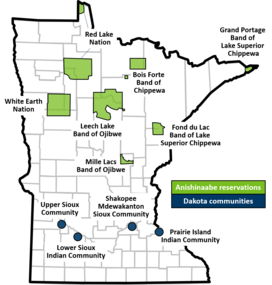
The next webinars in a multi-part series designed for health professionals who work with and serve American Indian and Alaska Native children will be at noon on Tuesday, March 3 and Tuesday, June 2. These sessions will explore practical strategies through culturally informed care. Please register for the March session, titled Indian Health Service and American Indian/Alaska Native Healthcare Services.
This series is supported and brought to you in partnership with the University of Minnesota Medical School, the Center for American Indian and Minority Health, and MDH. If you have any questions, please contact the Center of American Indian and Minority Health at 218-726-7235.
March 5 – Rare Disease Day
The theme for 2026's Rare Disease Day program on Thursday, March 5 is "Therapies for the Few, Impact for Many: Rethinking How We Develop Rare Disease Treatments." The University of Minnesota aims to inform the rare disease community about the initiatives being undertaken by the FDA to accelerate development of therapies for rare diseases, how academic researchers can effectively collaborate with biomedical companies in the design and conduct of small N trials, and how patient advocacy organizations can best contribute to these activities. Attend in-person at the McNamara Alumni Center or virtually. The deadline for the Rare Disease Day 2026 RSVP form is Wednesday, Feb. 25.
|
|
|
Resource corner
Helping children process difficult experiences
We recognize that children are being affected by what they see and hear in their schools, homes, and neighborhoods, and some may need help processing these experiences. When talking with children and youth about scary and sad events, we hope the resources below will provide helpful guidance:
Video explains exposures to harmful chemicals in the home
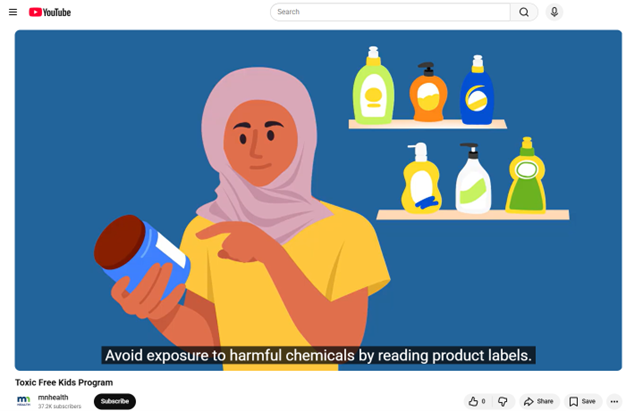
A new short video helps families understand and reduce exposures to harmful chemicals in the home. Produced by MDH's Toxic Free Kids Program, the video is available in English, Spanish, Hmong, and Somali on the mnhealth YouTube channel.
|
New MDH Hub on environmental hazards
The MDH environmental health division has created a new webpage, Resources for Children's Environmental Health, that brings together information about contaminants that affect children. Children are especially vulnerable to environmental hazards because their bodies and brains are still developing. This new resource page connects parents, caregivers, and communities to practical information to help keep kids healthy.
Minnesota Interagency Developmental Screening Task Force memo
National Center for a System of Services for CYSHCN resources
The National Center for a System of Services for CYSHCN from the American Academy of Pediatrics recently shared a compiled list of resources and tools in their newsletter:
Invoicing
|
Quarter 1
|
Quarter 2
|
Quarter 3
|
Quarter 4
|
|
Jan. 1 – March 31
|
April 1 – June 30
|
July 1 – Sept. 30
|
Oct. 1 – Dec. 31
|
Condition Follow-up
Complete nursing follow-up documentation in MEDSS by the end of the quarter after the one in which the referral was made. For example, if the date the event was sent to local public health is July 15 (in quarter 3), the follow-up documentation should be submitted by Dec. 31 (the end of quarter 4).
Invoice letters are sent to local public health by MDH in the month following the end of the quarter in which documentation was submitted, or training was completed. So, in the example, the invoice letter would be sent to local public health some time before Jan. 31 (the month following the end of quarter 4).
Follow Along Program
Follow Along Program semi-annual data reports are due every 6 months. Data for quarters 1 and 2 are due annually on July 31. Data for quarters 3 and 4 are due annually on January 31. Invoices for quarters 1 and 2 are due each year on August 20. Invoices for quarters 3 and 4 are due each year on February 20. Semi-annual data reports must be received prior to the invoice being paid.
|
|
About the CYSHN newsletter
Children and Youth with Special Health Needs (CYSHN) section staff at MDH work together to champion the health and well-being of people living in Minnesota with special health needs and disabilities, from the earliest states of life through transition to adulthood.
As the Child and Family Health Division works to coordinate and collaborate on communication, this newsletter may evolve to include a broader focus, but the following CYSHN programs are the primary focus: Birth Defects; Early Hearing Detection and Intervention (EHDI); Heritable Conditions (HC); Congenital Cytomegalovirus (cCMV); Critical Congenital Heart Disease (CCHD); Neonatal Abstinence Syndrome (NAS); and the Follow Along Program (FAP).
|
|
|
|
|