Refugee arrivals to Minnesota
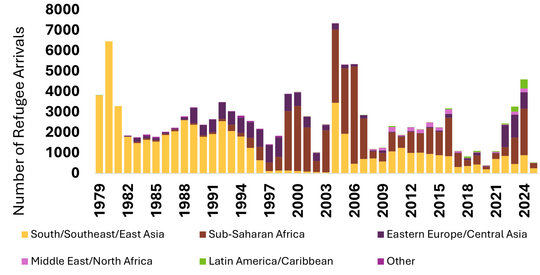
Minnesota has a long history of refugee resettlement, preceding the Refugee Act of 1980 (Figure 1). From 1979 to 2025, over 120,000 refugees resettled in Minnesota from overseas. The countries and regions of origin among refugee arrivals has varied from year to year, with primarily refugees from Southeast Asia arriving from 1979 to the mid-1990s after the Vietnam War. Arrivals from sub-Saharan Africa began arriving to Minnesota in the mid-1990s. In recent years, the largest refugee populations have been from sub-Saharan Africa, Eastern Europe, and Southeast Asia. The number of refugees arriving to Minnesota has also fluctuated from year to year, with peaks in the early-1980s and mid-2000s.
Though Minnesota has been a well-established state for refugee resettlement throughout the decades, refugees remain a small portion of the total Minnesota population. The 120,000 refugees resettled since 1979 represent only 2% of Minnesota’s 5.84 million total population.
During Federal Fiscal Year (FFY) 2025, which ran from Oct. 1, 2024, to Sept. 30, 2025, the United States resettled 38,102 refugees. Minnesota resettled the eighth highest number of refugee arrivals representing 3.5% of all arrivals during that FFY. The refugee admissions ceiling for FFY 2026 is 7,500 arrivals.
Data source: U.S. Department of State, Bureau of Population, Refugees, and Migrants
To learn more, visit: U.S. HHS Office of Refugee Resettlement: Refugee Resettlement Program.
Figure 1. Refugee Arrivals to Minnesota by Region of World, 1979-2025
Tuberculosis
The Centers for Disease Control and Prevention (CDC) Division of Global Migration Health has recently added an additional test to those approved for use in the tuberculosis screening portion of overseas screening. Panel physicians may now use the STANDARD E TB-Feron ELISA, a WHO-approved interferon-gamma release assay (IGRA) test.
The following tests have been approved by the CDC for overseas tuberculosis screening:
- QuantiFERON (FDA-approved)
- T-Spot (FDA-approved)
- Wantai (WHO-approved)
- STANDARD E TB-Feron ELISA (WHO-approved)
Tuberculosis screening guidance for panel physicians has not otherwise changed. More information can be found at CDC: Tuberculosis Technical Instructions for Panel Physicians.
Domestic screening recommendations remain the same:
- Screen all refugees for signs or symptoms of TB disease (pulmonary or extra-pulmonary) and history of contacts with active TB.
- Minnesota Department of Health recommendations:
- Accepting any documented positive IGRA results documented on overseas records.
- Domestically retesting those with a documented negative IGRA result, due to possibility of recent exposure or seroconversion.
More information can be found at MDH: Tuberculosis (TB) Domestic Refugee Health Screening Guidance.
Fight the Flu
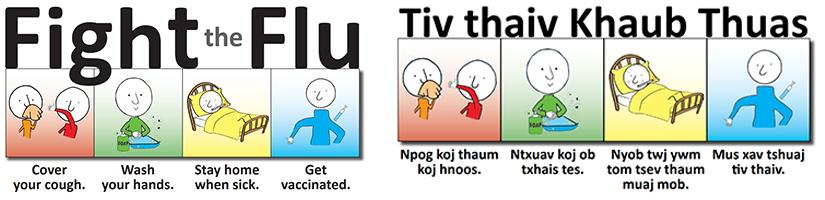
Influenza cases are currently elevated in Minnesota driven by influenza A (H3N2) (Situation Update for Influenza). Community members are strongly encouraged to get the flu shot. MDH has several resources and informational fact sheets on the Influenza Materials webpage. This includes a Fight the Flu poster, which provides visuals on what people can do to prevent catching and spreading the flu. These posters, also available in bookmark form, can be downloaded and printed and are available in many languages (Amharic, Arabic, Burmese, Chinese (Mandarin), English, Hindi, Hmong, Karen, Khmer, Korean, Laotian, Nepali, Oromo, Russian, Somali, Spanish, Tagalog, Thai, and Vietnamese).
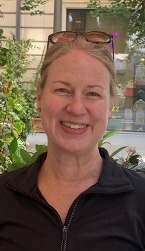
Ann Settgast, MD, DTM&H
Staff Physician
HealthPartners Center for International Health (CIH)
Department Chair
HealthPartners Travel & Tropical Medicine Center
Dr. Ann Settgast has been interested in the world outside the U.S. for as long as she can remember. Her work in refugee health was strongly shaped by her mentor, Dr. Patricia Walker, Minnesota’s very own leading international expert in refugee health. Dr. Walker hired Dr. Settgast 20 years ago. This was a privilege that Dr. Settgast shares was “the opportunity of a lifetime,” and it has turned out to be everything she had hoped for.
Dr. Settgast appreciates many aspects of her role at CIH. She loves the opportunity it gives her to work with and learn from her patients and their stories. She notes that “their resilience and perseverance provide a perspective on life that is inspirational and grounding.” Providers at CIH not only practice “regular primary care,” but get the chance to manage conditions not typically seen in primary care clinics in Minnesota – something Dr. Settgast does while also precepting residents from the University of Minnesota. Lastly, the staff at CIH are incredible. Many have been there for decades, speaking to how special of a clinic CIH is.
Finally, Dr. Settgast remarks that “hope lies in knowing none of us in the field are alone.” She is a part of a whole community of health care providers that remains committed to providing a welcoming environment to those who are here. Working with newcomers provides health care practitioners the opportunity to “let them know how happy we are they have come.” This can help to counteract barriers and fears they may have during resettlements, and these personal interactions give Dr. Settgast hope.
|
988 Lifeline
People can call or text 9-8-8 for free if they are having strong emotional distress, thoughts of self-harm, or substance abuse problems. A trained expert will be ready to listen and provide support and resources. 988 Lifeline is available in English and Spanish, with interpretation available for all other languages by calling.
Children with Traumatic Separation: Information for Professionals
This informational PDF from the National Child Traumatic Stress Network (NCTSN) provides information on the causes of traumatic stress in children, posttraumatic responses, and how to help.
Children with Traumatic Separation: Information for Professionals (PDF)
English Language Learning Curriculum Update
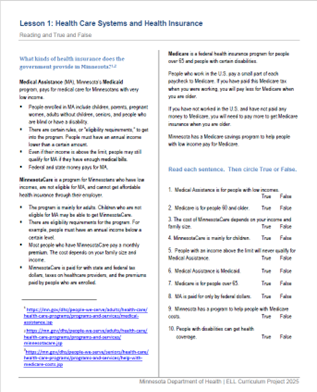
The MDH Refugee Health Program’s English Language Learners (ELL) Health Curriculum has been updated to incorporate the most up-to-date resources and information for learners and instructors alike. The ELL Health Curriculum is a resource created to help adults strengthen their English skills while also teaching them about key health topics. Developed in collaboration with experienced ELL instructors, the curriculum is tailored for intermediate and advanced adult learners. Each lesson features an activity with accessible readings, exercises, discussion questions, answer keys, and teacher notes to support instruction.
ELL Curriculum lesson topics currently include:
- Health Insurance
- Health Professions
- Immunizations
- Oral Health
- Cardiovascular and Nervous Systems/Hypertension
- Reproductive Systems and Sexual Health
- Respiratory and Skeletal Systems and Tuberculosis
- Muscular and Digestive Systems and Hepatitis B
- Diabetes
- Lymphatic System and Cancer
- Behavioral/Mental Health
- Safe and Healthy Homes
- Safe and Healthy Relationships
|
Health Services Directory Update
The MDH Refugee Health Program’s Directories for Organizations Serving Diverse Communities have been updated with a new, user-friendly design. These directories include the Diverse Media Directory, the Community Based Organizations Directory, and the Health Services Directory.
The Health Services Directory, which highlights immigrant-friendly, low-cost health care options that serve Minnesota’s diverse communities, has been expanded to include many newly added or updated health facilities. Thank you to all who assisted in updating and expanding this important resource!
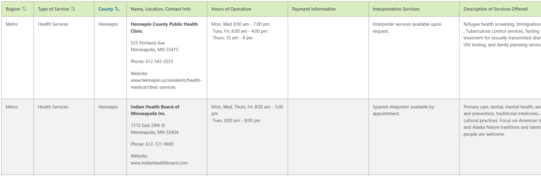 Do you know of a resource that isn’t listed? Do you have new information for a resource that is already listed? To add or update a listing, please submit your information to Update Directory Information form.
Refugee and Immigrant Helpline
The Minnesota Department of Human Services (DHS) Refugee and Immigrant Helpline continues to be available for free at 1-800-814-4806, and individuals can call to be connected with resources for health care, legal assistance, jobs, food, housing, language classes, and more.
|