|
True or False:
The 30-month Child and Teen Checkups (C&TC) visit is fully covered for all children enrolled in Minnesota Medical Assistance at no cost to families.
Federal changes to Medicaid (called Medical Assistance in Minnesota) are coming in 2026-2027, but there is nothing you need to do right now. Adults ages 21-64 years without dependent children or disabilities may see new requirements, like renewing coverage more often. Stay informed and be ready. Refer to the fact sheet "Worried about changes coming to your Medical Assistance? Get the facts." or visit https://mn.gov/dhs/federalchanges/ for the latest updates.
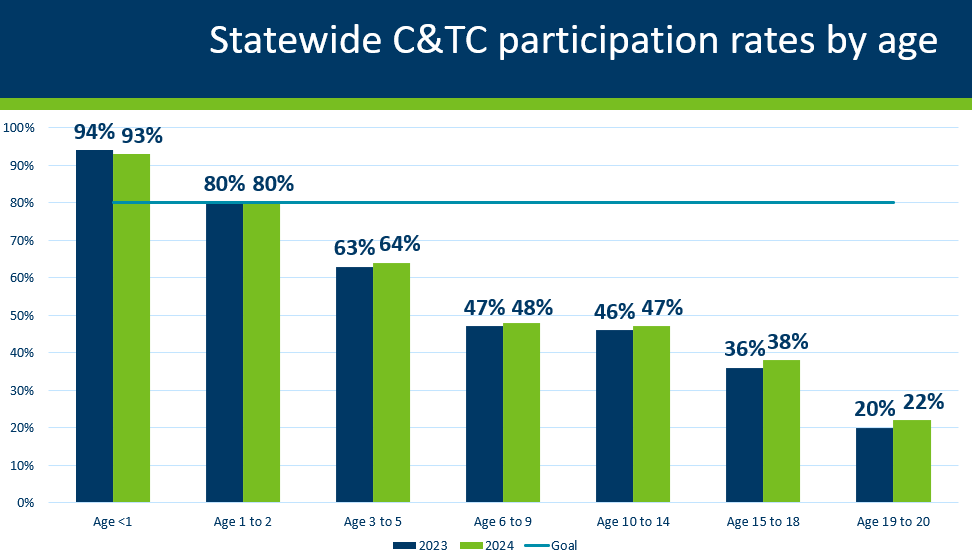
Getting children, teens, and young adults in for their age-related comprehensive C&TC visits is a team effort! Outreach, transportation, family input, and accurate billing and coding make for maximum program success. Here is a look at the totals for the federal fiscal years 2023 and 2024 by age group. Overall, Minnesota had a participation rate of 51% in federal fiscal year 2024. If you have questions about this data, please email dhs.childteencheckups@state.mn.us.
The 30-month C&TC visit is fully covered for all children enrolled in Minnesota Medical Assistance at no cost to families. Leaps in receptive and expressive speech happen between 2 and 2½ years. The 2½ year visit provides a unique opportunity to assess children’s speech and social development. Children typically show more detailed imitation of family members’ activities and engage in more independent play alongside other children. It is a great time to begin talking about early childhood programs available in the community.
For more information, refer to the Bright Futures: Guidelines for Health Supervision of Infants, Children and Adolescents.
Decades of extensive, independent research, including dozens of studies involving millions of children, continue to show the same result: Vaccines, including the measles, mumps, and rubella or MMR vaccine, do not cause autism. This conclusion has been affirmed across countries, populations, and research methods and it is strongly supported by national disability organizations, public health experts, and health care professionals. Vaccines are well tested and important for protecting against serious infectious diseases.
Scientists are still working to understand what causes autism. Current research shows there is not a single cause but likely involves a mix of genetic and environmental factors. Myths linking vaccines to autism reinforce the harmful idea that autism is a problem to be prevented and pulls attention away from what autistic people consistently say matters most: ensuring access, affordability, and high-quality health care and support services. The Minnesota Department of Health will continue to promote accurate information about both vaccines and autism so families can make informed decisions about their health.
MDH continues to support vaccination against hepatitis B at birth for all babies. This is in alignment with the American Academy of Pediatrics (AAP) and the American Academy of Family Physicians (AAFP) who also recommend vaccinating all infants at birth against hepatis B. Giving the hepatitis B vaccine within 24 hours of birth has been shown to significantly reduce infections. In other words – the vaccine works.
If a mother is infected with hepatitis B, it can be transmitted to a newborn baby during or after birth. If infected, up to 90% of babies will develop lifelong hepatitis B infections. Additionally, a child could become infected just by living with or being cared for by someone who has hepatitis B. Around one in four babies with hepatitis B will die prematurely from liver damage, liver failure, or liver cancer. Vaccination helps provide long-term protection.
MDH will continue to provide accurate and science-based information for parents and providers about the well-established benefits of vaccination.
The Minnesota Health Communications Initiative resource download center has materials about measles, COVID-19, flu, RSV, and other vaccines. Resources are featured in English, Spanish, and Somali and include images, videos, and fact sheets.
If you work with the Somali community, the website resource Health Wadaag gives community members answers to common questions about vaccines in English and Somali. There are resources and videos about routine vaccines, measles, and more.
Help Me Connect is Minnesota’s online hub that links families with young children to early childhood programs, services, and community supports. It helps providers quickly guide families to resources tailored to their needs, from pregnancy through age 8.
Join monthly tech support sessions to learn practical tips and tools for making the most of Help Me Connect.
Sessions are held on the second Wednesday of every month from noon–1 p.m.
Bring your questions, share ideas, and leave with new skills to better support families and partners across Minnesota.
Register for Help Me Connect: Monthly Tech Support
Editable screening flyers, postcards, and rack cards which you may customize to include your local program QR code, address, and other information are available in English, Spanish, Hmong, and Somali. Please contact Margo Chresand at Margaret.Chresand@state.mn.us if you are interested in downloading these for your program.
Statewide early childhood developmental screening flyers, postcards, and rack cards that are nonmodifiable can be found in the MDH Developmental Screening Marketing Toolkit.
Be Cannabis Aware is a new public health campaign from MDH focused on educating youth under the age of 25* years and the adults who support them about cannabis use. The webpage features:
- Downloadable materials and resources for communities, educators, and families.
- A “For Mentors” section that offers conversation tips and tools for parents, teachers, coaches and other youth-facing adults.
Campaign materials are also available via MDH’s Cannabis Materials.
*A substance use risk assessment is required for all C&TC visits for youth ages 11 through 20. For more information the Tobacco, Alcohol and Drug Use Risk Assessment fact sheet.
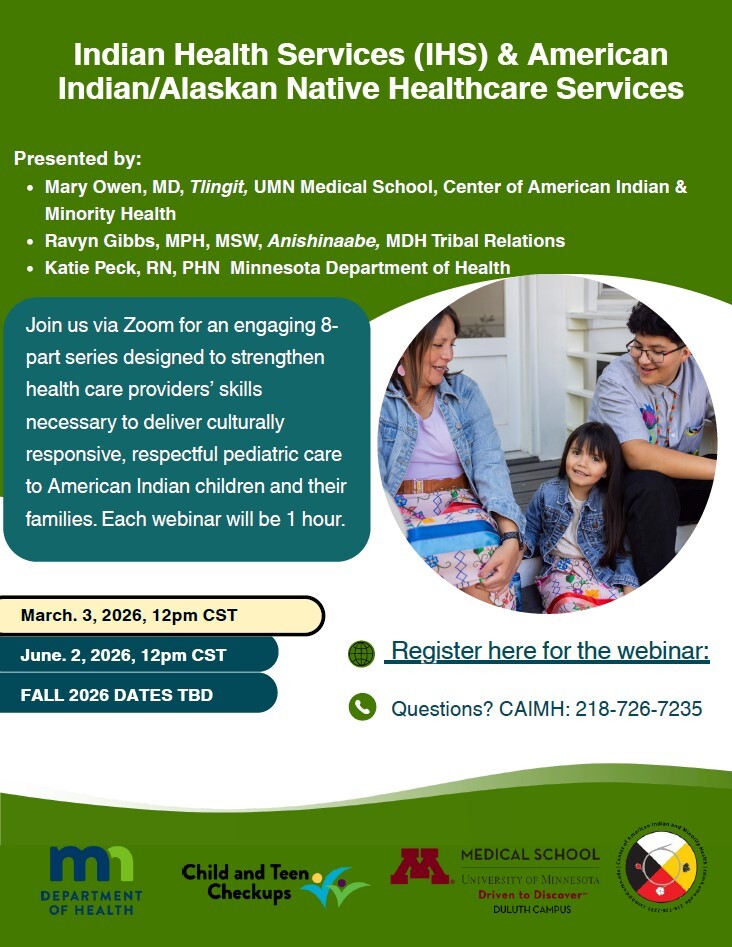
Join session three of a nine-part webinar series on Tuesday, March 3 at noon to strengthen culturally responsive pediatric care for American Indian and Alaska Native youth. This series will be offered both online and in person at the UMN-Duluth campus. Providers will gain valuable insights and skills to deliver respectful and informed care. Register for the Indian Health Service and American Indian/Alaska Native Healthcare Services March session.
Second Wednesday of each month from 9-9:30 a.m.
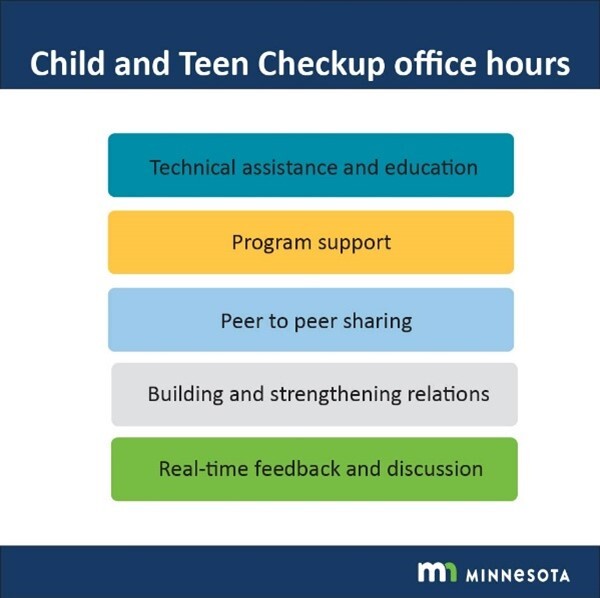
Join the Department of Human Services (DHS) and MDH C&TC program for optional virtual office hours to ask questions, get program support, engage in peer sharing, and strengthen relationships.
Register and submit your questions for our February session and March session.
|