Got Your Shots? News: December 2025

Minnesota Department of Health

Got Your Shots? News

View this as a webpage

December 23, 2025

In This Edition


Immunization resources survey

If you haven’t already, take a few minutes to participate in the Minnesota Department of Health (MDH) Immunization Resources Survey! We want to understand health care providers’ experience and usage of MDH immunization webpages and resources:

  • Do providers use the MDH website and resources?
  • Are they easy to find and use?
  • What do you find the most helpful and useful?

All health care staff that are part of the immunization process are encouraged to take the survey! This includes staff that schedule appointments, discuss, recommend, and or administer vaccines. The survey will close on Friday, Jan. 9, 2026.


Save the date: Immunization conference 2026

MDH is bringing back our immunization conference in 2026 entitled Trust in Every Dose: Rebuilding Confidence, Strengthening Communities. The conference will bring together health care providers, public health professionals, and community partners at the Heritage Center in Brooklyn Center. Please save the date for April 20-21, 2026. Registration information will be available soon at Immunization Conference 2026.

Hepatitis B vaccine updates

There has been significant national messaging and media attention related to hepatitis B vaccination over the past month. MDH continues to endorse evidence-based guidance from the American Academy of Pediatrics (AAP) and the American Academy of Family Physicians (AAFP), which recommend a universal hepatitis B vaccine dose at birth for all infants. A recent review by the CIDRAP: Vaccine Integrity Project found no benefit to delaying the first dose of hepatitis B vaccine compared to vaccination at birth. MDH does not expect access to hepatitis B vaccine to be impacted. The hepatitis B birth dose will continue to be available for all infants, including through the Minnesota Vaccines for Children (MnVFC) program. Insurance coverage will remain in place.

ACIP and CDC change

In early December, the Advisory Committee on Immunization Practices (ACIP) voted on changes related to hepatitis B vaccine recommendations for some infants. The Centers for Disease Control and Prevention (CDC) approved this recommendation on Dec. 16 HHS.gov: Fact Sheet: Hepatitis B Immunization and will update the immunization schedule to reflect this change. Of note, CDC recommendations for infants born to hepatitis B–positive pregnant people or those with unknown hepatitis B status remain unchanged.

Because the new CDC recommendations are not based on any new scientific evidence, MDH endorses the existing recommendations from AAP and AAFP.

Resources for patient conversations

Recent changes and messaging may lead to confusion or questions from families. The following trusted resources may be helpful:

If you have questions, contact our clinical unit or MnVFC team at health.vaccineSME@state.mn.us or health.mnvfc@state.mn.us.

MIIC forecaster tool

There is a new MIIC user guidance that was created to help users better understand the forecaster tool. The resource walks through what the forecaster is, some common scenarios, and frequently asked questions. The MIIC forecaster tool resource can be found at Interpreting a MIIC Vaccination Record MIIC User Guidance and Training Resources.


Reminder/recall HPV postcard

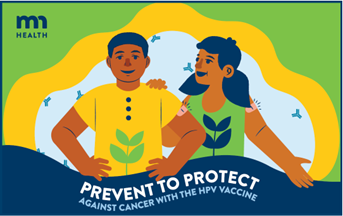
Prevent to protect against cancer with the HPV vaccine.

MDH sent out human papillomavirus (HPV) postcards in the middle of December. They went out to families of 9 -12-year-olds overdue or recommended for HPV. If you have any questions about the postcard, contact health.miichelp@state.mn.us.


Prevent cervical cancer with HPV vaccination

January is Cervical Cancer Awareness Month. Join MDH’s immunization and Sage Cervical Cancer Screening programs in promoting on-time human papillomavirus (HPV) vaccination for adolescents 9-12 years of age and routine cervical cancer screening for adults.

  • HPV infection can cause six types of cancer, including most cervical cancers.
  • HPV vaccination can prevent more than 90% of these cancers later in life.
  • Recent data from MDH shows that Black, Asian, Hispanic, and American Indian Minnesotans are more likely to be diagnosed with cervical cancer than other races and Asian Minnesotans are two and a half times more likely to die from cervical cancer.
  • Less than 60% of Minnesota 13-year-olds have started the HPV vaccine series and less than 30% have completed it.

For more information on adolescent vaccination coverage data and gaps visit MN Data: Adolescent Immunizations.

Participate by providing a strong recommendation for HPV vaccination and starting the conversation about HPV vaccine beginning at 9 years old.

  • Vaccinate as early as age 9 and promote on-time completion of HPV vaccine series by age 13.
  • Share HPV cancer prevention messages with families and through social media and engage with MDH social media posts.

For more information on strategies for improving HPV vaccination rates in your clinic, visit For Health Care Providers Serving Adolescents.


New year’s resolutions

As the new year approaches, we have an opportunity to set meaningful goals that can improve patient health and immunization coverage in our clinics and communities. As we help others, we can also set goals for our own mental and physical health to avoid stress and burnout. Prioritize yourself and staff well-being by scheduling regular breaks, setting boundaries, and practicing stress-management habits that support long-term resilience in a high-demand clinical environment. Vaccine conversations can be challenging. Remember that a “no” today does not mean you are a failure. If you have helped build trust and kept the door open for the next visit, consider yourself a success.

  • Strengthen vaccine confidence by listening to patient concerns with empathy and offering clear, evidence-based information that supports informed decisions. Visit Voices For Vaccines: Becoming Trusted Messengers for free online training on becoming a trusted immunization communicator.
  • Improve clinic workflows by updating standing orders, refining check-in processes, and minimizing barriers so every visit becomes a potential vaccination opportunity. Engage with MDH staff to explore strategies your clinic can employ to improve vaccination efforts. For more information visit Immunization Quality Improvement for Providers (IQIP).
  • Boost immunization rates by reviewing clinic coverage data early in the year and setting targeted, realistic improvement goals for priority populations. Reminder and recall systems can help reduce missed doses using calls, texts, or portal messages to help patients stay on track with recommended schedules.
  • Invest in ongoing education to stay current on immunization guidelines, new products, and communication strategies that support high-quality vaccine counseling. All staff (medical assistants, front desk staff, appointment specialist, nurses and providers) can help to create positive and helpful patient immunization interactions. Vaccinate Your Family: Vaccinate Your Family University is great for any learner and covers the essentials of vaccine science, safety, and access.

Download version for print

To download a version of this newsletter formatted for printing, go to the Got Your Shots? News site.