Work Satisfaction among Minnesota’s Health Care Providers, Before and After COVID
The Minnesota Department of Health (MDH) conducts an ongoing survey of licensed health care providers to measure things like demographics, practice location, career plans, and work experiences. A trend worth watching—and one that has captured a great deal of attention since the COVID-19 pandemic—is work satisfaction. Work satisfaction is a broad but reliable way to take the pulse of the workforce: it can help us to identify professions or settings where burnout is likely, and it is one of the best predictors of resignations or even career exits.
COVID-19 touched the professional lives of all health care providers in a variety of ways. Professionals working in hospitals or other acute care settings dealt with skyrocketing high-acuity patient loads which have not yet returned to their pre-COVID baselines. Providers working in outpatient clinic or dentistry settings first experienced temporary shutdowns and then a resurgence of pent-up demand for care. Still others, mainly mental health providers, have seen a general uptick patient loads driven by an increase in mental health and substance use disorders.
Nearly five years since the first COVID cases were reported in Minnesota, we have reached a “new normal” in health care. How is our health care workforce faring? Figures 1 and 2 provide a partial answer by showing a snapshot of work satisfaction in nearly all professions for which we collect data.
Figure 1: “How satisfied have you been with your career in the last 12 months?” Select Licensed Providers* in 2019
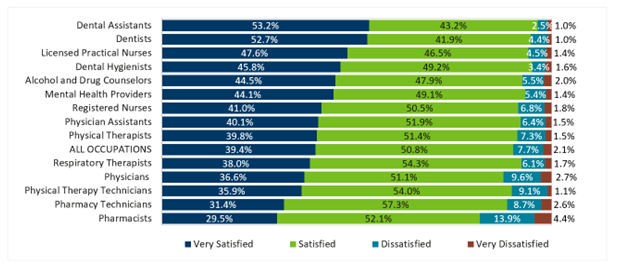 *Data source: MDH Health Care Workforce Survey February 2019-February 2020. This chart excludes data on some providers from whom we do collect data, either because the sample size was too small or because we began collecting data on them after 2019; for example, Dental Therapists, Occupational Therapy and Occupational Therapy Assistants; Licensed Nursing Home Administrators and Licensed Assisted Living Administrators. The RN group includes both RNs and APRNs.
The short answer is: the health care workforce needs care. In nearly every profession for which MDH collects data, work satisfaction declined between 2019 and 2024, with both a lower share of providers indicating that they were “very satisfied” and a higher share of providers indicating that they were “very dissatisfied.” Looking at the total of all occupations, in 2019, 39.4% of providers indicated that they were very satisfied in 2019, and that share dropped to 32.7% in 2024. Meanwhile, 9.1% of all providers indicated that they were either dissatisfied or very dissatisfied in 2019, and that share grew to 10.4% in 2025.
Figure 2: “How satisfied have you been with your career in the last 12 months?” Select Licensed Providers* in 2024
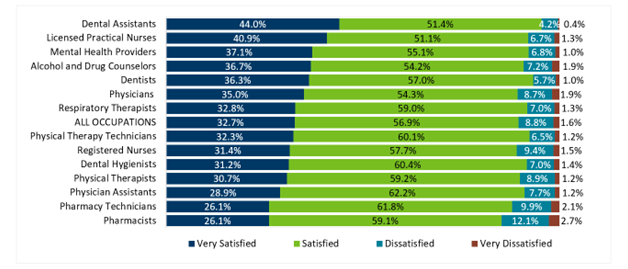 *Data source: MDH Health Care Workforce Survey March 2024-March 2025. See additional notes under Figure 1.
Looking at specific provider types, we can see that the greatest change in satisfaction occurred among dental hygienists (dropping from 45.8% to 31.2% “very satisfied”) and dentists (dropping from 52.7% to 36.3% “very satisfied). We also see substantial drops for physician assistants (40.1% to 28.9%) and registered nurses (41.0% to 31.4%). Physicians, on the other hand, show very little change between the two time points. Pharmacists and pharmacy technicians rank at the bottom of all licensed health care professionals in terms of work satisfaction in both 2019 and 2024. This is likely due to challenging working conditions, pressure, and high workloads in some pharmacies.
Health care providers are the heart of health care: without them there is no health care. It is clear that more research is needed to understand what is causing the general drop in work satisfaction among this important group of professionals. There are a wide variety of resources in Minnesota to help address the problems of provider dissatisfaction. For example, MDH manages a Mental Health for Health Care Professionals grant for health care organizations who establish programs aimed at improving the mental health of their providers. The Minnesota-based Institute for Professional Worklife provides several publicly-available tools that organizations can use to measure and address burnout. And the Minnesota Medical Association hosts the Practice Well Collaboratory to support physician wellness.
Home and Community-Based Services (HCBS) Employee Scholarship Grant and Loan Forgiveness
The Home and Community-Based Services Employee Scholarship Grant and Loan Forgiveness program assists HCBS provider organizations in developing their direct care workforce. Scholarship and loan forgiveness applies to nursing and other health care fields, in courses of study that lead to career advancement within the organization or broader HCBS field.
More details and the link to the online application can be found at Home and Community-Based Services (HCBS) Employee Scholarship Grant and Loan Forgiveness Program.
All applications must be submitted through the ORHPC Online Grants Portal by 4:30 p.m. on Friday Dec. 12.
Pediatric Primary Care Mental Health Training Grant
The Pediatric Primary Care Mental Health Training Grant Program awards grants for the development of new or expansion of existing pediatric mental health training programs located in outpatient primary care clinics. The training programs are designed to increase confidence, skills, and awareness of mental health resources among pediatric primary care providers caring for the mental health needs of pediatric patients.
All applications must be submitted through the ORHPC Online Grants Portal by 4:30 p.m. on Friday Jan. 16.
For more information, visit the Pediatric Primary Care Mental Health Training Grant webpage.
Rural Hospital Capital Improvement Grant Program
The Rural Hospital Capital Improvement Grant awards grants to eligible rural hospitals for modernization projects to update, remodel or replace aging hospital facilities and equipment necessary to maintain the operations of a hospital.
All applications must be submitted through the ORHPC Online Grants Portal by 4:30 p.m. on Friday Dec. 12.
For more information, visit the Rural Hospital Capital Improvement Grant webpage.
Rural Hospital Planning and Transition Grant Program
The purpose of the Rural Hospital Planning and Transition Grant Program is to award grants to help small hospitals (50 or fewer beds) preserve or enhance access to health services through planning or implementation projects.
All applications must be submitted through the ORHPC Online Grants Portal by 4:30 p.m. on Friday Dec. 12.
For more information, visit the Rural Hospital Planning and Transition Grant webpage
Webinar: Tools for Billing Community Health Worker Services in Minnesota
Date: Thursday, Dec. 18, 10-11a.m.
The Minnesota Department of Health contracted with St. Paul-based CHW Solutions to develop tools to assist Minnesota Community Health Worker service providers in gaining understanding and accessing resources to bill Medicaid and Medicare for health education and Community Health Integration (CHI) services. This webinar will provide an overview of the tools and how organizations can use them to access sustainable funds for CHW services through medical billing.
Audience: Webinar content will be directed to health care organizations, FQHCs, tribal organizations, community-based organizations, community hubs and local public health departments. Information about how to access additional resources and technical assistance will also be shared.
Register for Tools for Billing Community Health Worker Services webinar.
MN HOSA Future Health Professionals Seeks Judges & Event Volunteers
MN HOSA-Future Health Professionals is seeking judges and event volunteers for our upcoming Mid-Winter Conferences on Jan. 5, 7, and 9. These events bring together hundreds of high school students from across Minnesota who are exploring healthcare careers, building leadership skills, and preparing to serve as the future of our workforce. This is an excellent opportunity to give back to the next generation of health professionals, support workforce talent pipeline development, and inspire students who will one day serve our communities.
Students compete in a variety of events from presentations to hands-on skills and you’ll be supplied with everything you need to know to prepare yourself prior to the conference. You can learn more about the HOSA Competitive Events program here. We welcome professionals of all fields, not just healthcare, along with students in schools of allied health, nursing, or biological sciences to join us.
To learn more, direct questions to Malia Hasselius, Judge Coordinator: judgecoordinator@minnesotahosa.org
Minnesota Medical Association Creates Website to Support Healthcare Career Aspirations of Minnesota Students
HealthcareCareersMN.org, an initiative from the Minnesota Medical Association (MMA), is designed to support the healthcare career aspirations of students from across Minnesota. This site includes information about pathway programs and other resources that provide mentorship, training, exposure, and inspiration to students interested in healthcare careers. The goal of the MMA is to make HealthcareCareersMN.org a trusted, dynamic and go-to resource to support students interested in pursuing careers in healthcare.
The MMA is working to grow our platform to educate and empower students, families, and school counselors with:
-
Programs & Resources: A comprehensive set of programs and resources for students to enhance their academic journey, including mentorship programs, academic support, and extracurricular opportunities.
-
Career Options: Explore the site to learn more about the variety of healthcare careers available, including descriptions of various careers and their educational requirements.
The MMA asks that programs from across the state that may not yet be included on the site help us build and grow these resources as well. For more information, please visit our site at: https://www.healthcarecareersmn.org/
Free, Quality Improvement with Superior Health Quality Alliance
The Quality Innovation Network-Quality Improvement Organization, or QIN-QIO program, is a Centers for Medicare & Medicaid Services (CMS)-driven initiative aimed at improving the quality of care for Medicare beneficiaries. QIN-QIOs work to implement quality improvement strategies locally by partnering with clinicians and health care experts in clinics, hospitals, nursing homes and other care settings. Superior Health Quality Alliance, also known as Superior Health, is the QIN-QIO for Minnesota.
The goal of this free, non-regulatory program is to improve the quality of health care and outcomes for Medicare beneficiaries. This will occur through a range of activities, including the application of evidence-based quality improvement strategies in conjunction with technologies such as data analytics and artificial intelligence (AI), to align with the existing work your organization is already doing. The priorities for this work include improving chronic disease management, addressing patient safety, enhancing care coordination and improving care transitions.
Complete the today, to sign your facility up to participate! If you would like to enroll multiple sites or if you have questions, reach out to . Review the flyer for more information.
Now Read This:
|