U.S. Antibiotic Awareness Week: Human Health Spotlight

Minnesota One Health Antibiotic Stewardship Collaborative

U.S. Antibiotic
Awareness Week:
Human Health Spotlight

One Health banner

View this as a webpage
Nov. 19, 2025

In this issue:

Stewardship trivia? You betcha!

Quiz Icon


Which of the CDC Priorities for Hospital Core Element Implementation have Minnesota acute care hospitals implemented the most in 2023?


A. Leadership

B. Pharmacy Expertise

C. Action

D. Reporting

The answer is at the bottom of this newsletter.

Antibiotic Use and Stewardship in Minnesota: 2025 Update on Progress and Opportunities

The Antibiotic Use and Stewardship in Minnesota: 2025 Update on Progress and Opportunities (PDF) report summarizes data that the Minnesota Department of Health (MDH) uses to describe the state of antibiotic use and stewardship in Minnesota. The report includes current and past measures of outpatient and hospital antibiotic use and metrics, and presents who prescribes and receives antibiotics in Minnesota. The antibiotic stewardship program data show trends in hospital and nursing home core element implementation, as well as data on outpatient stewardship practices.

  • In 2023, Minnesotans received fewer outpatient antibiotics than the U.S. overall and Minnesota’s state-level prescribing rate is lower than that of many other states.
  • Like the national trend, overall outpatient antibiotic prescribing rates in Minnesota decreased from 2019 to 2020, falling 19.8% in the first year of the COVID-19 pandemic. Overall rates began to rise in 2021 and, in 2023, returned much closer to pre-pandemic levels.
  • Minnesota’s top 10% antibiotic prescribers by volume were responsible for 35% of the total antibiotic volume prescribed in 2022. These prescribers were most commonly family medicine providers.
  • 38% of Minnesota’s high-volume prescribers in 2022 maintained their status in the high-volume prescribing category consistently from 2018 through 2021. Moreover, most high-volume prescribers (68%) in 2022 were also high-volume prescribers in 2021.
  • Use of first-line antibiotics for uncomplicated UTIs improved in 2020–2021. Nearly half (49.5%) of patients treated during this period received a first-line antibiotic. Compared with 2018–2019, uncomplicated UTI cases in 2020–2021 were more likely to be treated with a recommended first-line option (OR 1.38; 99.99% CI: 1.35–1.41).
  • In Minnesota, 69% of acute care hospitals implemented four or more priority core elements in 2023, an increase from 35% in 2021.

U.S. and Minnesota outpatient antibiotic prescribing rates per 1,000 population, 2019–2023
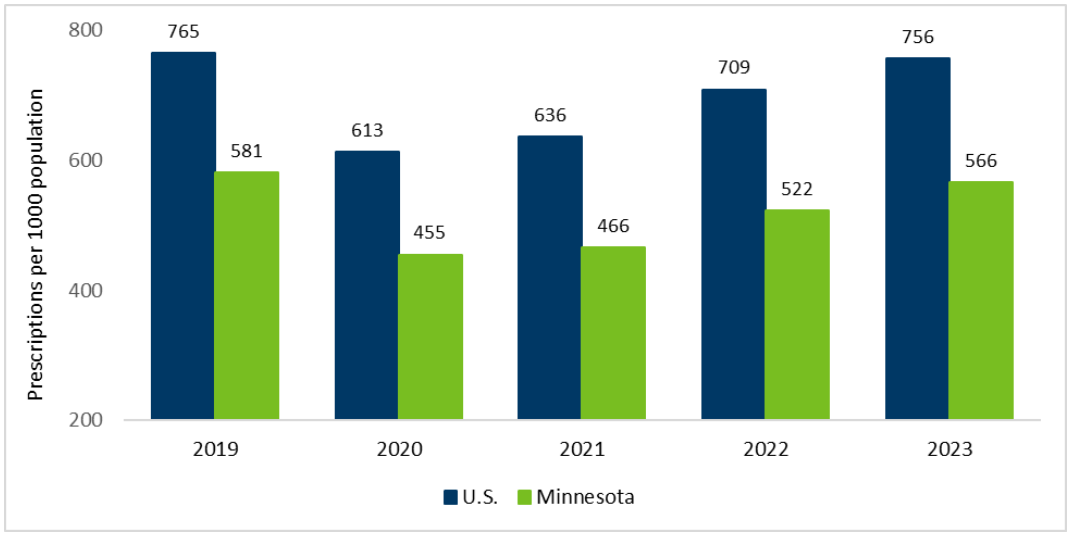
U.S. and Minnesota outpatient antibiotic prescribing rates per 1,000 persons, 2019–2023

Apply Now: Minnesota Antibiotic Stewardship Honor Roll

MDH is proud to recognize 71 hospitals and 15 long-term care facilities on our Antibiotic Stewardship Honor Roll! We invite you to join your peers in publicly demonstrating your commitment to antibiotic stewardship by applying for the Minnesota Antibiotic Stewardship (AS) Honor Roll:

The Honor Roll was designed to recognize antibiotic stewardship programs and the associated organizational commitments to improving antibiotic use and prescribing practices. This program aims to:

  • Encourage AS commitment from the highest level of administration to prescribers and caregivers.
  • Share AS activities with health professionals and the public, with the aims of highlighting new ideas and encouraging facility-to-facility engagement.
  • Provide incentive for AS program improvement through mentorship in both individual facilities and statewide.
  • Publicize the importance of using antibiotics judiciously.

For more information, visit Minnesota Antibiotic Stewardship Honor Roll or email Health.Stewardship@state.mn.us.

Honor Roll Logo
One Health banner icon

Stories of Antibiotic Use and Resistance

Elizabeth Hirsch, PharmD, RPh

Elizabeth Hirsch, PharmD, RPh

Clinical Pharmacist and Assistant Professor
University of Minnesota

How does your work involve issues of antibiotic use?

I am a clinical pharmacist with infectious diseases expertise. In my clinical practice, I routinely encounter patients receiving antibiotics and make recommendations on their antibiotic therapies. I also run a research lab that studies the detection and treatment of antibiotic-resistant bacterial infections.

How has antibiotic resistance or antibiotic use affected your work?

In my research and practice, I have seen many patients treated with antibiotics when such treatment was not necessary. For example, patients may have normal bacteria present in a collected sample that are not causing infection. These patients are often treated “just in case,” putting them and others at risk for antibiotic-resistant bacteria. Education and awareness are needed so that health care providers and patients alike realize that antibiotics can and do result in harmful side effects, so should be held in reserve and used only when truly needed.

What worries you most about antibiotic resistance as a professional and person?

In my work as a clinical pharmacist with infectious diseases teams in the hospital, I have seen patients with infections for which almost no effective treatment options exist. It terrifies me that within my lifetime, we may run out of antibiotics to treat simple infections, which will also make many modern surgical procedures impossible.

Visit our Stories of Antibiotic Use and Resistance webpage for more on this and other stories. 


One Health banner icon

Webinars and eLearnings

Arizona Department of Health Services webinar series

eLearning Course: Penicillin Allergy Management Course – CE/CEU available

CDC antibiotic stewardship training course: Modules for health care professionals

One Health banner icon

Antibiotics Only When Needed

Antibiotics are lifesaving drugs that treat infections caused by bacteria. Using antibiotics when they are not necessary – especially for viral infections like the common cold and flu – make some infections very difficult to treat. For everyone's health, we must use antibiotics only when needed (O.W.N.).

MDH developed this campaign and its graphic elements to increase awareness of appropriate antibiotic use and prevent antibiotic resistance. Visit Antibiotics Only When Needed (O.W.N.) to use these graphics and resources and improve antibiotic use in your community.

Antibiotics Only When Needed (O.W.N.) own the problem, own the solution, own your health

Trivia Answer!

Quiz Icon

Which priority of the CDC Priorities for Hospital Core Element Implementation have Minnesota Acute Care Hospitals implemented the most in 2023?

B. Pharmacy Expertise

Pharmacy expertise was the most implemented priority core element (79%) while reporting was the least (32%). Learn more at Antibiotic Use and Stewardship in Minnesota: 2025 Update on Progress and Opportunities (PDF)

CDC released Priorities for Hospital Core Element Implementation (Priorities) in 2022 to help enhance the quality and impact of existing antibiotic stewardship programs. The Priorities highlight highly effective implementation approaches and are supported by evidence and stewardship experts.


Handy Links