|
View this as a webpage
In this edition:
If this email was forwarded to you and you’d like to join our list, subscribe at this link.
C&TC Coordinators: please forward this email to your clinic contacts.
- True or false: The PHQ-9 is an appropriate screening tool for the recommended suicide risk screening component of a complete C&TC.
- True or false: Syphilis rates in females in Minnesota increased by 437% from 2014 to 2023.
The updated Minnesota C&TC Schedule of Age-Related Screening Standards (DHS-3379) was posted on Oct. 1 to include the new recommended components:
-
Syphilis screening at least once for ages 18 years and older, and
-
Suicide risk screening at each visit starting at age 12 years.
These changes follow recommendations from state and national health experts. You are strongly encouraged to complete the recommended components as part of a C&TC visit.
Refer to the syphilis screening (PDF) and suicide risk screening (PDF) fact sheets for more information. Updated periodicity schedules are available to order.
September was Suicide Prevention Awareness Month, but mental health and suicide prevention matters all year. There are many resources available to support suicide prevention work:
Vaccines help protect children during respiratory season. Here are the latest updates:
-
Influenza: The Advisory Committee on Immunization Practices continues to recommend annual vaccination for everyone older than 6 months. Last year, 266 children died from flu—most were not vaccinated. Only single-dose, thimerosal-free formulations are now recommended. Thimerosal has been proven safe as a preservative but has not been included in routine childhood vaccines since 1999.
-
RSV: More options are available to protect infants. Nirsevimab (Beyfortus) and the maternal RSV vaccine (Abrysvo) are highly effective. A new monoclonal antibody, clesrovimab (Enflonsia), is now approved for infants in their first RSV season and added to the MnVFC program.
COVID-19 (2025–26 season)
The FDA has fully approved four vaccines - no longer under emergency use. Availability depends on age and underlying health conditions:
- Moderna Spikevax (mRNA): Ages 65+ and 6 months–64 years with at least one underlying health condition.
- Moderna mNEXSPIKE (mRNA): Ages 65+ and 12–64 years with at least one underlying condition.
- Pfizer Comirnaty (mRNA): Ages 65+ and 5–64 years with at least one underlying condition.
- Novavax Nuvaxovid (protein-based): Ages 65+ and 12–64 years with at least one underlying condition.
For young children:
-
Spikevax is the only option for ages 6 months–4 years.
-
Comirnaty starts at age 5.
CDC lists underlying health conditions. The American Academy of Pediatrics and the American College of Obstetricians and Gynecologists confirm these vaccines are safe and effective.
Join session two of a nine-part quarterly webinar series on Wednesday, Dec. 3 at noon to strengthen culturally responsive pediatric care for American Indian and Alaska Native youth. This series will be offered both online and in person at the University of Minnesota-Duluth campus. Providers will gain valuable insights and skills to deliver respectful and informed care. Register for the December session.
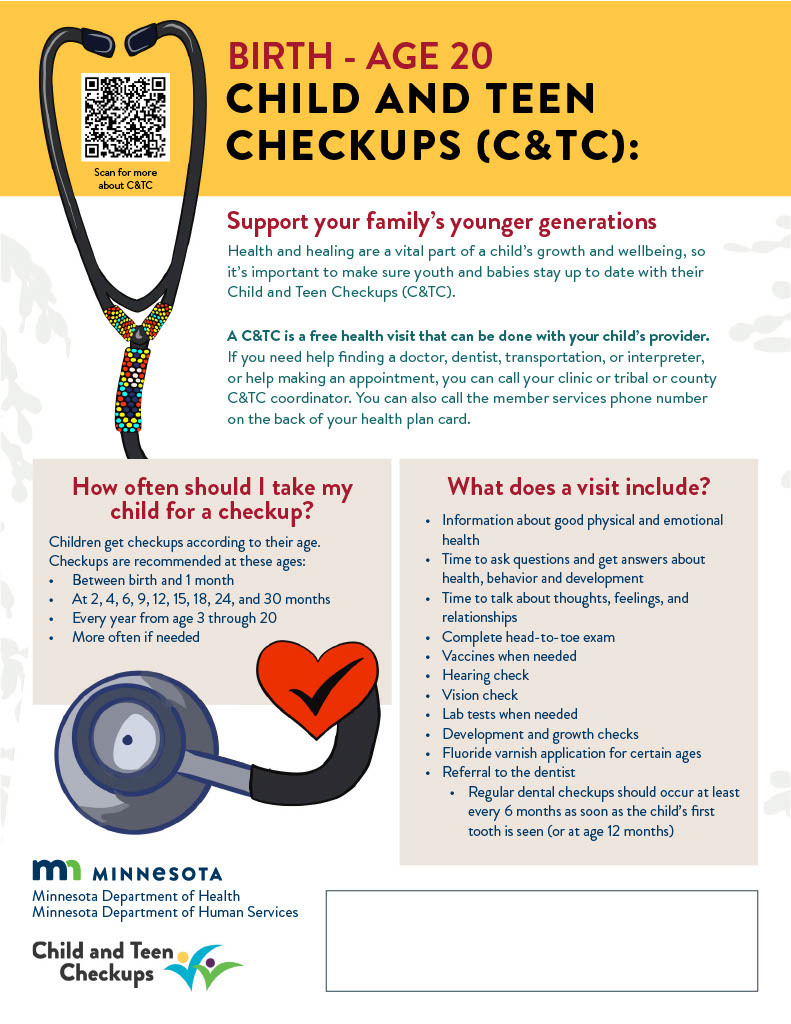
Two new resources have been created specifically for American Indian children and young adults in Minnesota. These informational brochures highlight the importance of preventive care and offer culturally relevant information to support American Indian children and their families.
Please share with families and clinics in your community:
The Newcomer Education for Wellness (NEW) program offers free, accessible health education videos to help refugees, immigrants, and other newcomers understand the U.S. health system.
Videos are available in more than 10 languages (including Arabic, Karen, Somali, Spanish, and Swahili) and topics include interpretation services, healthy eating, stress management, dental and vision care, and using health care facilities.
Videos are sent by text to participants’ phones—no app is required, and no personal information is collected.
Learn more or request materials: MNCOENewcomerHealth@state.mn.us
Sign up or share with families: https://forms.web.health.state.mn.us/form/coe-new
MDH and the Maternal and Child Health Advisory Committee are now accepting nominations for the 2025 Betty Hubbard Maternal and Child Health Leadership Award, honoring those who improve health outcomes for mothers, children, and families in Minnesota.
Award categories:
- Statewide impact: Contributions with statewide outcomes
- Community impact: Contributions benefiting a community or specific population
How to nominate:
- Complete the 2025 Betty Hubbard Maternal and Child Health (MCH) Leadership Awards Nomination Form
- Include 1–3 letters of support
- Submit by Wednesday, Oct. 29, 2025
Learn more at Betty Hubbard Award webpage or health.mch@state.mn.us.
Second Wednesday of each month from 9-9:30 a.m.
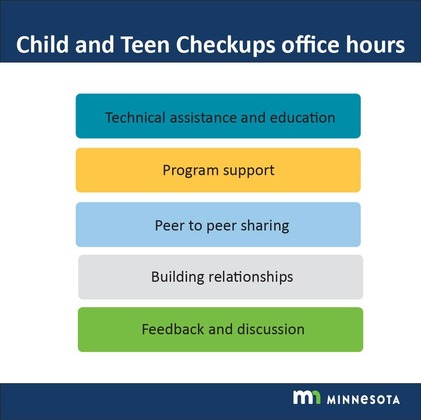
Join the Department of Human Services (DHS) and the Minnesota Department of Health (MDH) C&TC program for optional virtual office hours to ask questions, get program support, engage in peer sharing, and strengthen relationships.
Register and submit your questions for our November session and December session.
|