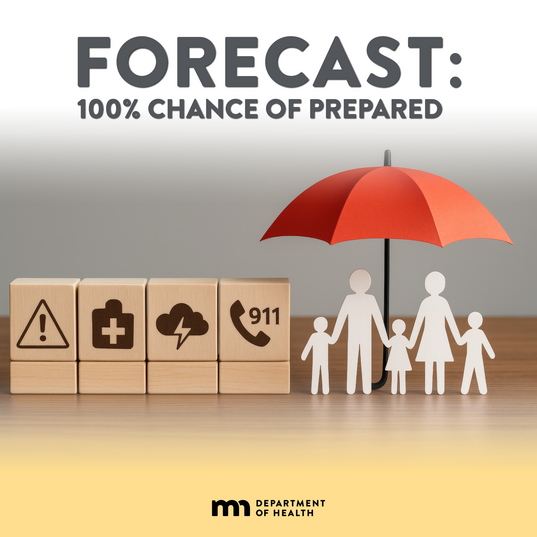
 September marks National Preparedness Month (NPM), an annual campaign that brings awareness to planning ahead for emergencies and disasters that may affect you, your loved ones, or your community. Here are some tips to make sure you are prepared:
-
Make a family or individual plan: Write down how you’ll connect if separated during an emergency (texts, meeting spots, phone numbers).
-
Build a ready kit: Pack basics like water, snacks, flashlights, medications, and comfort items for kids.
-
Stay informed: Sign up for local alerts and make sure you and your family know how to get information quickly.
-
Practice together: Run through your plan with the whole family. Even a quick “what if” conversation helps kids feel ready.
-
Know your safe areas: Identify the safest place in your home or workplace during storms or other hazards.
-
Keep documents dry: Store important papers (insurance, medical info) in waterproof containers or digitally.
Most importantly, remember to stay safe! Rain or shine, you’ll be ready when you plan ahead. For more resources, visit Plan Ahead for Disasters | Ready.gov
Have you noticed a hazy sky or smelled smoke in the air this summer, even on a clear day?
Wildfires are becoming larger and more frequent across the United States and Canada, partly due to climate change. Warmer temperatures and dry conditions make it easy for fires to start and spread. Even if a wildfire is burning far away, the smoke can travel thousands of miles and harm your health.
Health symptoms you might experience when air quality is unhealthy
- Coughing, wheezing, or shortness of breath.
- Burning eyes or throat.
- Headaches, dizziness, or nausea.
- Worsening of asthma and/or COPD symptoms.
- Increased risk of heart failure, heart attack, or stroke.
Protect yourself when air quality is unhealthy
-
Be air aware. Check the air quality, just like the weather. Visit AirNow.gov or download the AirNow app. The Air Quality Index is color-coded to communicate how polluted the air is or is forecasted to become. Orange is unhealthy for sensitive groups such as infants, children, and teenagers, adults age 65 and older, pregnant people, outdoor workers, and people with preexisting lung or heart conditions. Red and purple mean the air is unhealthy for everyone. Maroon means hazardous emergency conditions.
-
Limit outdoor exposure. Reduce time outside, especially intense physical activity.
-
Take precautions. If you must be outdoors, a properly fitted N95, KN95 or P100 mask can help protect against wildfire smoke. Take breaks in clean air spaces.
-
Don’t make it worse. Reduce air pollution from backyard fires and gas-powered tools like lawn mowers. Limit driving and idling when possible.
-
Keep indoor air clean. Close windows and doors, set your home and vehicle’s air conditioning to recirculate, use an air filter if available, and avoid vacuuming and burning incense and candles. No air conditioning? Consider making a do-it-yourself air filter using a box fan.
- Seek medical attention for prolonged difficulty breathing, chest pain, cough or sneezing, eye irritation, or dizziness or confusion.
For more information, visit our Wildfire Smoke - a Growing Health Concern webpage and Minnesota Pollution Control Agency’s air quality webpage.
Minnesota Behavioral Health Medical Reserve Corp with therapy dogs
The Minnesota Behavioral Health Medical Reserve Corp (BH MRC) is a statewide group of volunteer behavioral health specialists, whose mission is to support the global resilience of individuals, communities, and the Public Health Incident Command System during disasters by providing expert skills in the area of behavioral health. The BH MRC provides disaster behavioral health education and training, handouts and resources, and disaster intervention and referral services.
BH MRC services might be provided in a variety of ways such as at Disaster Recovery Centers, Multi-Agency Resource Centers, Assistance Centers, Reunification Centers, and Points of Dispensing, or waiting family members and/or survivors of the disaster to provide emotional support services and assist in connecting with other disaster support services. The BH MRC may provide outreach (door-to-door) support services in disaster-impacted neighborhoods, schools, places of worship, and other community locations to assist survivors without access to disaster services and/or survivors who may not be actively seeking formal services. The BH MRC can also be deployed to public health Incident Command Centers, to staging areas and deployment sites to support the emotional health of public health and health care responders.
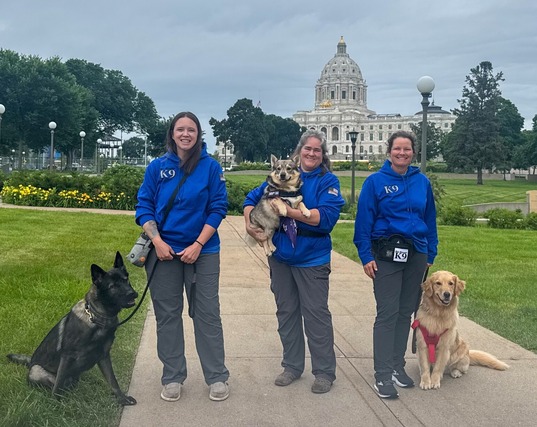
On June 25, 2025, the BH MRC deployed their three therapy dogs to the State Capital Complex to provide emotional support to current and former legislative staff in the wake of the tragic shooting of State Senator John Hoffman and his wife Yvette, and the assassination of State Representative Melissa Hortman; her husband, Mark; and their dog Gilbert. Therapy dogs were deployed in response to a statement released by Sophie and Colin, the Hortmans’ children, urging those wishing to honor their parents to:
- Plant a tree.
- Visit a local park and make use of their amenities, especially a bike trail.
- Pet a dog. A golden retriever is ideal, but any will do.
- Tell your loved ones a cheesy dad joke and laugh about it.
- Bake something — bread for Mark or a cake for Melissa and share it with someone.
- Try a new hobby and enjoy learning something.
- Stand up for what you believe in, especially if that thing is justice and peace.
As a state asset, the BH MRC must be formally requested in order to deploy. Emergency management can request the assistance of the BH MRC by submitting a resource request through the State Emergency Operations Center (SEOC), or if the SEOC is not open, they can submit a request to MDH through the State Duty Officer. More information about the BH MRC can be found at Minnesota Behavioral Health Medical Reserve Corp - MN Dept. of Health
Emergency Preparedness and Response Division staff
In mid-August the Emergency Preparedness and Response Division staff met to review how an incident is reported at MDH and the next steps. Division Director Cheryl Petersen-Kroeber, along with Assistant Division Director Deb Radi, walked staff through the reporting process and considerations for activating a response.
Colleagues worked together to update job action sheets, ensuring they reflect the current processes. These updates strengthen our readiness by providing clear guidance to staff who may be called on to support the Department Operations Center during emergencies. If you are an MDH employee, keep an eye out for Incident Command System trainings coming your way!
|