Center of Excellence in Newcomer Health
|
|
|
View this as a webpage
July 2025
The Minnesota Center of Excellence in Newcomer Health (MN COE) is dedicated to developing resources to support health care providers, public health professionals, and resettlement partners in their efforts to better serve refugee and other newcomer families. We build on existing infrastructure and partners’ extensive experience to identify and monitor newcomer health issues and needs, contribute to evidence-based policies and guidance, and ultimately improve continuity of care and health outcomes for newcomers.

1. Which influential person was a refugee? (select all that apply)
A. Henry Kissinger
B. Albert Einstein
C. Madeleine Albright
D. Freddy Mercury
|
For our clinical audience...
Mohammad, a 26-year-old man from Sudan, presents for establishing primary care. He arrived in the U.S. through the U.S. Refugee Admissions Program four months ago. During his domestic medical exam, he completed schistosomiasis and strongyloidiasis serologies; both were negative. During the evaluation, he complains of abdominal pain, bloating, dyspepsia, and nausea starting within the last few months, which is untreated.
2. What is your next best step?
A. Do nothing, as he already tested negative for parasitic infection.
B. Advise him to take OTC Tums, avoid tight clothing and spicy foods, and come back next week if it doesn’t resolve.
C. Complete an O&P x2 to rule out parasitic infection, with a stool antigen test added on to rule out h. pylori.
D. Complete an O&P x2 to rule out parasitic infection.
Answers at the end of the newsletter
Prevalence of Diabetes Among U.S. Refugees and Opportunities to Improve Screening, 2012–2022
Our MN COE partners at HealthPartners, Denver Health, and Thomas Jefferson University have recently published an article, Prevalence of Diabetes Among U.S. Refugees and Opportunities to Improve Screening, 2012–2022. From their evaluation, they suggest that adding routine diabetes screening recommendations to domestic medical exam (DME) guidance may decrease the time for diabetes diagnosis for refugee patients. Early detection of diabetes may result in reduced complications and better health outcomes (UChicago Medicine: Understanding Diabetes: The Importance of Early Detection and Management).
After reviewing electronic health records, our team was able to identify refugees with diagnosed diabetes at DME, and refugees with undiagnosed diabetes through evaluating elevated hemoglobin A1c values and ICD-9/10 codes.
We included 4,521 refugees: 127 (2.8%) had diagnosed diabetes at DME, and 244 (5.4%) were diagnosed with diabetes within three months. Of those without known diabetes at DME (n = 4,384), 63.3% (n = 2,863) were screening-eligible, and 25.4% (n = 726) had screening within three months. While the prevalence of overall diabetes among newly arriving refugees was lower than the general U.S. population (8.2% vs. 11.6%), this may be an underestimate as only one-fourth of screening-eligible patients were screened.
Read the article and learn about the prevalence of diabetes among refugees and opportunities to improve screening:
Kollannoor Samuel, G., Settgast, A., Walker, P., Chrenka, E., Steiner, A., Payton, C., Frumholtz, M., Knuti Rodrigues, K., Bergenstal, R., & DeSilva, M. Prevalence of Diabetes Among U.S. Refugees and Opportunities to Improve Screening, 2012–2022. Journal of Immigrant Minority Health (2025). doi:10.1007/s10903-025-01706-w
|
|
|
Newcomer Education for Wellness (NEW) is a free resource designed to help refugees, immigrants, and newcomers to the U.S. navigate the health care system and take care of their health. Subscribers will receive free, accessible health education videos in their own language texted directly to their phone. No identifiable information is required, and phone numbers are only used to send educational health videos.

These videos are made for newcomers to the U.S. – and anyone else who wants to learn more about their health in their own language. NEW videos are designed to be accessible regardless of language or literacy, so all can understand and use the information with confidence.
The videos are available in Arabic, Burmese, Dari, English, French, Haitian Creole, Karen, Pashto, Somali, Spanish, and Swahili. Video topics will cover interpretation services, health care facilities, dental and vision care, stress management, and healthy eating.
Register now to receive COE Newcomer Education for Wellness (NEW) videos!
Learn more at Newcomer Education for Wellness (NEW) Video Series.
|
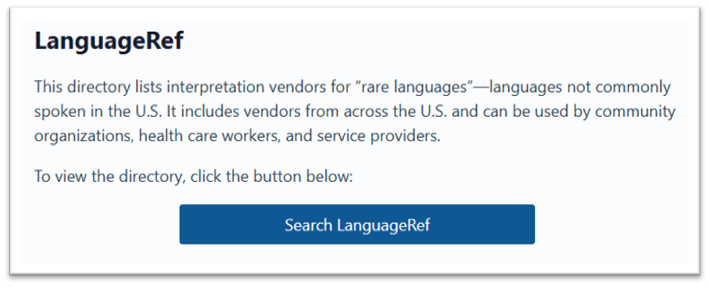
We are happy to announce the launce of a new MN COE resource, LanguageRef!
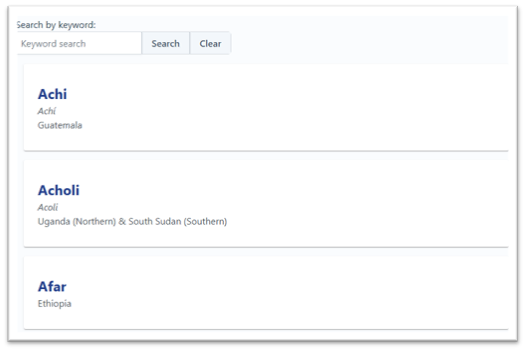
To use this tool, you simply type the name of the language(s) in the search bar and results will filter by keywords to show relevant languages.
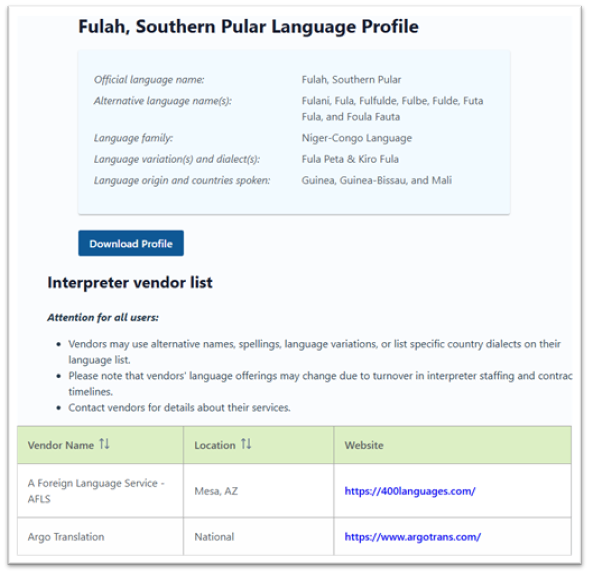
Once you select the language you are looking for, a list of vendors will appear.
Disclaimer: Vendors listed have been reviewed by the Minnesota Department of Health but are not officially approved or certified. Users are responsible for verifying each vendor’s qualifications and services, which may vary by location. The Minnesota Department of Health does not guarantee service quality or outcomes.
If you can’t find a language or know of vendors offering interpretation services for rare languages that are not listed, you can request the addition of the language(s) and vendor(s) to the directory using the LanguageRef Request Form.
Spotlight on Hepatitis B
We often receive questions and requests for resources and information on hepatitis B, so we wanted to take a moment to spotlight this disease and resources we have found helpful.
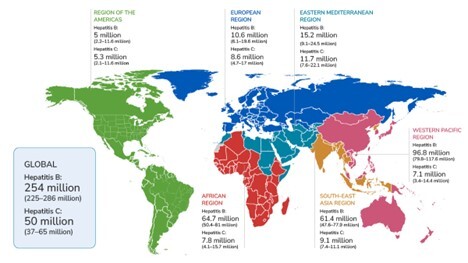
According to the World Health Organization (WHO), hepatitis B is a viral infection that attacks the liver and can cause both acute and chronic disease. It can be transmitted vertically (mother to child during birth and delivery) and horizontally (through contact with infected bodily fluid). The WHO estimates that 254 million people were living with chronic hepatitis B infection in 2022, with 1.2 million new infections each year. In 2022, hepatitis B resulted in an estimated 1.1 million deaths, mostly from cirrhosis and hepatocellular carcinoma (primary liver cancer). Universal hepatitis B vaccination in the U.S. started in 1991, after it was determined that it was the best way of preventing infection.
Globally, hepatitis B is found in every region; however, there are more cases found in the Western Pacific, Southeast Asia, and African regions. Subsequently, clinicians should be mindful of vaccination history and regional risk for their patients.
Image acquired from CDC: Global Viral Hepatits
Resources from the MN COE:
Publications:
- DeSilva, M. B., Settgast, A., Chrenka, E., Kodet, A. J., & Walker, P. F. (2022). Improving Care for Patients with Chronic Hepatitis B via Establishment of a Disease Registry. The American journal of tropical medicine and hygiene, 107(1), 198–203. doi:10.4269/ajtmh.21-1013
- Payton, C., DeSilva, M. B., Young, J., Yun, K., Aragon, D., Kennedy, L., Tumaylle, C., White, D., Walker, P., Jentes, E. S., & Mamo, B. (2021). Hepatitis B Evaluation and Linkage to Care for Newly Arrived Refugees: A Multisite Quality Improvement Initiative. Journal of immigrant and minority health, 23(3), 558–565. doi:10.1007/s10903-020-01058-7
- Young, J., Payton, C., Walker, P., White, D., Brandeland, M., Kumar, G. S., Jentes, E. S., Settgast, A., & DeSilva, M. (2020). Evaluation of a Program to Improve Linkage to and Retention in Care Among Refugees with Hepatitis B Virus Infection — Three U.S. Cities, 2006–2018 . MMWR. Morbidity and mortality weekly report, 69(21), 647–650. doi:10.15585/mmwr.mm6921a2
- DeSilva, M. B., Kodet, A., & Walker, P. F. (2020). A Best Practice Alert for Identifying Hepatitis B–Infected Patients. The American journal of tropical medicine and hygiene, 103(2), 884–886. doi:10.4269/ajtmh.20-0041
Resources from our colleagues:
On July 9, the CDC Domestic Team issued a Dear Colleague Letter (PDF) regarding the 68 Afrikaners who arrived in the U.S. in two groups during May 2025. Everyone in both cohorts received overseas medical exams and is eligible for domestic medical exams (DMEs). Learn more at CDC: Refugee Health Domestic Guidance.
- Clinicians can utilize CareRef to receive recommendations for screening tests and other preventive care based on the demographic and geographic factors that contribute to risk.
- State refugee health coordinators and domestic health care providers can contact the CDC Immigrant and Refugee Health Branch Domestic Team at IRHBdomestic@cdc.gov with any questions regarding this update or domestic screening in this cohort.
SimLab
Our partners at the University of Minnesota are inviting interested health care professionals working with newcomers in clinical settings in dentistry, medicine, nursing, public health, social work and other professions to a two-hour online simulation-based workshop.
The Supporting Newcomer Health Workshop: Enhancing your skills with interpreters (PDF) is designed to build capacity in the area of working with interpreters for interprofessional team members. Workshop objectives include:
- Supporting newcomers and improving their care by collaborating with trained interpreters
- Working as part of an interprofessional team
- Applying just-in-time training in an online, simulated clinical environment with standardized patients and trained interpreters
- Discussing practical applications in health care settings

Aug. 5 and 6 are the final workshops and will both have two sessions offered, 5:30-7:30 p.m. CT and 6:30-8:30 p.m. CT.
We are excited to announce that CME/CEUs are available for our SimLab workshops in July and August!
Scan the QR code or visit http://z.umn.edu/9ehx to register!
|
International Refugee and Migration Health Conference Recap
Thank you to everyone who came by and said hi at the International Refugee and Migration Health Conference!
In case you missed us, we sent out a special edition newsletter linking all of our presentations and our new tools that we launched at the conference. We presented the following sessions:
Workshops and oral presentations:
- The Centers of Excellence in Newcomer Health: 10 Years of Adapting to the Dynamic Landscape of Newcomer Health (a collaboration with the Colorado COE!)
- Developing a Simulation-based Workshop to Teach Providers Effective Collaboration with Interpreters
- Addressing substance use with newcomers: Culturally informed partnerships, treatment, and prevention
- Hypertension prevalence among newcomers to the United States, 2018-2024
Poster sessions:
- Hypertension prevalence among newcomers to the United States, 2018-2024
- Development of an Interactive Orientation Booklet for Newly Arrived Children to the United States
- Evaluating CareRef’s Utility and Uptake Among Clinicians
- Standards for public health surveillance methods among newcomers to the United States
- Translated Cultural Adaptation of Survey of Well-Being of Young Children for Newly Arrived Afghans
Missed a webinar? Don’t sweat it!
The following recordings have recently been approved for accessibility and are posted on our Trainings: Minnesota Center of Excellence in Newcomer Health webpage:
Coming soon:
- Understanding and Addressing Avian Influenza (H5N1) in Newcomer Populations
Take a moment and review some recent publications on newcomer health:
- Bocanegra, H. T., Yama, A., Pirzada, A. F., Neamaallah, H., & Chang, J. (2025). Assessing the Effectiveness of Reproductive Health Literacy Trainings on Access To Care for Arab and Afghan Refugee Communities. Journal of immigrant and minority health. Advance online publication. doi:10.1007/s10903-025-01734-6
- Virk, S., Milewski, A., Khan, N., Cheung, C., Wright, D. N., & Kaur, G. (2025). Vaccination in Forcibly Displaced, Pediatric Populations: A Systematic Review and Meta-Analysis. JAMA network open, 8(6), e2516237. doi:10.1001/jamanetworkopen.2025.16237
- Mokashi, A., Fellows, K. M., Chin, R. J., Whittaker, S. G., Simpson, C. D., & Ceballos, D. M. (2025). Lead in traditional eyeliners: An investigation into use and sources of exposure in King County, Washington. PLOS global public health, 5(6), e0004643. doi:10.1371/journal.pgph.0004643
- Chan, C., Ryder, S., Luong, D., & Puri, G. (2025). Massive Thymic Hyperplasia in Graves Disease. JCEM case reports, 3(6), luaf076. doi:10.1210/jcemcr/luaf076
- Hasnain, R., Hounmenou, C. E., Smith, A. B., Johnson, T. P., Kondratowicz, D. M., Taradash, J. M., Shinde, A. R., & Alvarado, F. (2025). Service capacity and disability resource integration: A strategic survey of immigrant and refugee-serving agencies in Illinois. American journal of community psychology, 75(3-4), 278–291. doi:10.1002/ajcp.12788
- Zhang, S., Obeng-Nyarkoh, P. I., Altomare, A., & Zuckerman, R. (2025). Understanding care experiences amongst immigrant and refugee clients in a Ryan-White funded HIV clinic. Communications medicine, 5(1), 225. doi:10.1038/s43856-025-00879-7
|
|

Did you know that we are one of two centers established by support from the Centers for Disease Control and Prevention? Visit our partner site: Colorado COE in Newcomer Health!
The Colorado team leads data/epidemiology and public health navigation initiatives through partnerships with states and sites across the country. Their primary goal is to maintain a data repository to identify and respond to the changing landscape of newcomer health, with a focus on domestic medical exams and long-term health follow-up data.
Additionally, they support public health teams in ensuring that all populations are included in public health responses, regardless of culture or language. They develop best practices, toolkit resources, and capacity-building trainings for navigators and public health teams.
|
Please sign up now if you are not already subscribed to Minnesota Center of Excellence in Newcomer Health Updates and wish to receive future updates.
For more information or questions, please contact the Minnesota Department of Health Refugee Health Program at MNCOENewcomerHealth@state.mn.us or 651-201-5414.
The Minnesota Center of Excellence in Newcomer Health is supported by NU50CK000563 (MN) from the U.S. Centers for Disease Control and Prevention.
|
|
|
|