|
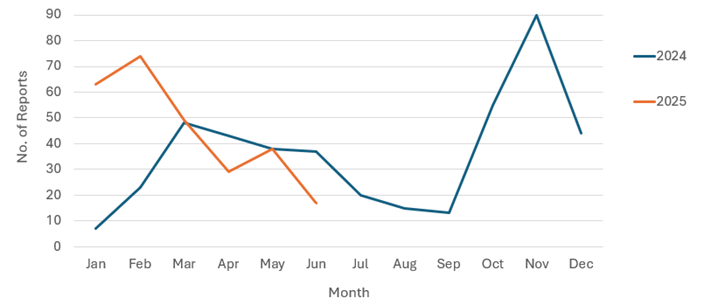
Civil surgeons are required to report all Class B2 TB cases (also known as latent TB infection or LTBI) and submit relevant attachments, including I-693s, chest X-rays (CXR), and interferon-gamma release assay (IGRA) results, through eMedical. In accordance with this policy, 26 civil surgeons reported 703 LTBI status adjuster reports to the Minnesota Department of Health (MDH) from January 2024 to June 2025.
Figure 1. Number of Status Adjusters with LTBI Reported to MDH by Month,
January 2024 to June 2025*
 *Includes status adjusters reported to MDH as of June 13, 2025.
The top countries of birth among status adjusters diagnosed with LTBI and reported to MDH were Mexico (19%), Ethiopia (10%), India (9%), Somalia (7%), and Liberia (5%). The remaining 50% represented 72 additional countries of birth among those reported to MDH.
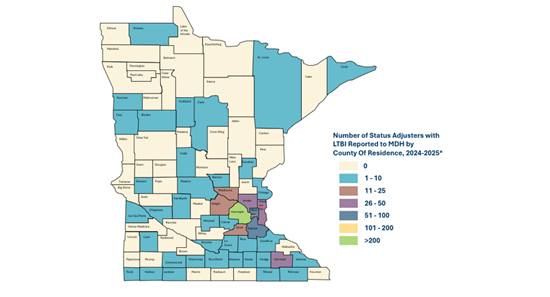
The majority of status adjusters diagnosed with LTBI and reported to MDH resided in Hennepin County (43%), followed by Ramsey (11%), Dakota (10%), Anoka (6%), and Olmsted (6%) counties. The remaining 75% were distributed across 40 other Minnesota counties.
Figure 2. Number of Status Adjusters with LTBI Reported to MDH by County of Residence, January 2025 to June 2025*
 *Includes status adjusters reported to MDH as of June 13, 2025.
These reports were forwarded to local public health departments, who then conducted outreach and offered treatment to status adjusters. The standard reporting timeframe for LTBI cases was five days after completion of the I-693 or within 30 days. In Minnesota, the average reporting time for LTBI status adjusters was 40 days, with a median of 27 days.
Although local public health agencies conduct outreach to LTBI candidates, the response rate remains low (19%). MDH is exploring strategies to improve this rate; however, treatment outcome metrics have demonstrated improvement over time.
Additionally, MDH conducted a Status Adjuster Diagnosed with LTBI Survey in 2023-2024 to better understand their experiences with diagnosis, treatment access, and follow-up care. Based on their feedback, several key challenges were identified: (1) unfamiliarity with TB testing requirements and logistics for the I-693 exam, including the need for multiple appointments and sites; (2) need for additional education on LTBI and its treatment; and (3) financial barriers for screening and treatment.
To address these gaps, MDH has developed resources for civil surgeons to support their work with status adjusters diagnosed with LTBI. These educational materials below are intended to inform status adjusters about their diagnosis and LTBI treatment options:
-
What does having latent tuberculosis (LTBI) mean for me? (PDF) brochure provides a basic overview about LTBI, how to get started with treatment, and answers some FAQs.
- Other languages available in brochures dropdown on TB Basics: Amharic, Arabic, Chinese, Dari, French, Hindi, Hmong, Karen, Korean, Oromo, Pashto, Russian, Somali, Spanish, Ukrainian, Yoruba, and Vietnamese.
-
Treatment for Latent TB Infection (LTBI) provides general information about LTBI treatment for people who are interested in or starting LTBI treatment.
- Other languages provided as PDFs: Amharic, Arabic, Bosnian/Croatian/Serbian, French, Hmong, Karen, Khmer (Cambodian), Laotian, Nepali, Oromo, Russian, Somali, Spanish, Tibetan, and Vietnamese.
For more information about civil surgeon reporting requirements, please visit MDH: Tuberculosis Screening | Minnesota Civil Surgeons and CDC: The eMedical System Documentation | Tuberculosis Technical Instructions for Civil Surgeons.
For questions, please contact the MDH Refugee and International Health Program at refugeehealth@state.mn.us.
USCIS COVID-19 update
People applying to adjust their immigration status to be become a United States permanent resident (“green card”) are required to have received age-appropriate vaccines according to Advisory Committee on Immunization Practices (ACIP) guidelines as recommended for the general population.
In March 2025, the United States Citizenship and Immigration Services (USCIS) updated the vaccine requirements for those adjusting their status to lawful permanent resident. Effective Jan. 22, the COVID-19 vaccine requirement has been waived. More information about vaccination requirements for the adjustment of status exam can be found at USCIS: Vaccination Requirements.
Refer to Minnesota Civil Surgeons for more information on adjustment of status exams, including a list of civil surgeons and differences in requirements for refugee applicants. Please reach out to refugeehealth@state.mn.us with questions.
Medical interpreters
Working with interpreters is an important part of providing quality health care to newcomers. Minnesota has several statutes related to interpreter requirements and insurance coverage (refer to Language Access). Interpreters should be trained medical interpreters; family members or friends should not be expected nor asked to assist with interpretation.
Best practices when working with interpreters:
- If possible, clarify language and dialect beforehand to ensure the appropriate interpreter is requested. Minnesota has a Spoken Language Health Care Interpreter Roster to search for interpreters by language and geographic region. The Minnesota Center of Excellence in Newcomer Health (MNCOE) will release LanguageRef soon, a tool to assist in finding interpreters for languages not commonly spoken in the U.S.
- Introduce yourself and discuss the goals for the visit with the interpreter prior to meeting with the patient.
- Speak directly to the patient in a normal tone of voice. For example, say “today we are going to review your labs” rather than speaking to the interpreter, “today we are going to review her labs.”
- Pause frequently to allow for translation. Saying multiple sentences at a time before pausing for translation may lead to errors.
In partnership with the University of Minnesota, the MNCOE is hosting an interactive two-hour online simulation-based workshop for interprofessional team members seeking to improve their ability to work with interpreters: Supporting Newcomer Health Workshop: Enhancing your skills with interpreters (PDF). All dates will have two sessions offered, 5:30-7:30 p.m. CT and 6:30-8:30 p.m. CT:
- July 22 and 23
- Aug. 5 and 6
Register now: You're invited to a virtual workshop!
For more information on interpretation:
Microlearnings
As part of the Microlearning Series, MNCOE has released five-minute videos on Strongyloidiasis and Schistomiasis to give an overview of the conditions and screening considerations for newcomers. Videos on H. pylori and latent tuberculosis infection are coming soon!
MNCOE Newcomer Education for Wellness (NEW)
The Minnesota Center of Excellence in Newcomer Health has launched its Newcomer Education for Wellness (NEW), a free resource designed to help refugees, immigrants, and newcomers to the U.S. navigate the health care system and take care of their health.

By signing up, newcomers will receive free, accessible health education videos in their own language texted directly to their phone. The videos are short (around two minutes), culturally and linguistically accessible, and cover key health topics such as interpretation services, navigating the U.S. health care system, dental and vision care, healthy eating, and stress management. Videos are available in Arabic, Burmese, Dari, English, French, Haitian Creole, Karen, Pashto, Somali, Spanish, and Swahili.
|
The online sign-up form is now live and we encourage you to spread the word about this resource: COE Newcomer Education for Wellness (NEW).
- Post promotional materials in waiting rooms or intake areas.
- Share with clients during appointments or orientations.
- Include information in welcome packets or email newsletters.
- Add video links to newcomer patients’ electronic health records.
- Refer newcomers directly to the service.
If you would like to access informational flyers, watch videos, or learn more, you can visit Newcomer Education for Wellness (NEW) Video Series or reach out to refugeehealth@state.mn.us.
Samantha Grimsley, Arrive Ministries, Saint Cloud
Arrive Ministries is a resettlement agency headquartered in Richfield, Minnesota. Since 1988, it has welcomed over 12,000 refugees, mostly in the Twin Cities metro area; its office in Saint Cloud primarily provides essential orientation and navigation of services for people who move to central Minnesota.
|
Ten years ago, Samantha Grimsley didn’t know what the word “refugee” meant. Today, she’s the Saint Cloud Area Director for Arrive Ministries. In 2015, two serendipitous events changed the trajectory of her career: stumbling upon a blog of a woman who had visited Iraq and shared the stories of women who had fled due to religious persecution, and the opportunity to take part in a relief trip to Iraq serving internally displaced persons. After returning home, she pioneered the first Arrive Ministries site outside of Richfield. Samantha finds great joy in connecting people from different walks of life, and shares that “with proximity, people better understand how to really love neighbor as self, and I have the privilege of bearing witness to this.”
When asked what she wants refugee health providers to know about her work, Samantha shares that Arrive has great flexibility to meet needs and fill in gaps through their work with volunteers and other donations. In Saint Cloud, Arrive donates furniture/household items, trains volunteers from local churches who desire to be friends and “good neighbors” to newcomers, offers ESL classes and volunteer tutors. It is also the provider of Community Workshops, the education branch of the Resettlement Network Services, providing essential classes (financial literacy, housing literacy, health literacy, safety, etc.) to assist newcomers’ integration in the community.
“Hope” is Samantha’s word of the year. There is work to be done and people who need assistance. She has been heartened by recent increases she’s seen in awareness and advocacy for newcomers, and shares that her past shows her a good reason to hold on to hope: “Though it’s important to plan for the future (which I do), my past reminds me that my plans 15 years ago didn’t transpire, but the interruptions I faced led me to something better than I could’ve planned – this vocation, serving immigrants.”
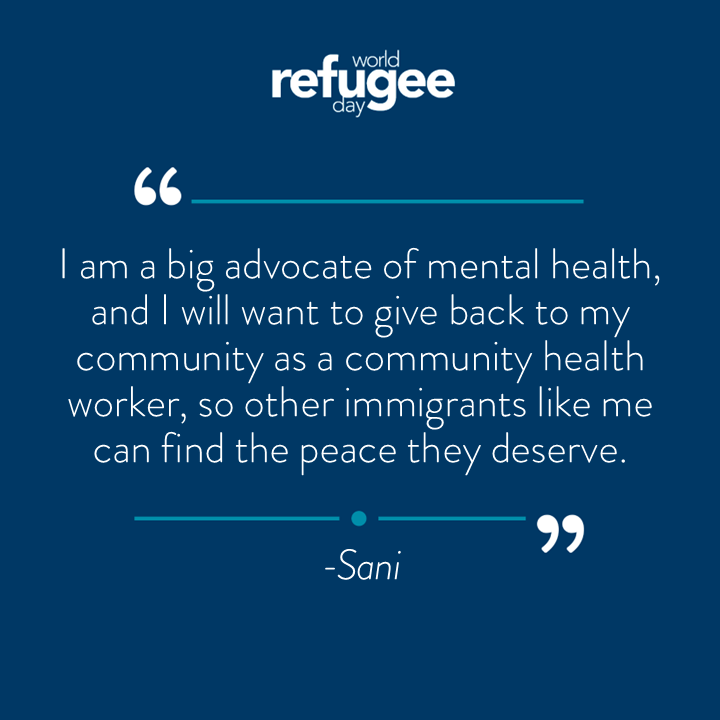
Every year, the MDH Refugee and International Health Program highlights the experiences of refugees and newcomers in our community and what health means to them. In honor of World Refugee Day, we shared stories from Iryna, Tri, and Mahdi in June. Please join us in continuing to celebrate and amplify the voices of Minnesota’s refugees by reading Sani's story below.
Sani, Ghanaian asylee
Community health worker trainee at CHW Solutions
Sani came to the U.S. in 2020 after he left his home country of Ghana in search of safety and peace. Initially arriving in California, Sani began volunteering for the Minority Humanitarian Foundation in San Diego, the same organization that had originally helped him when he arrived. There, Sani helped other migrants with things like travel coordination, housing, and accessing support.
He then moved to Minnesota, where he earned a community health worker degree at St. Mary’s University in 2025. Sani now uses his education and incorporates advocacy in his work as a community health worker trainee at CHW Solutions, where he supports newcomer communities and is an advocate for migrants and mental health.
“I was diagnosed with post-traumatic stress disorder (PTSD) when I got here, but with the help of the beautiful people of Minnesota, my community, and specifically the Center for Victims of Torture, I received the resources that can help stabilize my situation.”
Learn more about Sani's story and what health means to him, and revisit the entire World Refugee Day collection:
|