August ORHPC Newsletter

ORHPC

View this as a webpage

August 2025

ORHPC Monthly Update


MDH and ORHPC News

Data Corner

Minnesota’s Grow Your Own Programs: An Effective Recruitment Strategy

The month of August is our transition from the end of summer to the beginning of school, making it a great time to emphasize the importance of Grow Your Own programs and initiatives for health care professions in rural Minnesota.

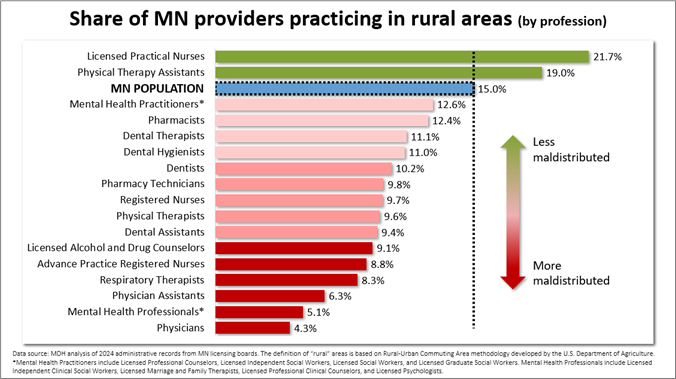
The share of health care providers working in rural Minnesota is imbalanced when comparing the population in rural Minnesota to metropolitan or urban areas of the state (see graph 1 below). There are many more health care professionals working in metropolitan areas and more professionals per capita than in rural Minnesota.

By 2030, one-fourth (25.4%) of residents of rural Minnesota counties are projected to be 65 years of age or older vs. 19% for urban counties. (Rural Health Care in Minnesota: Data Highlights Chartbook, page 8). With rural Minnesota’s aging population, health care needs will only increase in the coming years.

Share of MN Providers Practicing in Rural Areas

Graph 1. Fritsma, Teri. (2024). How to grow a rural health provider [PowerPoint slides]

One successful method of increasing provider numbers in rural Minnesota is through Grow Your Own programs and initiatives in health care professions. These programs are a great opportunity to provide students in rural communities with early exposure to health care careers. Health care practitioners who grew up in rural communities are more likely to choose to work in rural communities as adults.

Grow Your Own pathways are not limited to one type of program – some examples include:

  • Job shadowing and summer internships with health care facilities and providers in the community. (Here is one example: High School Senior Inspired to Explore Nursing After Positive Summer Internship Experience | Blog Article | CentraCare)
  • Career fairs held by school districts or in partnership with health care professionals and health care organizations.
  • Scrubs camps that let students explore health care careers through hands-on activities like learning CPR or practicing injections using oranges and syringes filled with saline solution), or by interacting with healthcare professionals and taking field trips to tour health care facilities. (Examples of scrub camps in Minnesota: HealthForce Minnesota - For Students - Scrubs Camp and High School Level SCRUBS Camp - ARCHS)
  • Health Occupations Students of America (HOSA) Future Health Professionals – a global student-led organization to empower students to become leaders in the global health community through education, collaboration and experience. HOSA currently has 84 active chapters throughout Minnesota.
  • Post Secondary Enrollment Options (PSEO) credits for health careers such as certified nursing assistant (CNA) opportunities for high school students. (This Instagram post shares how one Minnesota community came together to provide high school students with hands on experience during their CNA training as well as provide screenings for Senior AmeriCorp members. The Sartell High School student newspaper wrote about it in You should join the CNA class – The LeSabre.)
  • Other college at high school opportunities.

Grow Your Own opportunities provide an early entryway into health careers. For example, if a high school has a partnership with a local community college, students can sometimes attend classes and work toward credits to earn their certified nursing assistant (CNA) license during the regular school day.

Once they’ve completed the required credits, students could start working as a CNA while still in high school. This early entry into health care may put students on a path to studying for advanced degrees in the health care field, later earning more credits towards other health professions such as nursing, pharmacy, physical therapy or dentistry.

Community partnerships between school districts, community colleges, health care facilities and providers can really help Grow Your Own programs flourish. Parental involvement adds an important dimension – families can provide support and encouragement as their student is exploring health care professions in their community.  

To learn more about Grow Your Own initiatives happening throughout Minnesota, check out these spotlights published by ORHPC:


September National Shortage Designation Update

The federal Health Resources and Services Administration (HRSA) will conduct the next National Shortage Designation Update for Health Professional Shortage Areas (HPSAs) in September 2025. As a result of updates to their database, some HPSAs may no longer automatically qualify as designated shortage areas. However, there are a number of steps states can take to make sure as many areas as possible retain their designation and to help prevent areas from losing a designation, if there is any way that they can still qualify.

At this time, the Minnesota Primary Care Office (PCO) is proactively submitting HPSA applications for areas that qualify to maintain their designation, and we will continue through the end of the summer. After HRSA has completed the September 2025 National Update, they will place areas that no longer meet the qualifications in "proposed for withdrawal" status. Our Minnesota PCO team will then review the designations that are being proposed for withdrawal, and we will review and resubmit any that may qualify for a new designation. If the area still does not qualify for a HPSA, it will be officially withdrawn in July 2026 in the Federal Register Notice.

Auto-HPSA Facility Designations (FQHC, FQHC look-a-likes, Tribal Clinics, Rural Health Clinics) may experience changes in their HPSA scores but are not at risk of being placed in "proposed for withdrawal" status.

What action can I take?

  • Minnesota providers and clinics may contact the Minnesota Primary Care Office to request a preview report of their HPSA designation and score.
  • Clinics may contact the Minnesota Primary Care Office to share updated provider data to be entered into the designation database.
  • We will also be reaching out directly to some of you to get updated information. If you get an email from us, please respond! That information will help us evaluate whether we are able to keep an area’s shortage designation.

For questions or assistance, please contact Ann Odens, Shortage Designation Coordinator, Office of Rural Health and Primary Care at ann.odens@state.mn.us.


2025 MDH Home and Community-Based Services (HCBS) Scholarship and Loan Forgiveness Recipients

The HCBS Scholarship and Loan Forgiveness Program helps provider organizations support their employees in pursuing education in nursing and other health care fields as they continue working in home and community-based services. These awards cover costs related to coursework that leads to career advancement within HCBS or with their current employer. The program aims to expand access to educational opportunities, retain skilled direct-care professionals, and address workforce shortages across Minnesota.

The 2025 HCBS Scholarship and Loan Forgiveness Program awarded funding to 21 HCBS provider organizations for employee scholarships and/or loan forgiveness, including loan forgiveness awards for 32 individuals. Thanks to the reviewers who volunteered to participate in this process! If you would like to volunteer as an ORHPC grant reviewer, please fill out the online form at forms.office.com/g/9s0CD2szzb to express your interest.

Learn more about the HCBS Scholarship and Loan Forgiveness Program and other opportunities at ORHPC Grants and Funding.


Opportunities and Resources

Minnesota e-Health Initiative Advisory Committee Open Positions

The Minnesota e-Health Initiative Advisory Committee is currently accepting applications for five seats on the Minnesota e-Health Advisory Committee:

  • Clinical Guideline Development
  • Small/Critical Access Hospital
  • Designated Alternate – Local Public Health
  • Rotating Professionals – Additional Health Settings (two seats available)

The advisory committee is looking to fill these seats as soon as possible. Seats will remain open until filled. Cover letters and resumes are optional but encouraged to help inform appointment recommendations to the Commissioner of Health. Application materials do not need to include personal addresses and phone numbers.

Applications can be submitted on the advisory committee's webpage at Board/Commission Details by selecting the Apply button next to the open position listed. More information about the e-Health Initiative and advisory committee can be found at Minnesota e-Health Initiative - MN Dept. of Health. Questions can be directed to mn.ehealth@state.mn.us.


Healthy Brain & Aging Policy Event

Strengthening Minnesota’s Rural & Tribal Community Infrastructure

This landmark event will bring together state policymakers, researchers, healthcare professionals, state agencies, nonprofit leaders, and tribal and rural-serving organizations and community members to engage in conversations on the challenges, needs, strengths, and resources of Minnesota’s rural and tribal communities to address aging and brain health.

Goal: To create a shared vision for healthy aging and dementia prevention in rural and Tribal communities. 

Objectives:

  • Educate participants on the current landscape of aging and dementia in the State of Minnesota, including rural and tribal communities
  • Describe current aging and dementia infrastructure, research, services, and support systems
  • Communicate current and future needs and challenges to address healthy aging and dementia
  • Share best practices and solutions for supporting dementia prevention, healthy aging, and elders and caregiver support services

Event details:

Wednesday, August 13

8:30 am – 3:00 pm

451 Lexington Parkway North in Saint Paul

Register at Events | Memory Keepers MDT.


Geriatric Lecture Series

Emergency Preparedness: Meeting the needs of aging populations

Register now for this free online program that will cover:

  • The unique access and functional needs of older adults during disasters and how these intersect with social determinants of health
  • Practical strategies for inclusive preparedness planning that supports older adults before, during and after emergencies
  • Learn tools and best practices to coordinate accessible response and recovery efforts to prioritize the safety and dignity of aging populations

Event details:

Wednesday, August 20

11:00 am – 1:00 pm

Space is limited. Register by Monday, August 18 at https://bit.ly/GLSPreparedness.


Crush Med School Debt

Federal Programs for Financing Your Future in Medicine Webinar

Crush Med School Debt is a one-hour webinar all about how the National Health Service Corps (NHSC) can help manage medical school debt through meaningful scholarship and loan repayment programs. The webinar is free to attend and is intended for medical students (MD & DO), medical school faculty, clinicians, and medical association leaders and representatives.

Attend the webinar to learn about NHSC scholarships and repayment programs, including how you can qualify. This event will also include a live Q&A portion, so bring any questions.

Event details:

Thursday, August 28

1:00 – 2:00 pm

Register at Microsoft Virtual Events Powered by Teams.


Important Dates

September 21

Deadline for National Rural Health Day video submissions

Share your voice for rural health care! Minnesota's rural communities need strong health care advocates. Help us create powerful video vignettes by recording a short clip answering any of these questions:

  1. Why is rural health care important in Minnesota?
  2. How can people support rural health in Minnesota communities?
  3. What does rural health mean to you?

We want to hear from:  Health care professionals, students in health programs, rural community members, or any rural health care advocates

It's easy!

  • Record on your phone
  • Keep it under 10 seconds
  • Choose the question that speaks to you
  • Submit by September 21 via email to orhpc@state.mn.us

Your clips will be featured in video vignettes shared on ORHPC channels leading up to National Rural Health Day!


September 30

Deadline for Minnesota Rural Health Award nominations

Do you know someone who has made a significant contribution to improving the health of people in rural Minnesota? We want to hear about them! Nominations are now open for the 2025 Minnesota Rural Health Awards. Please make your nominations by Tuesday, September 30, for the:

  • Hero Award – nominate an individual
  • Team Award – nominate a team or group of people
  • Lifetime Achievement Award – nominate an individual  

Nominees can have contributed to rural health in any capacity—in a paid position or as a volunteer, as a health care provider or administrator, through policy development or in practice. Areas of impact could include, but are not limited to, health care and health programs, rural health policy, legislation, rural health equity, improved patterns of health care delivery, cooperative efforts, achieving efficiencies to avoid duplication of services and reach common goals, education, and a lasting impact on people and areas served. If you have any questions, please contact health.orhpc@state.mn.us.


November 20

National Rural Health Day
We are excited to celebrate the #PowerOfRural this National Rural Health Day! Join us in honoring rural America's resilience and the dedication of healthcare professionals to meet rural health needs. Discover more at powerofrural.org.


Other News

  • MN’s new St. Cloud medical school campus aims to train rural doctors
    The University of Minnesota Medical School's CentraCare campus recruits students from rural areas and will prepare them for practices there, too, with the hope they’ll serve long term in greater Minnesota.
  • NRHA's Rural Health Voices Blog | National Rural Health Association
    Summer camps inspire students to choose rural health careers.
  • 946: Stay Cool Campaign, Telling the Public Health Story
    Kristin Raab, director of the Minnesota Climate and Health Program at the Minnesota Department of Health, shares how the state’s “Stay Cool Minnesota” campaign is working to protect Minnesotans against the negative health effects of extreme heat. ASTHO alum, Dr. Matthew Christiansen, chief medical officer and vice president of health affairs at Valley Health Systems, discusses ASTHO’s recent Executive Leadership Forum and the value of public health. Plus, ASTHO’s new data dashboard help states use data to guide health improvement.

The Office of Rural Health and Primary Care (ORHPC) promotes access to quality health care for all Minnesotans. We work as partners with policymakers, providers, and rural and underserved urban communities to ensure a continuum of core health services throughout the state.

651-201-3838

health.orhpc@state.mn.us