|
Child and Teen Checkups Newsletter |
|
|
According to the Minnesota C&TC periodicity schedule, when is it appropriate to perform additional C&TC visits? (multiple answers possible; answer at the end of the newsletter)
A. When deemed medically necessary.
B. If the child is transitioning into a new foster care placement.
C. When the child has not missed any scheduled visits and is healthy.
D. Only during the summer months to prepare for school.
|
|
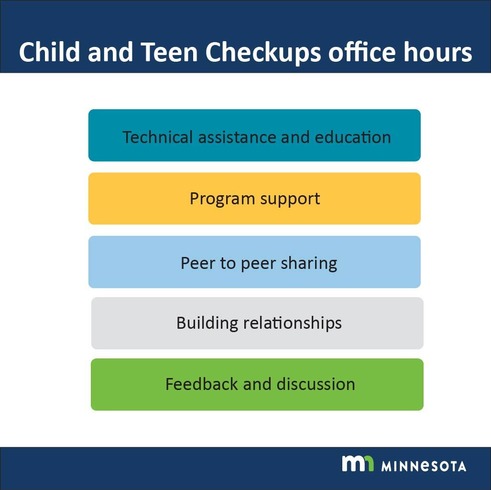
Second Wednesday of each month from 9-9:30 a.m.
Join the Department of Human Services (DHS) and the Minnesota Department of Health (MDH) C&TC program for optional virtual office hours to ask questions, get program support, engage in peer sharing, and strengthen relationships.
Register and submit your questions for our August and September sessions.
|
|
Introduction by Dr. Katie Smentek, Mankato Clinic Pediatrics
“As a community pediatrician, I’ve seen firsthand how incorporating suicide risk screening into routine adolescent care can make a critical difference. With the updated C&TC periodicity schedule now recommending universal screening starting at age 12, it's important to recognize how this simple addition to a well-visit can lead to early identification, timely support, and even life-saving intervention. For some clinics, this may already be standard practice, while for others, it may feel new or uncertain. To highlight the real-world impact of this change, I want to share a story from our clinic that demonstrates how effective early screening and a coordinated response can be when we prioritize mental health as part of preventative care.”
Story from an integrated behavioral health psychologist working with Dr. Smentek
“A pediatrician saw a teen patient to restart ADHD meds. PHQ-9 was 23 and patient reported thoughts they would be better off dead, or of hurting themselves in some way more than half the days. Patient reported thoughts of suicide and engaging in non-suicidal self-injury; marks from such injury were observed on patient’s arms. The doctor started the patient on medication and referred to me. I was able to see them same day.
I engaged in further risk assessment and safety planning. Patient contracted to safety and agreed to use distress tolerance skills taught in session. Plan was to discuss referral to higher level of care. Patient expressed suicidal ideation three days later and so parent took patient to the emergency department and from there patient went to a psychiatric hospitalization. Upon discharge, patient is working with pediatrician and care manager to remain stable while waiting for admission to residential chemical dependency treatment.”
Vaccines protect children from diseases and keep them healthy. Staying up to date can be challenging – but here are ways to stay informed:
-
Got Your Shots? News: A monthly MDH newsletter with vaccine updates, schedule changes, and state-specific disease news.
-
Minnesota Vaccines for Children Announcements: Updates for providers in the vaccines for children program, including clinical and program changes.
-
IZ Express: Immunize.org’s source for new CDC vaccine guidelines, FDA approvals, immunization resources, notable publications, and global immunization news.

Encourage parents of 3- to 6-year-olds to complete early childhood screening. Use Help Me Connect to refer families to their local screening program. The Minnesota Department of Education (MDE) has more details for families and districts, including an optional screening summary form.
If a clinic uses Minneapolis Preschool Screening Instrument Revised (MPSI-R), Developmental Indicators for the Assessment of Learning 4 (DIAL-4), Brigance III, or Battelle 3 for screening, parents can request results (developmental, social-emotional, vision, hearing, immunizations, height, and weight) to submit to their school district.
A new law (Statutes 142D.091, Subdivision 3) allows virtual screening for children who are immunocompromised or other health concerns. Parents can also request a copy of a virtually completed C&TC visit.
|
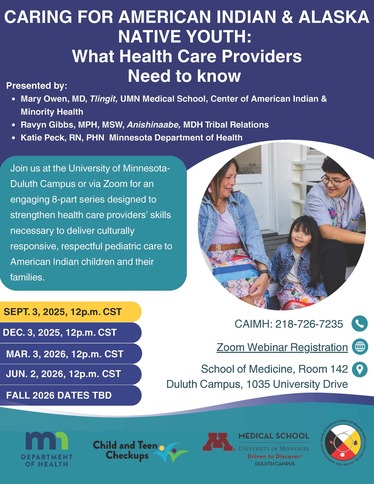
Join a new eight-part webinar series starting Sept. 3, at noon to strengthen culturally responsive pediatric care for American Indian and Alaska Native youth. This series will be offered both online and in person at the University of Minnesota Duluth campus. Providers will gain valuable insights and skills to deliver respectful and informed care. Register for the September session.
The Survey of Well-being of Young Children (SWYC)™ is a free screening tool for children under 5 years. Minnesota Center of Excellence in Newcomer Health worked with experts to translate the tool into Dari and Pashto.
Visit Afghan Cultural Adaptation of the Survey of Well-Being of Young Children (SWYC) to access the translated SWYCs, the companion resources, and trauma considerations.
Additional translations are available through TEAM UP for Children: Translations.
The American Academy of Pediatrics confirms fluoride as safe and effective. The C&TC program recommends fluoride varnish application at all visits from tooth eruption through age 5 and regular dental referrals. Use the Fact Checked: Fluoride is a Powerful Tool for Preventing Tooth Decay resource to support conversations with families and reinforce the importance of early oral health care.
 |
|
The DHS Medicaid Matters communications toolkit offers providers and clinical teams with ready-to-use materials—such as fact sheets and social media content—to explain the importance of Medicaid (Medical Assistance) to patients, families, and partners. This toolkit highlights the critical role providers play in ensuring children and families maintain access to essential health care services through Medicaid. |
|
|
|
Training descriptions are located on the MDH website. Submit a C&TC training request form to request a training for your staff or organization.
Clinic trainings
For clinic staff (medical providers, nurses, medical assistants, nurse managers, billing) involved in C&TC screening in the clinic.
Vision Basic Screening Skills (FREE)
Learn how to perform distance and near visual acuity screening, pass/refer/rescreen criteria, and documentation.
Sports Physical into a Complete C&TC (FREE)
Incorporate a Minnesota State High School League sports physical into a routine visit for youth ages 11-20 years who are eligible for C&TC.
In-person hearing and vision trainings
Registration closes one week prior to the training date.
Hearing and Vision Basic Screening Skills ($60)
Includes how to do basic hearing and vision screening. Intended for anyone who performs hearing and vision screening on children.
- Aug. 11: 8:30 a.m. – 12:30 p.m., St. Paul
- Sep. 25: 8 a.m. – noon, Duluth
- Oct. 9: 8:30 a.m. – 12:30 p.m., Brainerd
- Oct. 14: 8:30 a.m. – 12:30 p.m., St. Cloud
Hearing and Vision Advanced Screening Skills for Nurses ($105)
Includes how to do basic hearing and vision screening. In addition, the hearing portion includes in-depth ear anatomy and physiology, risk assessment/hearing history, otoscopy, tympanometry, and otoacoustic emissions screening (OAE). The vision portion includes a review of myopia, hyperopia, and amblyopia, performing pupillary light, and red reflex procedures. Intended for RNs/LSNs/PHNs who perform hearing and vision screenings.
- Aug. 11: 8:30 a.m. – 4:30 p.m., St. Paul
- Sep. 25: 8 a.m. – 4 p.m., Duluth
- Oct. 9: 8:30 a.m. – 4:30 p.m., Brainerd
- Oct. 14: 8:30 a.m. – 4:30 p.m., St. Cloud
Webinar trainings
Registration closes one week prior to the training date.
Best Practices ($60)
Overview of recommended and required components of a complete C&TC well child exam. Intended for anyone who provides or assists in providing C&TC screening.
- Nov. 18: 8:30 a.m. – 12:30 p.m., WebEx
Hearing and Vision Basic Screening Skills ($60)
Includes how to do basic hearing and vision screening. Intended for anyone who performs hearing and vision screening on children.
- Dec. 11: 8:30 a.m. – 12:30 p.m., WebEx
|
|
|
Billing for a complete C&TC exam can be complicated. The MHCP Provider Manual has information including referral codes and screening exceptions you may find helpful.
If training or additional assistance is needed, please connect with us at dhs.childteencheckups@state.mn.us.
Answer: A and B. Additional C&TC visits may be appropriate outside the traditional periodicity schedule for reasons such as medical or developmental concerns, changes in health status, or major life events like entering foster care, as these situations can significantly impact a child's wellbeing
|
|
|
As always, if you have any questions, please reach out to us!
|
|
Child and Teen Checkups (C&TC) is Minnesota’s Early Periodic Screening, Diagnosis, and Treatment (EPSDT) program. EPSDT is a federal program required in every state to provide comprehensive health care and dental services for children under the age of 21 who are eligible for Medicaid. Periodic examinations or screenings are delivered according to the C&TC Schedule of Age-Related Screening Standards. |
|
|
|
|