Center of Excellence in Newcomer Health
|
|
|
View this as a webpage
May 2025
The Minnesota Center of Excellence in Newcomer Health (MN COE) is dedicated to developing tools to support health care providers, public health professionals, and resettlement partners in their efforts to better serve immigrant and refugee families. We build on existing infrastructure and partners’ extensive experience to identify and monitor newcomer health issues and needs, contribute to evidence-based policies and guidance, and ultimately improve continuity of care and health outcomes for newcomers.
For this year’s World Refugee Day on June 20, we are bringing you a special edition of our pop quiz showcasing the wide variety of languages spoken around the world!

1. Determine each language for the following versions of “Welcome:"
A. Murakaza neza
B. أهلاً و سهلاً
C. Hoan nghênh
D. Ласкаво просимо
E. Karibu
For our clinical audience...
Four-year-old Mohammad from Somalia presents at your clinic with his parents for the Domestic Medical Exam. While taking a history, the parents inform you that he received several vaccinations for school at a community clinic last week. You are planning to draw labs at today’s visit.
2. What should you consider prior to drawing labs? (Select all)
A. No special considerations, as the vaccines were more than a week ago.
B. You should wait at least one month to draw an IGRA after the administration of a live-virus vaccine.
C. Hepatitis B vaccines may cause a transient HBsAg positive screening, so be aware that rescreening after four weeks may be indicated.
D. Screen titers on all recent vaccinations to verify immunization status.
Answers at the end of the newsletter
|

Many of you have seen the rise in measles cases in the U.S. over the last several months (CDC: Measles Cases and Outbreaks) and may have wondered how the newcomer community may be impacted by this.
We asked our COE subject matter expert, Dr. Janine Young, to gain some insight into this issue.
|
How are newcomers impacted by this measles outbreak?
- As of May 8, 2025, there were over 1,000 confirmed cases of measles in 30 U.S. states with 14 outbreaks, meaning with three or more measles cases that were related to each other. Eligible newcomers who arrive through U.S. Refugee Admissions Program (USRAP) should have received two doses of measles, mumps, and rubella (MMR) vaccine overseas before departure, or if not available, another measles-containing vaccination. Where there are measles outbreaks overseas, before departure to the U.S., International Organization for Migration (IOM) and/or CDC will reach out to the location of the outbreak to initiate measles vaccinations to infants ages 6-11 months as well (refer to CDC: Vaccination Program for U.S.-bound Refugees and Visa 93 (V93) Applicants for further vaccination information for USRAP populations). For USRAP-eligible arrivals, most will have some degree of protection against measles from the receipt of the measles vaccination.
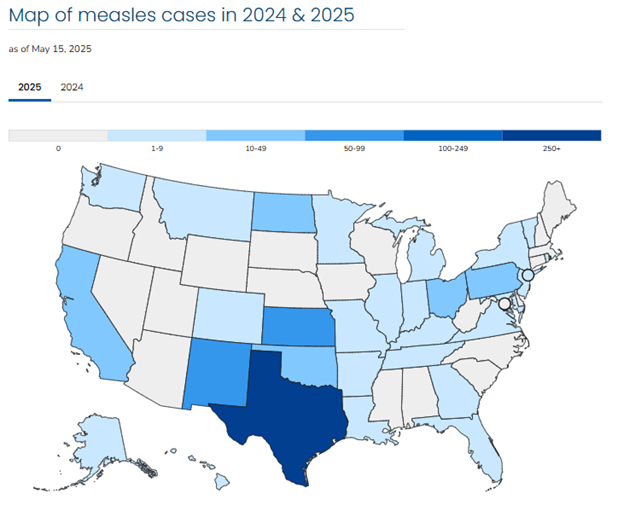
- To see the distribution of where the measles outbreaks are occurring, you can explore the CDC map of measles cases in 2024 & 2025. Notably, over 250 of the 1,024 cases are in Texas, largely focused in Gaines County (Texas Department of State Health Services: Measles Outbreak – May 20, 2025).
Are there any considerations for newcomers who have lived in the U.S. for years, who visit friends and relatives in measles-endemic areas?
- The current recommendation for anyone traveling to measles-endemic areas is to initiate MMR vaccination of infants early—at 6-11 months of age, and again at 12 months and 4-6 years, per standard Advisory Committee on Immunization Practices (ACIP) booster recommendations to confer adequate immunologic protection. Older children and adults who have not been vaccinated should receive two MMR vaccines separated by at least 28 days. For anyone with a confirmed measles exposure, it is important to see a physician immediately to determine eligibility for post-exposure prophylaxis. Children and adults who have already had two appropriately spaced MMR vaccines are considered immune. For children and adults with only one recorded dose of MMR, a second dose within 72 hours after exposure is recommended. Because MMR is a live viral vaccine, infants younger than 6 months and pregnant or immunocompromised individuals are advised to see a physician who can provide immune globulin. If a patient comes with no records, it is important to provide catch up vaccinations, per ACIP recommendations.
What should I consider when deciding between vaccinating versus drawing serology in someone with an unknown vaccine status?
- It is possible to send IgG serological titers to demonstrate evidence of immunity against measles, mumps, and rubella, but do not send titers if a patient presents with a record of having received only one MMR vaccination. Full, long-term immunity is only conferred after a person receives two MMR vaccines at appropriate intervals, even if titers are positive. Also, if you are concerned that your patient may not return for follow-up appointments, initiating MMR vaccination is recommended, particularly in cases where the Vaccines for Children program covers the cost of the vaccination. However, in adults without insurance or with an insurance policy that does not cover vaccinations, it is advisable to arrange vaccination at the local public health department where there are often funds to cover costs of vaccination. Pregnant and immunocompromised patients should not receive live viral MMR vaccination.
How can health care workers and public health professionals best support newcomers in protecting themselves against measles?
- It is essential to vaccinate all eligible patients with MMR to protect themselves and others who are too young to receive the vaccine, pregnant, or immunocompromised. We all need to present the overwhelming evidence from expert scientists that MMR vaccine is the most effective way to prevent measles infections, outbreaks, preventable hospitalizations, and deaths. Many of my patients and families have seen measles infections in their home countries, where vaccination rates are low. They have seen infants and children die from this preventable disease. I also have seen cases of vaccine-preventable disease in my patients, have hospitalized these children, and have seen some of them tragically die from not having vaccines.
- Now we are seeing this in the U.S. because of low vaccine rates. I think it is important to discuss this with patients and families. As a pediatrician, I know that vaccinations are one of the best evidence-based preventative measures that we provide for our patients and families. I explain that what I recommend is what I do for my own children and family as well.
- I also think it is important to have trusted members of communities provide vaccination information to newcomers in their primary language and for public health workers to bring vaccinations to communities to decrease barriers. Outreach should include culturally vetted public health messages in preferred languages delivered via radio, TV, and social media that communities use.
Helpful resources
In accordance with Executive Order 14204: Addressing Egregious Actions of the Republic of South Africa, the U.S. Department of Health and Human Services, through its Office of Refugee Resettlement (ORR), is supporting the admission and resettlement of Afrikaners arriving in the United States as refugees. On May 12, the Department of State released a press statement, Welcoming Afrikaner Refugees Fleeing Discrimination, announcing the arrivals of the first Afrikaner refugees to the U.S.
Since these newcomers are going through the United States Refugee Admissions Program (U.S. Department of State: Refugee Admissions), they will have received medical and security clearance prior to arrival. Afrikaners will be referred to a Domestic Refugee Health Medical Screening and may be eligible for medical services after arrival (CDC: Refugee Health Domestic Guidance).
Clinicians can use CareRef for guidance on conducting a routine post-arrival medical screening of a newly arrived refugee to the U.S.
|
|
|
VaxRef is a web-based application that translates vaccine records from a variety of languages—now including Dari, Pashto and Arabic—into English. Multilingual newcomers, interpreters, health care workers, and community organization staff can all use this tool.
As a reminder, VaxRef does not give medical advice or vaccine guidance. It’s important to consult with your health care team for health advice and information about vaccinations. The information you enter on the VaxRef form will be deleted immediately after the translation is completed, except for the language that is translated and the U.S. state residence of the vaccine record owner. This information will only be used to better understand the usage of the application.
The MN COE turns 10 this year! As we reflect on where we started, the refugee health landscape has expanded. Health care and public health professionals who completed a survey in 2016 highlighted refugee health gaps in resources and needed support for clinicians: A Survey of Health Care Providers to Identify Educational Needs to Ensure Quality and Equitable Care for Refugees, 2016 (PDF).
- The survey identified the need to expand the CDC: Refugee Health Domestic Guidance to include robust mental health, pediatrics, women’s health sections, and more.
- Respondents had strongly voiced support for having this guidance embedded in electronic health records and online interactive tools and presented in conferences or trainings.
- Additionally, over half of the survey respondents requested background health profiles that included cultural context for the various communities they were caring for.
Understanding the gaps and needs of these providers led to some of our biggest projects, including the Newcomer Health Profiles, CareRef and the Clinical Decision Support tool. Additionally, we supported the CDC in expanding their guidance to include more topics and have consistently hosted 4-8 national webinars and trainings each year on the guidance and emerging issues.
The Society of Refugee Healthcare Providers’ annual conference, the 2025 International Refugee and Migration Health Conference (formerly known as the North American Refugee Health Conference, or NARHC) will be held June 27-29 in Halifax, Canada.
 What can you look forward to at IRMHC this year?
Pre-courses
The Society of Refugee Healthcare Providers and partners is offering several free pre-courses on Thursday, June 26. Registration is required.
IRMHC is offering hybrid registration!
Register today to attend either in person or virtually! There are several pricing options, including for members, non-members, and students.
Plan your sessions in advance
The Society released the official 2025 International Refugee and Migration Health Conference Agenda (PDF), which can be downloaded. Minnesota Center of Excellence in Newcomer Health (MN COE) and Colorado Center of Excellence in Newcomer Health (CO COE) will have a large presence this year! Come find us at our MN COE sessions to learn more about our projects and say hi!
-
Workshop: The Centers of Excellence: 10 Years of Adapting to the Dynamic Landscape of Newcomer Health (a collaboration with the Colorado COE!)
-
Workshop: Developing a Simulation-based Workshop to Teach Providers Effective Collaboration with Interpreters
-
Workshop: Addressing substance use with newcomers: Culturally informed partnerships, treatment, and prevention
-
Oral Presentation: Hypertension prevalence among newcomers to the United States, 2018-2024
-
Poster: Translated Cultural Adaptation of Survey of Well-Being of Young Children for Newly Arrived Afghans
-
Poster: Development of an Interactive Orientation Booklet for Newly Arrived Children to the United States
-
Poster: Standards for public health surveillance methods among newcomers to the United States
-
Poster: Evaluating CareRef’s Utility and Uptake Among Clinicians
New Microlearning: Schistosomiasis
SimLab
Our partners at the University of Minnesota are inviting interested health care professionals working with newcomers in clinical settings in dentistry, medicine, nursing, public health, social work and other professions to a two-hour online simulation-based workshop.
The Supporting Newcomer Health Workshop: Enhancing your skills with interpreters (PDF) is designed to build capacity in the area of working with interpreters for interprofessional team members. Workshop objectives include:
- Supporting newcomers and improving their care by collaborating with trained interpreters
- Working as part of an interprofessional team
- Applying just-in-time training in an online, simulated clinical environment with standardized patients and trained interpreters
- Discussing practical applications in health care settings

All dates will have two sessions offered, 5:30-7:30 p.m. CT and 6:30-8:30 p.m. CT:
- July 22 and 23
- Aug. 5 and 6
Scan the QR code or visit http://z.umn.edu/9ehx to register!
|
ECHO Colorado Newcomer Health Series
In partnership with ECHO Colorado, the Minnesota Center of Excellence in Newcomer Health has been hosting a monthly training on newcomer health since Oct. 25, 2022.
Next ECHO session:
-
Tuesday, June 24:
Case Studies: Newcomer Health in a Changing Landscape
11 a.m. ET | 10 a.m. CT | 9 a.m. MT | 8 a.m. PT.
Learn more and sign up now: ECHO Colorado: Newcomer Health
Please note that you may need to clear your internet history/cache before registering on this new website. You can also access and explore past session materials on the Newcomer Health ECHO Resource Page.
Missed a webinar? Don’t sweat it!
The following recordings have recently been approved for accessibility and are posted on our Trainings: Minnesota Center of Excellence in Newcomer Health webpage:
Recordings available in early June:
Cervical, Breast, and Colorectal Cancer Screening Outcomes Among Refugees in Philadelphia, Pennsylvania
Colleen Payton, Nina Kvaratskhelia, Melanie Chalfin, Jessica Deffler, Marc Altshuler
Journal of Immigrant and Minority Health. June 2025, 27(3):480-488. Doi: 10.1007/s10903-025-01685-7
Our MN COE partners at Thomas Jefferson University have recently published an article about cancer screening outcomes between 2018 and 2019 at a refugee health screening clinic in Philadelphia. Read the article to learn about how longitudinal outcomes beyond the domestic medical exam provide valuable insight into cervical, breast, and colorectal cancer screening among refugees in the United States.
New Nutrition Guidance
On May 20, the Centers for Disease Control and Prevention’s Division of Global Migration Health updated the Refugee Health Domestic Guidance for Nutrition and Growth. This update includes key changes of guidance for multivitamin supplementation in children, an overview of updated epidemiologic information on nutrition in refugees, and new data tables that will help health care providers analyze anthropometric (height/length and weight information) and laboratory data (results from screening exams) to determine nutritional status of the refugee. Please email the CDC Domestic Team with any questions, irhbdomestic@cdc.gov.
Reminder: Last Call for Ordering CDC Tuberculosis Materials
As CDC’s Publication Warehouse has offered more tuberculosis materials electronically, and demand for printed materials has declined, CDC has decided to close the warehouse and end this service in September 2025.
For questions, please contact tbinfo@cdc.gov.
- Kim, J., Zieneldien, T., Ma, S., & Cohen, B. A. (2025). Cutaneous Leishmaniasis in the Context of Global Travel, Migration, Refugee Populations, and Humanitarian Crises. Clinics and practice, 15(4), 77.
- Maas, D., & Marji, J. S. (2025). Dermatologic Research in Displaced Populations: Importance, Challenges, and Proposed Solutions. JMIR dermatology, 8, e64828.
- Othman, M., & Selnow, G. W. (2025). Community health workers: a narrative review of a curriculum and training program for low-income communities facing limited access to healthcare. Frontiers in public health, 13, 1504490.
- Magan, I. M., & Goodkind, J. R. (2025). Understanding the mental and physical health consequences of the U.S. citizenship exam for Rohingya refugees: Implications for policy and practice. Social science & medicine (1982), 379, 118138. Advance online publication.
|
|

Did you know that we are one of two centers established by support from the Centers for Disease Control and Prevention? Visit our partner site: Colorado COE in Newcomer Health!
The Colorado team leads data/epidemiology and public health navigation initiatives through partnerships with states and sites across the country. Their primary goal is to maintain a data repository to identify and respond to the changing landscape of newcomer health, with a focus on domestic medical exams and long-term health follow-up data.
Additionally, they support public health teams in ensuring that all populations are included in public health responses, regardless of culture or language. They develop best practices, toolkit resources, and capacity-building trainings for navigators and public health teams.
|
Please sign up now if you are not already subscribed to Minnesota Center of Excellence in Newcomer Health Updates and wish to receive future updates.
For more information or questions, please contact the Minnesota Department of Health Refugee Health Program at MNCOENewcomerHealth@state.mn.us or 651-201-5414.
The Minnesota Center of Excellence in Newcomer Health is supported by NU50CK000563 (MN) from the U.S. Centers for Disease Control and Prevention.
|
|
|
|