|
Man overheated in sun
As summer temperatures rise in Minnesota, so does the risk of heat-related illness. Whether you’re working outside, playing sports, or just enjoying a warm day, it’s important to know how to stay safe in extreme heat. High heat and humidity can cause dehydration, heat exhaustion, and even heat stroke—especially for children, older adults, outdoor workers, and athletes.
Here are some simple steps to stay safe this summer:
- Drink water often, even if you’re not thirsty.
- Take breaks in the shade or indoors.
- Check the forecast before heading outside.
- Know the signs of heat exhaustion and heat stroke that include dizziness, headache, nausea, confusion, heavy sweating, or dry, hot skin.
- The OSHA-NIOSH Heat Safety Tool App is a great resource, especially for outdoor workers or anyone who spends time in the heat. You can download it for free on your smartphone. More information can be found at through the Centers for Disease Control (CDC) webpage at OSHA-NIOSH Heat Safety Tool App.
- The National Weather Service created a tool called the HeatRisk Index; the index uses a color-coded map to show how dangerous the heat is expected to be on any certain day. You can find more information at NWS HeatRisk. Using tools and apps like the HeatRisk Index and OSHA-NIOSH Heat Safety Tool can help reduce your risk of heat-related illnesses.
By using the resources available and paying attention to your body, you can enjoy a safe and healthy summer in Minnesota. Stay cool, stay hydrated, and stay informed!
 Due to the recent federal funding cuts, the public inquiry hotline ended April 18.
The hotline was a vital service that offered a way for Minnesotans to connect with the Minnesota Department of Health to get information and answers about public health information and resources, as well as communications issues for the department to be addressed quickly.
The hotline provided a way for people to receive health and safety information in other languages. Staff bilingual in Spanish, Somali, and Hmong provided this service; the Language Line was also used for other languages when needed.
It started in the early days of the COVID-19 pandemic. Many staff were assigned at various points to help answer calls and emails from the public when they had questions about COVID-19 as well as other respiratory illnesses and public health issues.
Having the public inquiry hotline as a main point of contact for Minnesotans helped streamline responses so that other areas of the agency did not get overwhelmed.
From March 2020-March 2025, the public inquiry hotline handled 461,792 calls. This does not include countless emails or the over 7.3 million total outreach calls the hotline helped conduct from 2021-2022 for the COVID-19 Individual Engagement and Vaccine Information programs.
As with many other programs that have suddenly lost funding, the public inquiry hotline was about more than just COVID-19. From 2023-2025, the hotline’s scope expanded to include things like:
- Conducting long COVID study follow up.
- Helping with pertussis and varicella case investigations.
- Sharing information with people about avian influenza, RSV vaccines, and measles.
The agency wishes to thank all of the staff who have worked on the public inquiry hotline over the last five years. Your service truly made a difference in helping to protect, maintain, and improve the health of people in Minnesota.
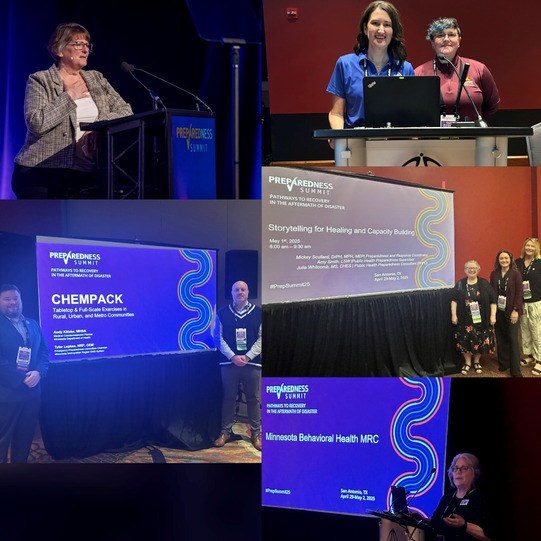
Minnesota had a strong presence at the 2025 Preparedness Summit, hosted in San Antonio, Texas. In late April, staff from the Minnesota Department of Health (MDH) and local health departments attended the summit as attendees, speakers and presenters. This year’s theme focused on recovery after disaster.
Cheryl Petersen-Kroeber, director of MDH’s Emergency Preparedness and Response Division, closed the event by participating in a panel discussion on the long-term impacts of disasters and the roles public health can and should play in the future.
Minnesota Presentations:
-
Cheryl Petersen-Kroeber (MDH): Closing plenary – Bridging the Gap: Public Health’s Role in Long-Term Recovery
-
Nancy Carlson (MDH): Trauma-Informed Emergency Response and Recovery: An Essential Approach to Disaster Recovery
-
Nancy Carlson (MDH): More Than Meets the Eye: The Role of Medical Reserve Corps in Integrating Behavioral Health Into Disaster Response and Recovery
-
Mickey Scullard, Amy Smith and Julia Whitcomb (MDH): Storytelling for Healing and Capacity Building
-
Andy Klitzke (MDH): CHEMPACK Tabletop and Full-Scale Exercises in Rural, Urban and Metro Communities
-
Tess Konen (MDH): Disaster Epidemiology’s Road From Response to Recovery: Partnerships, Data Sharing and Rapid Analytics to Improve Effectiveness and Efficiency of Public Health Emergency Preparedness and Response
-
Bharat Balyan (MDH): Building Community Resilience With Resilience Hubs in Minneapolis
-
Alicia Rodriguez (LPHA), Mary Lyon (LPHA), Mickey Scullard (MDH): Statewide Collaboration for Recovery in the Wake of Public Health Emergencies
-
Jayson Ely and Kris Kaus (Hennepin County): Visualizing Improvement: Tracking AAR/IP Actions Through Power BI
-
Courtney Wetternach (University of Minnesota): Building STTRONGer MRCs: Assessing and Developing a Competency-Based Standard Training Curriculum
-
Jeff Shaw (Hennepin County): Poster – Mitigating and Preparing for the Unexpected: Emergency Response for Newly Arriving Communities
-
Jeff Shaw (Hennepin County): Poster – Two in One: A Map for Gap Identification and Strategic Decisions Around POD Locations
MDH staff presented a breakout session titled Storytelling for Healing and Capacity Building. This session highlighted two projects that gathered topic-specific response experiences from local public health, and general response experiences from MDH staff. Using qualitative data analysis methods, project members identified themes and created best practices fact sheets, guides, case studies, and exercise injects. A storybook and card game were even developed. These products, as well as lessons learned during these two-year projects, were shared along with ideas for how they could be used. Participants of the session used Legos in a creative, hands-on activity to visually tell a story with data.
Congratulations to all Minnesota presenters for your contributions to this year’s summit and for showcasing the innovation and dedication of public health professionals in our state!
|