|
Mar. 2025
View this as a webpage
Statement regarding the impact of federal actions
We know there are many questions and concerns about the potential impacts of federal actions on state, local public health, and Tribal public health funding. We at the Minnesota Department of Health (MDH) share those concerns.
It is important we take these potential impacts seriously and with a patient and level approach. We feel it is very important we share with you only what is certain and true and to not add to the swirl by communicating without clear information.
There remains a great deal of confusion and ambiguity around potential actions from the federal government and what is and is not impacted. Please know we continue to work collaboratively with federal, state, and local partners to understand and identify how this impacts programs and services in Minnesota.
For now, the best thing we can do is to keep working and not allow these moments to deter us. We look forward to knowing more and sharing it soon.
Register today for the CYSHN Local Public Health Conference and share your stories!
The Children and Youth with Special Health Needs Local Public Health Conference is fast approaching, and we’re excited to announce that registration is now open!
Join us May 5 – 6 at the River’s Edge Convention Center in St. Cloud to connect, share knowledge, and explore strategies to better support children and youth with special health needs and disabilities. This year’s theme, Children, Families, and Caregivers: A Focus on Mental Health, highlights the vital role public health plays in supporting mental well-being.
|
If the link above does not work, please copy and paste this into your browser:
https://redcap.health.state.mn.us/redcap/surveys/?s=934AYLKFMJDWFTCX
In addition to registration, we are also collecting stories from local public health staff to highlight during the conference. These stories will help showcase the incredible work being done across Minnesota to support children and families. Stories can be submitted at any time and this story submission form will continue to be live after the conference.
Program-specific updates
Longitudinal follow-up
MDH begins screening for Duchenne muscular dystrophy (DMD) and guanidinoacetate methyltransferase (GAMT) deficiency in newborns.
Newborn screening for DMD and GAMT deficiency began on Feb. 24 in Minnesota. The MDH public health lab expects to identify about six to 10 infants per year with DMD and zero to one infants per year with GAMT deficiency. More information about newborn screening for these genetic conditions can be found on the Newborn Screening: New Conditions webpage.
If you have questions or need additional information about any of the CYSHN follow-up conditions, please email health.cyshn@state.mn.us or call 651-201-3650.
Follow Along Program
April 9 – Follow Along Program statewide meeting
Please join the next statewide meeting at 9 a.m. on Wednesday, April 9. We plan to cover some of the redesign updates and connect with our regional partners in small groups to discuss implementation strategies.
Data reporting and invoicing reminder
If you haven’t submitted your data report and/or invoice yet, please do so as soon as possible. MDH does not require a budget/itemized list of activities with your invoice, and you can submit an invoice for activities related to program deliverables (such as mailing or staff time), even if you did not receive a referral during the Q4 period. The data report should cover both Q3 and Q4 of 2024.
Community connectors update
The CYSHN Follow Along Program is working to ensure that families from historically underserved communities can easily access early childhood developmental resources. As part of the program’s redesign, we have partnered with representatives from eight community organizations who provide culturally and linguistically inclusive outreach and support.
Over the past year, these community connectors have played a key role in identifying barriers to enrollment and participation in the program. One of the most significant successes has been strengthening collaboration between local public health and community partners. These relationships improve outreach and ensure families have access to consistent information. Looking ahead, the group plans to develop a resource guide to further support culturally inclusive strategies.
March 10 – Information session: new Help Me Connect for professionals
Help Me Connect has launched an electronic referral system to help professionals make and receive referrals on behalf of families they are serving. The system gives public health, early education, home visiting, childcare, and other providers a secure platform to connect families to needed services and receive follow-up information that confirms next steps are in place.
They are recruiting 25 professional referral teams to begin using the system as the first cohort of users, which will allow for individualized technical assistance and the opportunity for Help Me Connect staff to gather feedback about the usability of the system. Referral teams should include at least two community partners who want to send referrals to or receive referrals from each other on behalf of families they are serving.
If you are interested in learning more or would like to participate in the first cohort, register to attend the upcoming virtual information session on Monday, March 10 at 9:30 a.m. or contact Help Me Connect staff at helpmeconnect@state.mn.us.
March 13 – Family-led academic grand rounds
Register for the next Family-led Academic Grand (FLAG) Rounds session at noon on March 13 hosted by the University of Wisconsin-Madison and the Bluebird Way Foundation. The next session’s speakers and topic have not been announced yet. However, you can find a link to the previous session recording under “January” on the FLAG Rounds webpage. In the previous session, attendees explored how low expectations impact children with disabilities—and how partnerships between families and clinicians can break barriers. Through real-life stories, speakers Cara Coleman and Danielle Gerber highlighted issues of substandard care, dehumanization, and inaccessibility, offering strategies to foster inclusion and collaboration. Continuing education credits are available.
|
March 18 or May 22 – Introduction to using the Ages and Stages questionnaires
This training is intended for local public health staff who want an introduction to understanding the use and purpose of these developmental and social emotional screening tools. Participants will also learn how to accurately choose, score, and interpret the questionnaires correctly. A live webinar offering a combined training on the ASQ-3 and ASQ:SE-2 will be offered quarterly.
Registration is required and all participants must have access to the ASQ-3 and ASQ:SE-2 starter kits from Brookes Publishing either individually or through their employing agency. Register via either of the links below.
May 15 to 16 – Proof Alliance Caregiver Conference
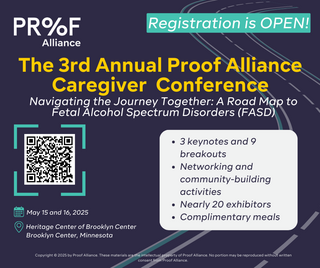
Registration for the Proof Alliance annual Caregiver Conference on May 15 - 16 at Heritage Center of Brooklyn Center is now open! This is a free event designed for caregivers navigating the fetal alcohol spectrum disorders journey.
What to Expect
- Engaging Sessions – three keynotes and nine breakout sessions on essential fetal alcohol spectrum disorders topics
- Community Connection – Share experiences and build relationships with other caregivers
- Resource Fair – Explore nearly 20 exhibitors offering valuable tools and support.
Looking for more insights on fetal alcohol spectrum disorders? Proof Alliance recently joined MPR News to discuss the impact of fetal alcohol spectrum disorders, the importance of early diagnosis, and available support services. Hear firsthand experiences and learn how Proof Alliance is working to raise awareness and expand resources.
|
Infant and toddler developmental evaluation webinar recording
This webinar, hosted by Gillette Children’s, provides insights into recognizing the early signs of cerebral palsy, understanding the latest evidence on accurate diagnosis, and exploring screening tools and timelines for evaluation. Through real-world case presentations, viewers will also gain a deeper understanding of early intervention opportunities and their impact on long-term outcomes.
|