|
View this as a webpage
June 30, 2023
The ALL Together newsletter provides updates, details, and information about assisted living licensure for providers, residents, family members, and the public.
The Minnesota Department of Health’s Health Regulation Division (HRD) will work to provide information, news, updates, and links to resources for assisted living providers and families to help residents and loved ones live their best lives as they age in place.
Please share this newsletter with colleagues, friends, and family. Subscribe to this newsletter.
For Assisted Living Facilities that are contracting with third-party foodservice contractors, take a moment to learn how to comply with the Minnesota Food Code. Several assisted living licensed facilities are contracting their food service with a third-party rather than operating the kitchen themselves. MDH has determined that since it’s not the assisted living licensed provider doing the foodservice, that the exemption from additional licensure as a food establishment in Minn. Stat. 144G no longer applies.
What this means for the third-party contractor?
This means that the third-party foodservice contractor will have to obtain a foodservice establishment license from the authority having jurisdiction within the city where the assisted living facility is located. As a reminder, MDH has delegation agreements with 28 local city, county and multi-county local jurisdictions that are responsible for the licensing and inspection of foodservice establishments within their respective jurisdiction. MDH licenses and inspects the remainder of the state. Information on finding out who the authority having jurisdiction can be found on the MDH Licensing Jurisdiction webpage.
Compliance with the Food Code
Third-party foodservice contractors are responsible for complying with the Minnesota Food Code; therefore, the assisted living licensed entity is not responsible for compliance with the Minnesota Food Code during the survey process. Inspections of the kitchen will be done outside of the survey process by the foodservice establishment licensing entity. MDH inspectors will still be coming out to verify who is providing the foodservice during the survey process in case the responsible entity has changed.
Can you request the inspection reports for third-party contractors?
Inspection reports are public information and are available by contacting the licensing authority. The only time they are not public is if the license holder is currently in the enforcement process. Visit the MDH Licensing Jurisdiction webpage to find out who has jurisdiction in your area.
What do you do if the kitchen being used by the third-party contractor is being remodeled or newly constructed?
Since the kitchen is in a licensed assisted living facility, staff in the MDH Health Regulation Division will conduct the plan review. This decision was made because the contract with the third-party could end, and assisted living staff could take on the task of food preparation for the residents at any time.
What happens if staff at the assisted living facility are taking control of the food and may be dishing up the food for service and/or doing clean-up from meal service?
In this case, since assisted living facility staff are involved in the foodservice to residents, the activities done by assisted living facility staff will become part of the survey. This is done because it’s important that all individuals involved in food preparation are handling and preparing resident food safely.
Questions
If you have questions or need to have a third-party foodservice contractor licensed, please reach out to the MDH Food, Pools and Lodging Services Section by email at health.foodlodging@state.mn.us or by calling 651-201-4500.
Beginning August 1, a construction permit is needed for ALF and ALF with dementia care construction projects. Learn more now about the new law for future projects.
Assisted living facilities and assisted living facilities with dementia care are now defined by Minn. Stat. 326B.103 Subpart 13 as a State Licensed Facility. They require construction permits from either the Minnesota Department of Labor & Industry (DLI) or municipalities having State Delegation Agreements with the DLI to provide plan review and inspections on their behalf (MN Statute 326B.107). Assisted living and assisted living with dementia care facilities will need construction permits from DLI for work initiated on or after Aug. 1, 2023. Applications for DLI plan review prior to permitting may be submitted here: https://www.dli.mn.gov/business/get-licenses-and-permits/building-plan-review
Background Studies Application Fee and Fingerprint and photo fees increase July 1
The 2023 Legislature enacted a fee increase for Department of Human Services (DHS) background study applications. Starting July 1, 2023, fees that are currently $40 or $42 will increase to $44 and fees that are $51 will increase to $53. The fee increase will help cover the actual costs of conducting background studies and criminal history searches. Child care background studies will continue to be covered by DHS through 2023.
Fingerprint and photo fee increase
Fingerprinting and photo service submissions for DHS’ statewide contracted vendor, IDEMIA, will increase from $9.50 to $10.50 on July 1, 2023. The fingerprint and photo service fee is paid to the vendor and is separate from the DHS background study application fee paid in NETStudy 2.0. This fee covers the electronic recording of fingerprint images, one photo of the study subject, and the secure transmission of those images to DHS.
For more information:
When there is an emergency such as fire or flood, ensuring residents can escape through bedroom windows is an important compliance check. Emergency escape is an extremely important aspect of safely operating an assisted living facility (ALF) in Minnesota. However, the Minnesota Department of Health is finding some ALFs that do not have the proper sized egress windows to ensure emergency escape from the facility is possible.
In single family houses, MDH has noted several single-family houses that do not have the proper sized egress windows. The state standard for an existing egress window in state licensed facilities is a window that has a minimum of 648 square inches with not less than 20 inches in height of openable area and 20 inches in width of openable area. Keep in mind that the window size is not only for resident egress but also a proper sized opening for first responders to enter.
Please review your buildings to ensure you are meeting this requirement. If the ALF is not, please move those residents out of the room with the improperly sized egress windows. Some providers have decided to enter into a fire watch to remove the immediate hazard while they install proper windows. If an ALF is surveyed and a resident is in a bedroom with an improper egress window, the ALF will be cited with an immediate correction that also has a $3,000 fine.
For more information, please speak with your local fire official or the state fire marshal’s office. See the following websites and the illustrations below:
Emergency escape information: https://dps.mn.gov/divisions/sfm/fire-code/Documents/Fire-Code-Information-Sheets/Emergency-escapes.pdf
Fire watch information: https://dps.mn.gov/divisions/sfm/fire-code/Documents/Fire-Code-Information-Sheets/Crowd-managers-fire-watches.pdf
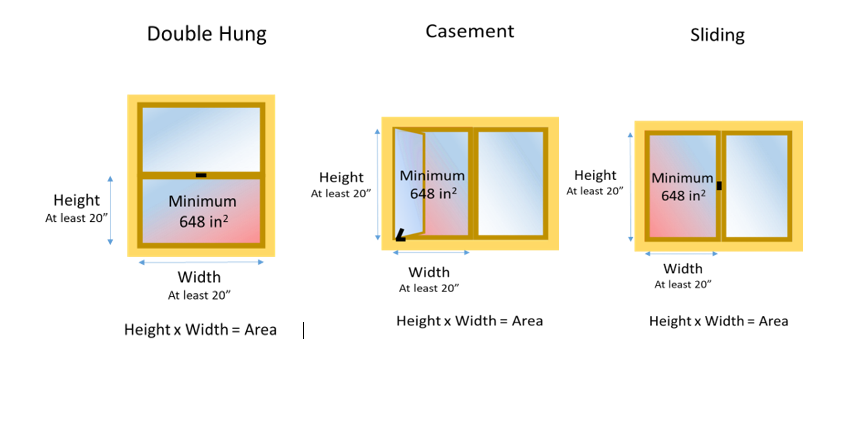 Picture of a double hung, casement and sliding windows all with 648 square inches with at lease 20 inches by 20 inches
Participate in an incident review process and mapping in July or August either as a primary provider participant or a secondary provider participant. Providers can participate in collaborative safety systemic incident reviews and mappings to study issues related to Tuberculosis Prevention and Control and Individual Abuse Prevention Plans. Providers can participate in the following opportunities who may have related compliance issues in Tuberculosis Prevention and Control and Individual Abuse Prevention Plans, as well as those providers who want to share their perspectives and understand the elements influencing the system.
Opportunities to participate include:
-
Mapping - primary provider participant – collaborates with MDH staff to identify the issues we want to learn about through the mapping process, to share and explore with other providers, partners, regulators and agencies.
-
Mapping - secondary provider participant – share their perspectives, experiences, and understanding of the issue.
-
Mapping - available for one or more mapping sessions on a rotating schedule.
-
A Collaborative Safety committee - review future mapping topics, provide input on the Collaborative Safety Program or develop a Collaborative Safety Community of Practice.
Participate in a mapping:
To participate in either a Tuberculous or IAPP mapping, simply click on one of the May or July mappings below or email Catherine.Lloyd@state.mn.us.
July Mapping opportunities
July 25 from 9 a.m. to 12 p.m.: TB or IAPP mapping available.
August Mapping opportunities
Aug. 14 from 1 to 4 p.m.: TB mapping available
August 22 from 1 - 4 p.m. - Primary and Secondary provider available for an IAPP mapping
|