|
View this as a webpage
Minnesota Department of Health
4/25/22
During COVID-19, staff from across the Minnesota Department of Health (MDH) have been reassigned to help with our public health response. Reaching all Minnesotans with important information about COVID-19 and how to prevent the spread has been a top priority. Many staff have been specifically working to provide culturally and linguistically responsive COVID-19 guidance, partnership, and updates to communities most impacted by health inequities across Minnesota, including Communities of Color and American Indians, LGBTQIA, disability, and faith-based communities. The following story highlights the efforts of our staff in collaboration with community partners during the COVID-19 response.
Celebrating Ramadan Safely during C
Summary: Spring of 2021 brought hope with COVID-19 vaccines becoming more available, as well as the anticipation of more in-person activities and celebrations. However, with COVID-19 still looming in the background, many of these gatherings posed a risk of spreading COVID-19 in the community. Ramadan, which starts every ninth month on the lunar calendar, fell during springtime in 2021. Knowing this, the Minnesota Department of Health (MDH) African immigrant community liaison team partnered with community-based organizations and helped provide faith-based guidance and resources for celebrating Ramadan safely.
When public health and culture intersect
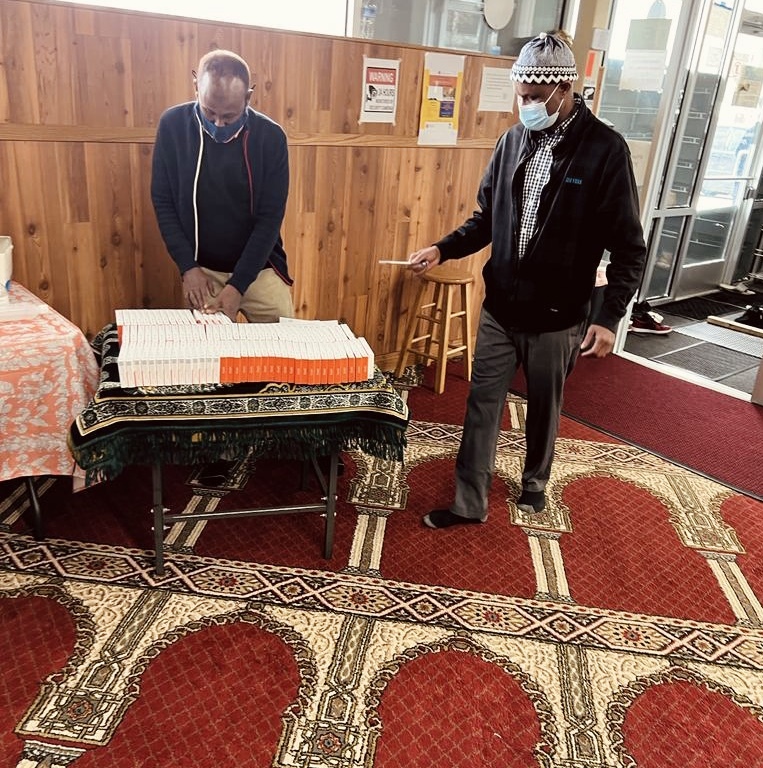
Spring of 2021 brought hope with COVID-19 vaccines becoming more available, as well as the anticipation of more in-person activities and celebrations. However, with COVID-19 still looming in the background, many of these gatherings posed a risk of spreading COVID-19 in the community. Ramadan, which starts every ninth month on the lunar calendar, fell during springtime in 2021. It is a holiday that brings together the Muslim community to celebrate their faith and their community. The holiday involves fasting, which starts at sunrise, ends at sunset, and lasts for the entire month. It is a time when family and friends gather at sundown at mosques, restaurants, and ethnic malls to spend time together and share food or break fast together. Ramadan is a period of time that can invovle spiritual reflection, communal prayer, practicing self-restraint, and charitable giving.
During the pandemic, the Minnesota Department of Health (MDH) African immigrant community liaison team helped provide faith-based guidance and resources for celebrating Ramadan safely. The team partners with community-based organizations who serve Muslim communities, diverse media organizations, and local public health departments through community events and regular check-ins to get frequent feedback on timely issues and questions in the community. There were several main concerns that the African immigrant community liaison team, — in partnership with organizations including African Career Education & Resources (ACER), WellShare International, Islamic Association of North American (IANA), Somali Community Resettlement Services, and African Immigrant Community Services (AICS) — identified that might lead to COVID-19 outbreaks while Minnesotans celebrate the holy month of Ramadan. For example, some community members feared that getting vaccinated would interfere with or invalidate fasting. Another concern was a lack of access to personal protective resources, such as masks, hand sanitizer, and accessible vaccination and testing sites.
Developing culturally relevant resources and outreach strategies
The contracted community-based organizations collaborated with the MDH Cultural, Faith and Disabilities’ communications team to develop resources to address these rising issues and concerns surrounding Ramadan. In 2021, Imam Hassan Jama shared that “IANA worked with MDH to film a video in Somali and English that talked about Ramadan and vaccine and what they’re supposed to do when they’re sick, which a lot of people in the community benefited from.” Sakhaudiin Mohamud, director of COVID-19 response from WellShare International, shared that last year, their teleconference call of 1,000 community members helped answer questions about Ramadan and COVID-19 in the community. In 2021, the MDH African Community Liaison team also supported the Muslim American Society in holding COVID-19 vaccination events throughout the state and helped vaccinate over 5,000 community members.
This year, MDH partnered with IANA, WellShare International, Somali Community Resettlement Services, and International Oromo Health Professional Associations to film another Ramadan video encouraging vaccinations and masking at mosques during prayer. Utilizing the talking points provided by MDH, Aru Sasikumar from ACER mentioned how her organization developed culturally relevant social media graphics with short pieces of information to share throughout the community through the month of Ramadan. Abdirahman Mahamud, a community health worker from WellShare International, emphasized that “the focus of this year’s Ramadan messaging is to encourage the safe gathering of crowds and get the community boosted.”
In addition to health education, ACER, AICS, WellShare International, IANA, and Somali Community Resettlement Services have leveraged their contracts with MDH to support the community in many other ways. Mohamud mentioned that last year and this year WellShare International has provided testing and vaccination events, as well as mental health resources through their COVID Community Coordinator (CCC) contract with MDH. Many of the tests distributed this year have been rapid tests, shared out at mosques, cultural malls, community organization offices, and outreach events and staff work hard to make sure community members know how to use the rapid tests at home. Similarly, AICS, another CCC contractor, has offered testing at their office during the weekdays and malls on Saturdays. Fayrus Duale and Ifrah Abdullahi, program managers from Somali Community Resettlement Services, have helped provide Afghan refugees resettle in Minnesota with testing and vaccination resources in Dari and Pashto, as well as helped the families navigate housing. They will also be providing Iftar meals, or the meals eaten after fasting, for families still in temporary housing this Ramadan.
Staying safe while celebrating
While this year’s Ramadan coincides with lower case counts, hospitalizations, and deaths, COVID-19 is still spreading in the community. Mahamud explained, “Last year was really tough for a lot of people, as they were not [ready] to gather with community, but this year, I am hoping it will change and be easier for the Muslim community to gather and observe Ramadan by taking safety precautions.” As Mahamud mentioned, there are precautions and layered safety measures that community members can take to keep themselves and their loved ones safe while celebrating Ramadan and other religious holidays this spring. These include: get tested if you are sick, have any COVID-19 symptoms, or have come in close contact to anyone with COVID-19; wear a mask in crowded areas, such as at mosques during night prayer; and make sure you are up to date on your vaccinations.
For assistance on finding vaccine and testing clinics, getting rapid test kits and masks, as well as other COVID-19 resources, please call:
IANA Hotline Number 612-254-7757
WellShare International Hotline Number 612-254-7308
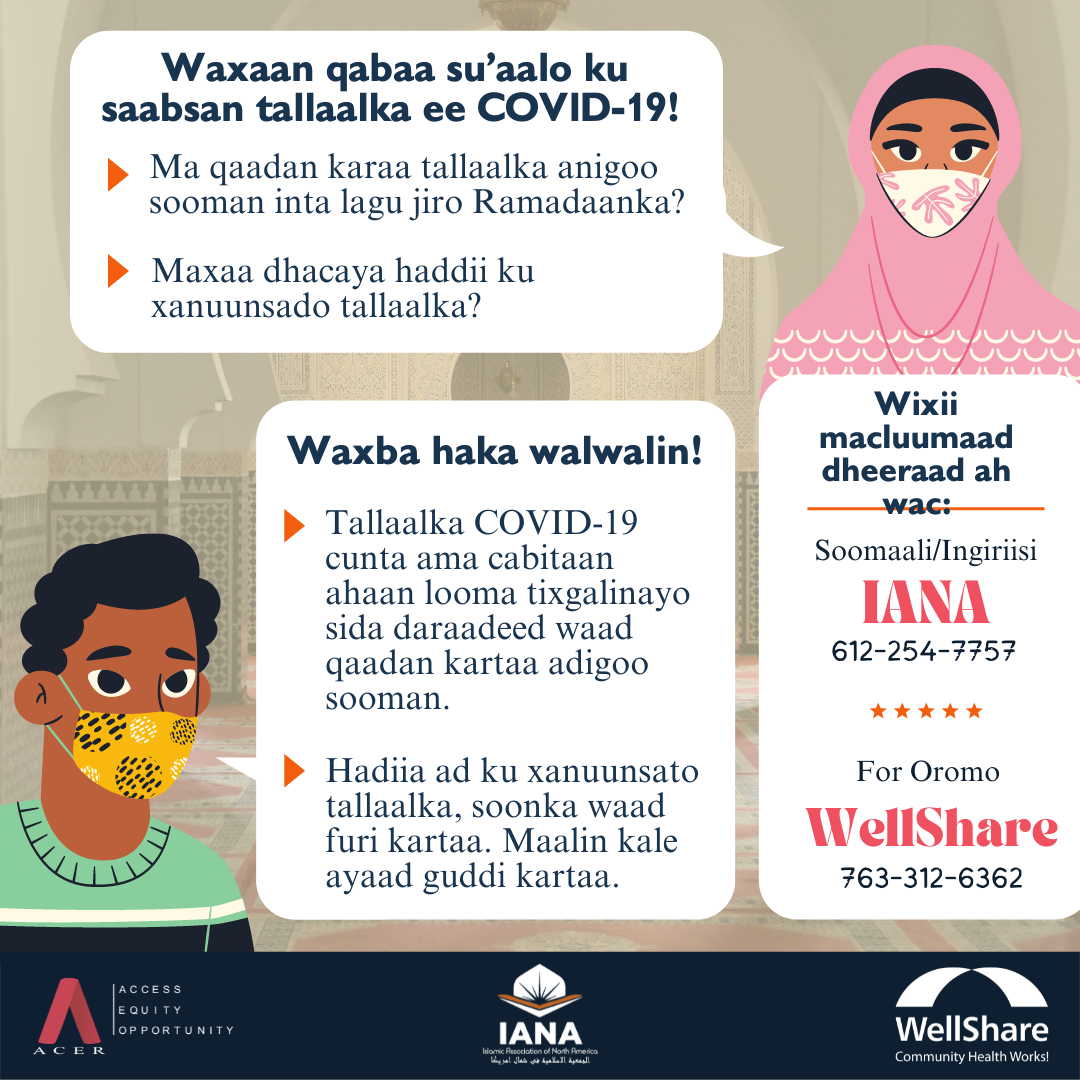 Culturally relevant social media graphic developed by community based organizations
|