|
View this as a webpage
Minnesota Department of Health
March 5, 2021
The Cultural, Faith, and Disability Communities COVID-19 Update is being sent to the following three MDH mailing lists to reduce duplication:
- Cultural, Faith, and Disability Communities COVID-19 Updates
- MN Immigrant and Refugee Health Announcements
- The Center for Health Equity
Today's COVID-19 updates include:
Updated March 5, 2021
- Total positive: 488,170
- Patients who no longer need to be isolated:
- Total approximate number of completed tests: 7,502,722
- Deaths: 6,534
o Deaths among cases that resided in long-term care or assisted living facilities: 4,076
- Total cases requiring hospitalization: 25,938
o Total hospitalized in ICU: 5,352
Numbers are cumulative since Jan. 20, 2020.
The number of lab-confirmed positive tests among Minnesota residents will be updated daily on Situation Update for Coronavirus Disease 2019 (COVID-19) with test results from the previous day. The page also includes a map of counties with confirmed cases, and more.
This total reflects only the results from laboratory testing. There are more cases in Minnesota, and the virus is circulating in communities. It is important for everyone to follow advice on community mitigation and social distancing to help us flatten the case curve.
Governor has launched a public dashboard which includes race data of cases: Minnesota COVID-19 Public Dashboard.
Community and Faith-Based Organizations: COVID-19 Vaccine Communication Toolkit
Winter PSA - Chinese
Minnesota Guidance for Allocating and Prioritizing COVID-19 Vaccine – Phase 1a
Childhood Vaccinations during the COVID-19 Pandemic PSA: Somali (YouTube)
Please see the excerpts below from a press release sent by the Governor’s office this morning.
Walz, Flanagan Announce Groundbreaking Partnership Between State of Minnesota, Health Care Systems on Race and Ethnicity Data Collection
State announces additional, targeted strategies to promote equity in vaccination.
The Walz-Flanagan Administration announced publication of vaccination data by race and ethnicity made possible through the groundbreaking partnership between the State of Minnesota and the Minnesota Electronic Health Record (EHR) Consortium. This unique and innovative collaboration between public health and health systems is the first statewide effort of its kind in the United States.
The data – published on the state’s COVID-19 Vaccine Data Dashboard – will inform additional, targeted strategies to ensure the equitable distribution of vaccine to Minnesotans of all races and ethnicities, including communities disproportionately impacted by COVID-19 as a result of systemic inequities.
The administration has issued updated allocation and prioritization guidance to providers across the state to inform best practices for vaccinators. The guidance provides recommendations for sub-prioritization factors and addresses systemic inequities and the disproportionate impact of COVID-19:
- MDH recommends that vaccinators prioritize people 65 years of age and older who are dual eligible for Medicare/Medicaid and younger people who participate in Minnesota Health Care Programs as they become eligible in later phases.
- Some communities have suffered disproportionately from COVID-19, including communities of color, older adults, people with disabilities, and people with comorbidities. The presence of multiple risk-factors should be considered if sub-prioritizing within groups.
Additional Resources
Please see the excerpts below from a press release sent by the Governor’s office
Governor Walz Announces COVID-19 Community Vaccination Site at Roy Wilkins Auditorium
Large-scale, permanent Saint Paul site joins Minneapolis, Duluth, Rochester and Bloomington in the state’s COVID-19 Community Vaccination Program
As part of the State of Minnesota’s COVID-19 Community Vaccination Program, Governor Tim Walz announced a new community vaccination site to launch this week at Roy Wilkins Auditorium in Saint Paul. The large-scale, permanent site will be the fifth of its kind, joining sites in Minneapolis, Duluth, Rochester and Bloomington. Roy Wilkins Auditorium will serve approximately 5,850 individuals, including both adults 65 years of age or older and pre-kindergarten through grade 12 educators, school staff, and child care workers in its first week through administration of the Pfizer vaccine.
Click here to view the full press release.
Black Coalition and the Kaiser Family Foundation Release New Campaigns About the COVID-19 Vaccine
A new campaign which is now live on Between Us About Us Website and Hello Black America! with W. Kamau Bell & Black Health Care Workers. There are more than 50 videos to start, and they will continue to add information as needs change. This information was provided by Kaiser Family Foundation, (KFF).
Black doctors, nurses and researchers dispel misinformation and provide accessible facts about the COVID-19 vaccines in a new campaign that launches today from Greater Than COVID and the Black Coalition Against COVID.
The Conversation: Between Us, About Us kicks off with an open and honest conversation between W. Kamau Bell and Black health care workers that gets to the heart of Black people’s questions about the vaccines.
COVID-19 Vaccine Toolkit from the American Lung Association
The American Lung Association is pleased to share the Better For It Vaccine Toolkit. The Lung Association partnered with The Center for Black Health and Equity and the National Alliance for Hispanic Health to develop materials that will help to reduce the morbidity and mortality of disease by offering trusted resources on the benefits and importance of immunizations, particularly in communities disproportionately affected COVID-19.
The Toolkit is an opportunity for individuals and communities to:
- Fact check and supplement their own research on vaccines, especially the COVID-19 vaccine;
- Encourage a dialogue among friends, healthcare provider, pastor and family members;
- Share accurate information on social media;
- Learn and understand the contributions of African American scientists and public health advocates who are helping to bring this pandemic to an end.
Visit the Better for it - COVID-19 Vaccine Toolkit to download the toolkit.
Open Path Resources and MHealth Fairview developed Video Resources for the COVID-19 Vaccine
Two videos feature Imam Sharif Mohamed getting his COVID-19 shot and ensuing discussion with Somali MD, Dr. Hassan.
The long video is 30 min and the short video is two and a half minutes long.
Short video: Imam Sharif Mohamed answers questions about the COVID-19 vaccine
Long video: Imam Sharif Mohammed answers questions about the COVID-19 vaccine
COVID-19 Vaccine Graphics: Why Get It, and What Happens Next?
The Public Health Communications Collaborative has two new one-pagers addressing vaccine concerns and questions people have after getting a COVID-19 vaccine, with mini graphics and sample social media copy for sharing across platforms (Spanish versions will be available soon)
Making the Decision to get a COVID-19 Vaccine
I got the COVID-19 Vaccine. Now what?
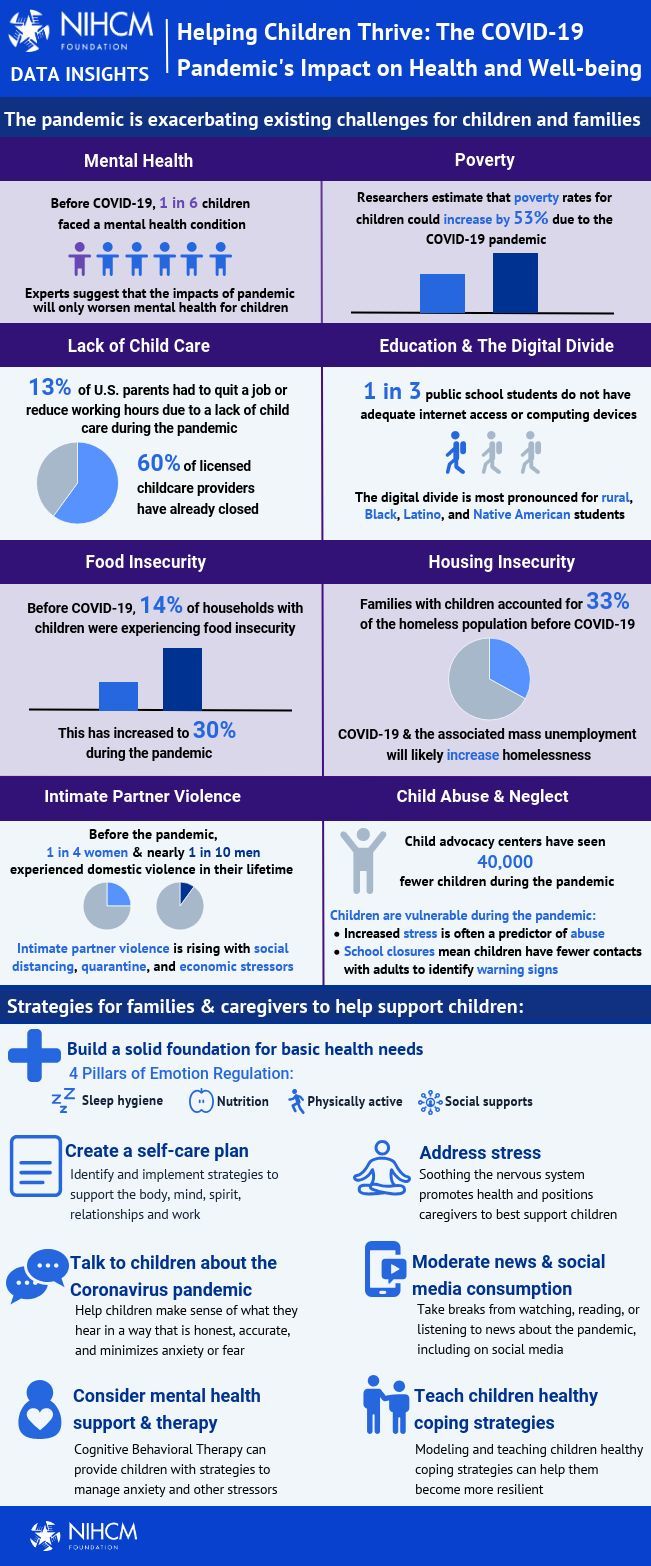
The National Institute for Health Care Management Infographic
There is a new infographic from the National Institute for Heath Care Management Foundation Helping Children Thrive: The COVID-19 Pandemic's Impact on Health and Well-being.
This infographic explores the challenges facing children and families and provides actionable guidance to nurture resilience and support caregivers and parents.
The Minneapolis Foundation Announces Micro Grants to Address Community Trauma and Promote Wellness
The Minneapolis Foundation has announced a new funding opportunity for local organizations that are working to address community trauma and promote wellness as Minneapolis approaches the anniversary of George Floyd’s death and the trial of a former Minneapolis police officer charged in his killing.
Starting March 15, the Foundation will begin accepting applications for micro grants of $2,500 to $5,000 from its Fund for Safe Communities. Applications will be reviewed on a rolling basis this spring, with decisions communicated to applicants within roughly two weeks.
Funds for Safe Communities webpage
|