Noncontinuous cooking defined
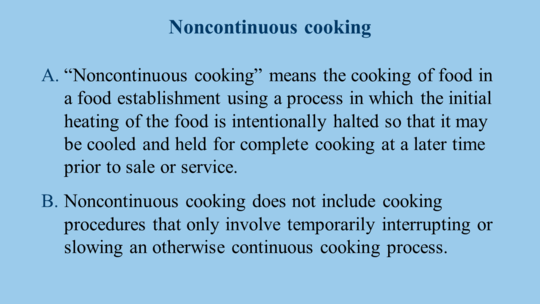
In order to keep pace with common food service industry practices, Minnesota food code effective Jan. 1 now defines “noncontinuous cooking.” Minnesota Rules, part 4626.0020, subpart 52d not only tells us what noncontinuous cooking is, it also tells us what noncontinuous cooking is not.
Minnesota Rules, part 4626.0020, subpart 52d
Rule includes time/temperature requirements
Minnesota food code includes specific requirements for noncontinuous cooking processes. Retail food establishments can safely heat, cool, store and then completely cook food. To use this process, you will need to write procedures and get them approved. Trained food employees can then follow your procedure during the noncontinuous cooking process.
Control growth of bacteria
Following an approved noncontinuous cooking process helps control growth of disease-causing bacteria.
The temperature range in which disease-causing bacteria grow best in time/temperature control for safety (TCS) food is called the temperature danger zone.
- The temperature danger zone is between 41°F and 135°F.
- TCS food must pass through the temperature danger zone as quickly as possible when being cooked and cooled.
- Always use a thermometer to check food temperatures.
The final cook temperature and time is critically important to ensure control of disease-causing bacteria that may survive and multiply during the initial heating and cooling steps.
Common uses of noncontinuous cooking
Noncontinuous cooking is sometimes used for:
- Mass production of chicken breasts or steaks for banquets.
- Grill-marking chicken wings for large scale catering operations.
- Partially cooked hamburger patties held for final preparation and service during peak periods.
If you have a food flow similar to one of these examples, work with your inspector to ensure you are doing it safely and that it meets requirements.
Five steps to safe noncontinuous cooking
You will need to work with your inspector to get your procedures approved. Your procedure must include these basic steps for safe noncontinuous cooking of raw animal food:
- Heat raw animal food for 60 minutes or less.
-
Cool food properly.
- Store food cold (below 41°F) or frozen.
-
Cook food completely.
- Serve immediately, hot hold, properly cool, or use time as public health control.
When noncontinuous cooking is not allowed
Animal food cooked using a noncontinuous process may not be served undercooked or in a raw state, even upon consumer request or with an adequate consumer advisory.
Learn more about noncontinuous cooking
Potentially Hazardous Food is now Time/Temperature Control for Safety Food (TCS)
The revision redefines “potentially hazardous food” (PHF) as “time/temperature control for safety” food (TCS). TCS means a food that requires time/temperature control to limit bacterial growth or toxin formation.
How to reduce risk factors is in the name
Time and temperature are the two most common control methods for preventing pathogen growth in these types of food. By including the risk control methods as part of the name of the category of food, the way to reduce the risk is clear and the decision-making process is improved.
Know your TCS menu items
Most formerly PHF foods are now TCS foods. TCS foods include:
- Raw or heat treated animal food
- Heat treated plant food
- Raw sprouts
- Cut melon
- Cut leafy greens
- Cut tomatoes
- Garlic in oil mixtures
- Foods that need a product assessment or have been determined to be TCS food by a product assessment
The change provides a method of determining if food is non-TCS food based on the food’s acidity (pH) and water activity (aw) or if a product assessment is needed. If a product assessment is required, then you should handle and store your food product as if it is TCS food.
Work with your inspector if you have any questions regarding what foods are TCS food and non-TCS food.
TCS food does not include
- Air cooled hard boiled or pasteurized shell eggs
- Commercially processed food in an unopened, sealed container
- Food with a pH and aw combination that make it a non-TCS food
- Food that has had a product assessment (PA) and the food inhibits the growth of pathogenic microorganisms or toxin
- Certain other foods as provided in the Food Code definition
Learn more about TCS food
If you want to learn more about how to meet the requirements, you can:
|