Minnesota Students Show Resilience as Test Scores Hold Steady in Challenging Year
MINNEAPOLIS — Today, the Minnesota Department of Education (MDE) released 2026 statewide assessment and accountability results, which include the first data set from an updated reading test based on new rigorous standards. In a year marked by profound disruption and federal uncertainty, students demonstrated resilience in their performance on the Minnesota Comprehensive Assessments (MCA) as test scores remained stable across grade levels and subjects.
“We’re asking more of our students and teachers,” said Commissioner Willie Jett. “In this data, we see the hard work Minnesota educators are doing to create safe and supportive learning environments and implement new, rigorous standards. We see where students are on their journey toward meeting those standards. And we see the potential for growth. The baseline students have set is encouraging, and Minnesota Department of Education is here to continue supporting educators and students.”
Measuring Student Success
The MCAs are single-administration standardized tests that provide limited instructional value and are part of a federally required accountability system of assessments. Testing data is one of many tools educators and families can use to measure student success and should be evaluated alongside other measures of engagement, wellbeing, and achievement. For example:
- Minnesota students in the class of 2025 had an average composite ACT score of 20.6, more than a full point higher than the national average
- The class of 2025 graduated at the highest rate in state history
- Minnesota students continue to lead in consistent attendance, with at least 76.5% of students attending more than 90% of the time
- Of those who took the 2025 Minnesota Student Survey, a combined 90% of students reported caring about doing well in school "all of the time” or “most of the time”
On the heels of a national conversation about the efficacy of standardized tests, and based on feedback from educators, school leaders, students, parents, and public officials across the political spectrum, MDE is convening a 28-member Testing and Assessment Task Force charged with reviewing Minnesota’s testing and assessment framework and identifying recommendations for future modernization.
Snapshot in Time
MCA results are a one-time look at student learning on Minnesota Academic Standards, reflecting what a student demonstrated knowing and understanding on the day of the test. In 2026, MCAs were administered from March 2 to early May, following an instruction period marked by profound disruption in schools across the state during Operation Metro Surge.
Recent data compiled by the Minnesota Truth Council begins to illuminate Operation Metro Surge’s impact on children in our state, with three-out-of-four schools reporting increased absences. Statewide, about 440,000 fewer school meals were served, and 80% of public-school leaders indicated Operation Metro Surge negatively impacted students’ ability to learn.
Despite being administered immediately following this period of learning loss, increased fear and anxiety, and other harms to child wellbeing, student performance on the 2026 MCAs remained stable — a testament to the long-term resiliency and success of Minnesota educators, students, and school communities.
Building Lifelong Literacy
Governor Tim Walz signed the bipartisan Minnesota Reading to Ensure Academic Development (READ) Act in 2023, a multi-year, comprehensive reform process that transforms the way Minnesota educators teach literacy. The impacts of rigorous, evidence-based literacy education and screening initiatives are expected to begin demonstrating meaningful assessment trend data as early as 2027-2030, as students progress through grades led by fully trained teachers.
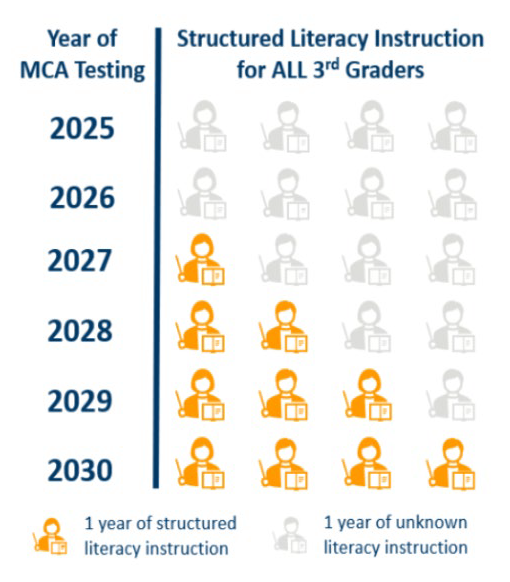
Approximately 35,000, or 78%, of required educators completed Science of Reading training in the first three years, with the remainder expected to complete training by July 2027. Early literacy screening data is already showing encouraging results with outcomes among kindergarteners and first graders showing students’ strength in phonemic awareness. Over 70% of kindergarteners ended the 2025-26 school year at or above benchmark. Growth in phonemic awareness among first graders shows 86% ending the year at or above benchmark.
In 2026, students took an updated Reading MCA-IV or Alternate MCA-IV for the first time, setting a new baseline for measuring future reading proficiency. This is an updated assessment aligned to new, rigorous standards, and results from 2026 cannot be compared to versions previously administered.
The updated Reading MCA-IV assesses students on new English Language Arts standards that were first implemented in classrooms across the state in the 2025-26 school year. These more rigorous standards place greater emphasis on comprehension, analysis, and higher-order thinking as Minnesota continues to focus on getting every student reading at grade level every year beginning in kindergarten. The accompanying updated Reading MCA-IV is comparatively rigorous, measuring student reading proficiency levels by assessing media literacy skills and integral competencies of reading, such as drawing conclusions, summarizing, analyzing, and making inferences.
While results from updated assessments cannot be compared to previous versions, it is common for updated assessments to reflect a ‘drop’ in proficiency due to limited instruction time of the new standards. Stable Reading MCA-IV proficiency — assessing new, complex skills for the first time amidst a challenging year — suggests Minnesota students and educators are rising to the occasion and are a foundation from which to measure continued growth.
Accessing Data
Students also took the MCA III in mathematics and the MCA-IV in science. This was the second year for the Science MCA-IV, which is based on rigorous science standards first implemented in the 2024-25 school year. Updated math standards will be implemented in the 2027-28 school year.
In addition to releasing assessment data, MDE today also released 2024-25 consistent attendance and course-based indicators data.
Data is available to view statewide and by school in the Minnesota Report Card. Learn more about statewide testing and assessment results on the MDE Data Center.
###
|