|
Semiannual update from Academic Standards, Instruction and Assessment
Vol. 4, No. 1: Oct. 13, 2025
Consider, but don’t compare

By Jennifer Dugan
Director of Academic Standards, Instruction and Assessment
As we settle into the new school year and embrace the fall, I hope this newsletter finds you all doing well. New academic years always bring new challenges, and on behalf of our division, I hope you all are facing those challenges with positive energy and optimism.
There is a lot of attention on assessments right now. Science MCA-IV and Alt MCA results were released earlier this month, and districts are preparing to implement the Literacy Screening Tools across all grades, the Minnesota Kindergarten Fall Assessment (MnKFA), and the 2026 Reading MCA-IV and Alt MCA. I feel it is important to again note that these are completely different assessments, where resulting scores are not comparable to MCA scores.
The temptation to draw conclusions across years and across assessments is strong—in the media, and among parents, staff and other educational partners. However, the data from different assessments cannot be used in ways that may be tempting. For example, a parent’s conclusion that “my student passed the kindergarten screener; therefore they will do well on the MCAs” cannot be drawn based on those different assessments.
In other words: consider, but don’t compare.
For the Science MCA-IV and Alt MCA, aligned to 2019 Minnesota Academic Standards in Science, consider the similarities and differences when thinking about past results releases, but don’t compare the results. They are different assessments aligned to a new and different set of academic standards.
Statewide assessments, specifically the MCAs and MTAS/Alt MCAs, are standards-based assessments—meaning they measure performance against a set of instructional goals (the Minnesota Academic Standards), and are summative—meaning they provide data about student performance when instruction is wrapping up.
Statewide assessment results are designed to be used as a “systems check” at a student group, school, district, and/or state level while providing a measure of an individual student’s learning of grade-level standards. They provide a single data point that should be considered in the context of each district’s balanced and comprehensive assessment system.
Where data from statewide assessments results provide a useful starting point, the most robust evaluations of district and school performance, and the most useful findings for maintaining and improving that performance, occur when this information is paired with information from district, local, and classroom assessments.
Another example: The 2026 Reading MCA-IV and Alt MCA will assess a student’s reading comprehension skills such as interpreting and evaluating arguments based on the Minnesota Academic Standards in English Language Arts (ELA). When results are released next fall, consider the similarities and differences to past results releases, but don’t compare because these are new assessments aligned to a different set of academic standards than the Reading MCA-III and MTAS.
Literacy Screening Tools measure foundational reading skills as well as characteristics of dyslexia. They screen for student knowledge of oral language, phonological and phonemic awareness, phonics, and morphology. In other words, they assess students’ foundational literacy skills to read accurately and fluently. They are not based on the Minnesota Academic Standards in ELA. Consider results from literacy screeners; however, do not compare them to the standards-based assessments. The screeners’ results are not designed to predict student performance on the Reading MCA-IV.
As always, I encourage everyone to lean into and utilize the tools our division provides to help make sense of all this data.
As English language arts (ELA) standards implementation takes place across all grade levels this year, reference the Performance Level Descriptors page on the MDE website (Districts, Schools and Educators > Statewide Testing > Performance Level Descriptors). Performance Level Descriptors (PLDs) communicate the skills and knowledge described in the academic standards that characterize student knowledge and skills at each performance level.
PLDs are available for all grades for Science MCA and Alt MCA. As of this fall, draft PLDs for Reading MCA-IV and Alt MCA are also available.
These PLDs can be used to promote learning for all students across the state by clarifying expected learning outcomes for instruction and local assessment of Minnesota Academic Standards and can support teachers’ analysis of the alignment and depth of their curriculum, instruction, and classroom assessments.
|
Back to Top
One of the responsibilities within the Division of Academic Standards, Instruction and Assessment is developing academic standards for K-12, in accordance with Minnesota Statutes 2025, section 120B.021. To support the process and implementation, we facilitate group discussions, provide proposed timelines, and develop measures to identify additional support resources and professional development that support districts and schools over the course of many years.
As we look at the Academic Standards implementation schedule and legislative expectations over the next four years, the Division of Academic Standards, Instruction and Assessment recognizes the need to provide comprehensive professional development and technical guidance for successful implementation. Please see the Academic Standards (K-12) webpage for more information on professional development opportunities. Additionally, specific content areas and curriculum leader meetings information and links for the 2025-26 school year are available in the Academic Standards and Assessment Information Packet. These professional development opportunities will support districts, schools and charters with information needed to implement the following changes in the current and upcoming school years:
2025-26
- English Language Arts Standards full implementation
- Reading MCA-IV and Alternate MCA administered for the first time
- Personal Finance graduation requirement for districts offering it in 10th grade
- Science, year 2 of full implementation
- Arts, year 3 of full implementation
- Physical Education, year 3 of full implementation
2026-27
- Social Studies Standards full implementation
- Personal Finance graduation requirement for districts offering it in grade 11
- Ethnic Studies course offering required in grades 9-12
- Cannabis Education program required for middle and high school students
2027-28
- Math Standards full implementation
- Math MCA-IV and Alternate MCA administered for the first time
- Personal Finance graduation requirement for districts offering it in grade 12
- Civics in grade 11 or 12 (first possible year)
- Ethnic Studies instruction required in grades K-8 (fulfilled by Social Studies Standards implementation)
2028-29
- Health Standards tentative full implementation
Back to Top
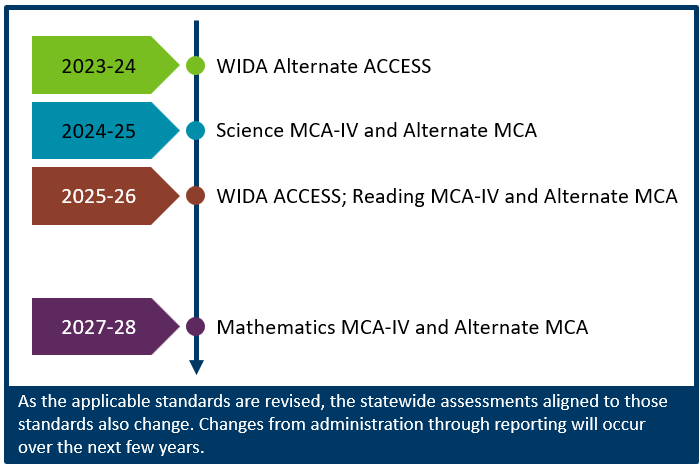
As academic standards are revised, the assessments that are aligned to the standards must also change. The Minnesota statewide assessment program will continue to undergo changes over the next few years, as outlined by the graphic below. In 2025-26, there will be two changes: WIDA ACCESS and Reading MCA/Alternate MCA (Alt MCA).
WIDA ACCESS Changes
The revised WIDA ACCESS (formerly ACCESS for ELLs) and WIDA ACCESS for Kindergarten (formerly Kindergarten ACCESS for ELLs) are English language proficiency accountability assessment aligned to the WIDA English Language Development Standards Framework, 2020 Edition. Both assess English language development in four language domains: Listening, Reading, Speaking, and Writing. WIDA ACCESS for Kindergarten remains paper-based and has been redesigned with fewer materials, a single storyline, new task types, and revised scoring rubrics. WIDA ACCESS for grades 1-12 continues to be administered primarily online, with updated Speaking and Writing rubrics introduced for 2025-26 while the testing experience stays the same. Learn more on the WIDA ACCESS in 2025-2026 page of the WIDA website.
Reading Assessment Changes
This will be the first year of a new Reading MCA-IV series of assessments aligned to revised academic standards, as well as the new Reading Alternate MCA (Alt MCA) that is replacing the MTAS. The new reading assessments will be aligned to the Reading strand of the 2020 Minnesota Academic Standards in English Language Arts.
This transition to new assessments began with science, and many of the same assessment administration changes will continue with reading, including:
- New accommodations for Reading MCA, such as assistive technology online forms, changes to the format of the large print test materials and read-aloud accommodations for eligible students. Annually, MDE updates the Guidance for Universal Supports and Accommodations for Minnesota Statewide Assessments, which is a resource developed specifically for district and school staff, that provides details on all of these accommodation changes. The Guidance document is posted on the District Resources page under the Universal Supports and Accommodations Resources expandable header, along with a stand-alone version of the infographic summarizing the available universal supports and accommodations for the MCAs. Please ensure staff are aware of and have access to these resources for both decision-making and test administration guidance.
- New administration options for the Reading Alt MCA, which can be administered in online, paper, or hybrid (any combination of online and paper) modes to meet student needs. There will also be new test materials available to support Reading Alt MCA administrations and changes in administration policies consistent with science, including an early stopping rule.
Several tools and resources are available to support understanding of the new series of assessments. Student Readiness Tools (SRTs) for the 2025-26 school year are available for the MCAs/Alt MCAs on the Student Readiness Tools (SRTs) page of the Minnesota Assessment Hub website to help students prepare for the online or paper MCA/Alt MCA they will be taking.
In addition to using the SRTs, the best way to prepare students for the content of the MCA is to provide instruction that addresses the K-12 academic standards and benchmarks. The released or sample questions in the Minnesota Questions Tool (MQT) are intended to support educators in understanding how the academic standards are assessed on the MCA and Alt MCA, to help identify student misconceptions, and to provide examples of questions that assess student understanding at different Depth of Knowledge (DOK) levels. In the MQT, all Reading MCA and Alt MCA items are aligned to the 2020 Minnesota Academic Standards in English Language Arts. For Science and Mathematics MCA, the released items are aligned to the current Minnesota Academic Standards being assessed (2019 for science, 2007 for mathematics).
A third resource available on the Statewide Assessments page of the MDE website are draft Reading MCA and Alt MCA Performance Level Descriptors (PLDs). The Performance Level Descriptors (PLDs), previously named Achievement Level Descriptors (ALDs), describe learning of the grade-level expectations set by benchmarks or extended benchmarks in the Minnesota Academic Standards. The PLDs are used to describe what it means to be proficient on the Reading MCA/Alt MCA following the first administration in spring 2026.
Standard Setting
After the first operational administration for each assessment, a Standard Setting committee is convened to define levels of performance on the new assessment and determine what it means to be proficient on the WIDA English Language Development Standards (for WIDA ACCESS) or the Reading strand of the Minnesota Academic Standards in English Language Arts (for Reading MCA/Alt MCA). Different standard setting processes will be used for WIDA ACCESS and Reading MCA/Alt MCA and reporting timelines and processes will vary.
WIDA will conduct standard setting in summer 2026 to establish updated proficiency level cut scores that reflect the revised assessments. However, districts will continue to receive early student-level results to make program exiting and instructional decisions in similar timeframes as past years. Any changes following standard setting will be communicated, but will not affect exit decisions for the 2026-27 school year.
In contrast, Reading MCA and Alt MCA will go through the standard setting process before any student results are released. Standard setting will take place in June 2026, and Minnesota educators will work together to recommend the cut scores of the four performance levels: Beginning, Intermediate, Meets, and Advanced. Once standard setting is complete, student results are then prepared for reporting to districts and the public, which is a later timeline than reading results are typically released. As you plan ahead for data usage in summer and fall 2026, keep in mind that reading results will be delayed and not be available in the summer for activities such as professional development or grant applications.
Watch the Overview of the Standard Setting Process for MCA and Alternate MCA video for more information about this process. Encourage your English Language Arts, special education teachers and multilingual learner educators to apply to be part of the Standard Setting process in June 2026 for Reading MCA and Alternate MCA to determine what it means to be proficient on these assessments. Submit your application to participate by Jan. 16.
Back to Top
The Minnesota Academic Standards in Science were revised in 2019 and fully implemented in Minnesota school districts and charter schools during the 2024-25 school year along with the first assessment of these standards, the Science MCA-IV and Science Alternate MCA (Alt MCA) this past spring. These assessments, just like the standards, are substantially different than the previous iterations of standards and assessments (MCA-III and MTAS). Results cannot be compared between the Science MCA-III/MTAS and the Science MCA-IV/Alt MCA.
The 2019 Minnesota Academic Standards in Science focus on three dimensions of science learning: practices, core ideas, and crosscutting concepts. Together, these dimensions describe how students explore and explain the structures, designs, and systems of both the natural and human-made world. To fully implement the standards, students need to engage in practices such as making observations, developing and revising models, and analyzing and interpreting data to answer scientific questions and design solutions to problems.
Fully implementing new standards and assessments takes time, and it may be a few years before we start to see the real benefits as educators and students become accustomed to the shifts in instruction and assessment. It is also important to keep in mind that the standards transition plan a district chose could potentially affect student results during the first few years of the administration of the new assessment.
District leadership teams, including curriculum leaders and District Assessment Coordinators (DACs), should develop a plan for communicating Science MCA-IV and Alt MCA results to the school board, school administrators, staff, families, and the public. Results from spring 2025 were released to districts in September. On Oct. 1, final assessment results were then made available to the public on the Minnesota Report Card and the Data Reports and Analytics pages of the MDE website, and Individual Student Reports (ISRs) were provided to districts and schools for distribution to families.
Two resources are available to support districts with the release of the new science results and continued academic standards implementation. The Guidance for Science MCA-IV and Alternate MCA Results Release document on the District Resources page under Test Score Interpretation Resources and the Science MCA and Alt MCA Performance Level Descriptors describing phenomenon-based learning of the grade-level expectations set by multidimensional benchmarks in the 2019 Academic Standards in Science.
Back to Top
Minnesota is in the process of developing statewide K-12 Academic Standards in Health, with final adoption anticipated in 2026. These standards will shape health education for all students across the state and are being developed through multiple phases of public feedback and review. One final opportunity for public input will occur before the standards are finalized. To stay informed, visit the Health Education page and sign up for the Health Standards Public Comment mailing list.
In addition, under Minnesota Statutes 2025, section 120B.215, schools are required to implement comprehensive, science-based cannabis and substance use education for middle and high school students by the 2026-27 school year. To support districts and charter schools in meeting this requirement, MDE, along with partner agencies and education experts, has developed a List of Cannabis Model Programs. While use of the list is optional, it provides evidence-based options and a rubric to guide local decision-making in preparation for implementing the new requirement next school year.
Back to Top
Please review the following information provided by the MDE Early Education division. Questions about the Minnesota Kindergarten Fall Assessment (MnKFA) timeline can be addressed to KFA.MDE@state.mn.us.
The MnKFA legislation was enacted in 2023 to provide a statewide snapshot of what children know and can do at the start of kindergarten. In 2025 the Legislature moved the date for implementation back by one year. The timeline below reflects that change.
The data the MnKFA will produce should be used to: (1) Promote equitable early educational opportunities; (2) improve alignment between the early care and education system and kindergarten; (3) guide conversations that strengthen the kindergarten transition and success in school (4) encourage developmentally appropriate, play-based classroom instruction and learning; (5) contribute to holistic student data collection and analysis to guide individualization. Guided by the Successful Learner Equation, MnKFA data won’t be used to determine whether a child was ready for kindergarten or a family should have delayed their child's enrollment in kindergarten.
MnKFA Timeline
Completed
- Obtained input to inform the design of the MnKFA (posted on the MnKFA website)
- Timeline established for MnKFA implementation
- MDE posted a call for proposals for a vendor that can provide a developmentally appropriate assessment, platform for the assessment, and training/professional development
Upcoming
School Year 2025-26
- Establish regular communications about the MnKFA using the MnKFA website and existing MDE newsletters and meetings
- Select the vendor for the MnKFA assessment
- Work with the selected vendor to develop or adapt an assessment tool and accompanying resources to meet the unique needs of the MnKFA assessment
- Call for and select pilot participants and prepare initial trainings
School Year 2026-27
- Provide pilot training and implement MnKFA Pilot, collect feedback, and make necessary adaptations
- Districts and Charter Schools submit the Local MnKFA Plan
- Finalize MnKFA professional development portfolio
- Districts and Charter Schools begin to complete required MnKFA trainings
School Year 2027-28
- Statewide administration of the MnKFA assessment
- Collect and analyze statewide and local data collected through the MnKFA platform
- Publish first annual report
Back to Top
Academic Standards, Instruction and Assessment
Minnesota Department of Education
Sign up to receive the Academic Standards, Instruction and Assessment Newsletter
Manage Preferences | Unsubscribe | Help | MDE Website
|




