|
July 2025
Ideas and Suggestions for Restorative Practitioners
July is Disability Pride Month. We honor the passage of the Americans with Disabilities Act (ADA) in 1990 while uplifting disabled voices, culture, and resistance. Rooted in the historical legacy of National Disability Independence Day, this month challenges the ableist norms that too often marginalize disabled people in education, employment, healthcare, and public life.
Drawing from Kevin Kumashiro’s call for anti-oppressive education, Disability Pride Month must also be a time when schools and institutions examine how they perpetuate ableism—by privileging “normalcy,” minimizing discomfort, and resisting structural change. Kumashiro reminds us that justice work demands troubling our own complicity and creating space for discomfort as a site of learning, especially when confronting systems that pathologize disability rather than understand it as part of human diversity.
Similarly, bell hooks’ “engaged pedagogy” asks educators to teach toward the practice of freedom—not by depositing knowledge, but by nurturing the wholeness of students and teachers alike. Disability Pride Month echoes that imperative: to center the lived experiences of disabled people, not as inspiration, but as leaders in reimagining education, access, and collective liberation.
Honoring Disability Pride means rejecting performative inclusion and instead committing to the difficult, joyful, and ongoing labor of transforming systems. Pride is not tolerance—it is resistance, culture, identity, and an unapologetic affirmation that disability is not a deficit, but a vital dimension of human being.
As we close out the first half of the year, we begin a new half to 2025. With new beginnings, or halves in this case, we also close out the Restorative Practices News Notes and begin something new. Our Nonexclusionary Discipline Specialist colleagues are working alongside of us to continue creating communities of belonging. It only makes sense to collaborate and offer one newsletter as we work together. Beginning next month in August, you will receive a joint newsletter from the Safe and Supportive Schools Team: Nonexclusionary Discipline and Restorative Practices. The newsletter may look different, but the work remains the same. To new beginnings!
Deepen Your Practice
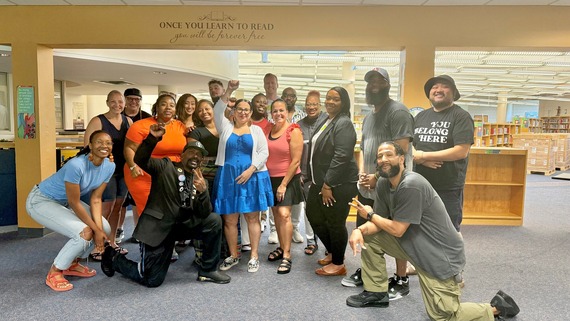 Some of the restorative practices trainers gathered for circle at Roseville Area Middle School.
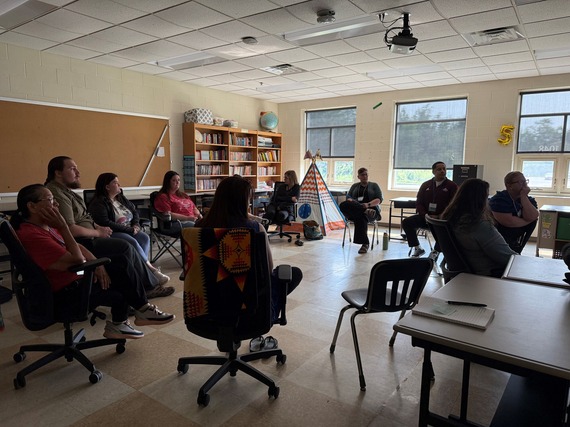 Educators learning in circle in Cloquet, MN
Restorative Practices Training in June Across Minnesota
Last month, restorative practices training happened in Bemidji, Cloquet, La Crescent and Roseville. Around 300 participants from Minnesota, Wisconsin, Ohio and Colorado engaged in restorative principles and practices with one another in circle. We look forward to the next restorative practices training.
Restorative Practices in Minnesota Schools
Many schools across the state of Minnesota are implementing restorative practices as ways to build community, repair relationships, and meet the needs of all people. Students and educators share their stories of what restorative practices are and how it has impacted them. Many thanks to Cloquet Area Alternative Education Program, John Marshall High School in Rochester Public Schools, Lionsgate Academy, Oak Ridge Elementary in Rosemount-Apple Valley-Eagan School District, and Osseo Area Public Schools for sharing your stories. View the video of Restorative Practices in Minnesota Schools.
Restorative Practices Trainers Directory 2024-25
Minnesota is home to several restorative practices trainers and community members. If you are looking to work with a restorative practices trainer, the Restorative Practices Trainers Directory 2024-25 provides their name, email, photo, and a short bio. This is a directory with trainers that MDE has worked with this past school year. More restorative practices trainers can be found at Living Justice Press, Circle/Restorative Justice Practitioners Listings. Additional resources can be found on the Restorative Practices Resources website.
Retrieve Your Learnings
A core component of restorative practices is learning and practicing empathy. In this episode of "School's In" you will be able to find a deeper understanding of how to both teach and learn how to practice empathy from the Stanford School Graduate School of Education (GSE). This is a great resource for multiple reasons and, because it is a podcast, you can access the learning in multiple ways while still holding the multiple hats that educators have to wear on a daily basis. To listen to the podcast, visit the School's In: Youth mental health: Teaching (and learning) empathy website.
Build Your Knowledge
Circle of Teaching
The month of July holds historical, cultural, and symbolic events that offer opportunities for reflection. July can be significant for different reasons. Half of the year has ended, while a new half begins.
Grounding Exercise: Take a moment to ground yourself, whether that means closing your eyes, taking deep breaths, gazing at the centerpiece, or imagining the sounds of the water moving. Let us take one-minute to center ourselves. (Begin one-minute timer). Thank you for taking time to ground yourself as we begin our circle together.
Introduction Prompt: Share your name, identities that make you feel seen, and one thing you learned so far this year.
Share: Read a portion of bell hooks' "engaged pedagogy."
"To educate as the practice of freedom is a way of teaching that anyone can learn. That learning process comes easiest to those of us who teach who also believe that there is an aspect of our vocation that is sacred; who believe that our work is not merely to share information but to share in the intellectual and spiritual growth of our students. To teach in a manner that respects and cares for the souls of our students is essential if we are to provide the necessary conditions where learning can most deeply and intimately begin."
Prompt: What resonates with you from bell hooks' words?
Prompt: Share a time when you experienced "engaged pedagogy."
Prompt: What do you imagine "engaged pedagogy" to look like and feel like for your students and staff?
Closing: Thank you for sharing. May we be encouraged by the wisdom from bell hooks, centering a holistic and engaged approach to teaching and learning. May this summer allow time to reflect, rest, and rejuvenate, so we can be the educator our students and families need.
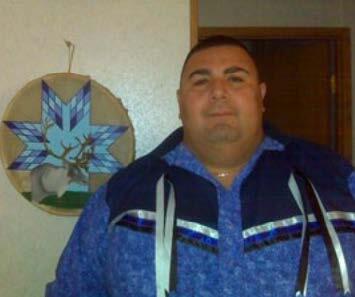
Getting Acquainted with Restorative Practices Trainer: Charles Grolla
Boozhoo gakina wiiya! (Greetings everyone!)
I am Charles Grolla and my Ojibwe name (Indian name) is Ogimaagiizhig (Boss of the Sky). I am Caribou Clan. I am from the Red Lake reservation, and I am an enrolled member of the Bois Forte Band of Ojibwe. I grew up mainly on the Red Lake reservation and lived on the Bois Forte reservation for a couple of years in my youth. I graduated from Red Lake High School and completed my Bachelor of Science degree in Criminal Justice with a minor in Ojibwe language from Bemidji State University. After retiring from the Red Lake Police Department, first as a police officer and then as a conservation officer, I started my second career as an Ojibwe language and culture teacher and currently teach at Cass Lake Bena High School on the Leech Lake reservation. I completed my Masters degree in Differentiated Instruction with Concordia St. Paul, and I am currently preparing to complete my dissertation and will earn my Doctoral Degree in Educational Leadership and Practices with University of North Dakota Grand Forks, graduating this coming December. Restorative Justice / Practices and Circle Process are a core aspect of a traditional Native American upbringing. I expanded my knowledge and beliefs and practices during my career in Law Enforcement and I am currently a strong advocate for RJ in our communities and RP in our educational systems, I specialize in the Indigenous (Ojibwe) aspects processes in those settings. I can be contacted through my personal email: ogimaagiizhig@yahoo.com
|
Resources
Nonexclusionary Discipline Workshop - FREE
Join the MDE Nonexclusionary Discipline team and others from MDE for a day of connection, learning, and collaboration on September 22 from 8:30 a.m. to 4 p.m. at the Minnesota Department of Education.
Come with your team or come on your own to participate in a deep dive on Nonexclusionary discipline strategies and best practices. The day will include opportunities for connection with peers from several different school districts, differentiated learning opportunities, and supported work time for putting learning into practice.
While this training is designed to be accessible to individuals who are new to Nonexclusionary Discipline, the engaging and differentiated format provides space for people with all levels of NED understanding to participate and come away with new learning.
Registration is FREE. Space is limited, so please register soon! Register for the Nonexclusionary Discipline Workshop.
Restorative Practices Youth Leadership Cohort with Restorative Justice Community Action and Koinonia Leadership Academy
What is it?
- An opportunity for young people, grades 9-12, to build relationships, community, and develop an understanding of restorative ways of being and leadership.
- The cohort begins with a four-day Restorative Retreat centering youth and practices of self & community care.
- After Retreat, students are invited to join in a nine month cohort building on the experience. Their time and energy matter, so they will receive a $100 stipend each month they attend September 2025 to May 2026.
- This is youth space to build genuine connections, step into leadership, and learn ways of healing that actually work - for youth and their community.
When is it?
- Restorative Practices Retreat will be August 19-22, 10 a.m.-3 p.m. in South Minneapolis.
- The nine-month cohort meets in-person, third Saturdays, 10 a.m.-1 p.m. and 1-hour online each month.
How do youth apply?
School Mental Health Resources and Training
MDE’s Healthy Schools Team has resources available to support school mental health including several upcoming training opportunities including the annual CoIIN cohort for school teams and several evidence-based practices trainings, as well as support specifically for Student Support Personnel. Please visit the corresponding links for more information or reach out to Brienne LaHaye (Brienne.LaHaye@state.mn.us), MDE’s Mental Health Lead.
teen Mental Health First Aid
teen Mental Health First Aid (tMHFA) teaches teens in grades 9-12, or ages 14-18, how to identify, understand and respond to signs of mental health and substance use challenges among their friends and peers. This training will prepare adults to utilize tMHFA in their schools. It will be held August 5th, 6th, and 7th virtually. Participants must attend all 3 days. Each attendee will get over 100 student workbooks (necessary for delivering the training) with their attendance to use in their district (more available for purchase by districts). If interested, please email Megan Lagasse (Megan.Lagasse@state.mn.us).
Student Support Personnel Leadership Series - FREE VIRTUAL
ALL Student Support Personnel provide leadership in many ways - formally and informally for teachers, interns, student support colleagues, and of course for our students. MDE is teaming up with current leaders and experts in the field to share their knowledge, tools, and resources across the state that make student support more efficient, effective, and equitable. Together we can recruit and retain an even stronger student support workforce in Minnesota schools! Dates will continue to be added. For registration and more information, visit the Student Support Personnel Leadership Series page.
Comprehensive School Mental Health Systems Trainings - FREE
The Project AWARE team is sponsoring the following trainings to support comprehensive school mental health systems, free of charge. More information can be found at the registration links. If you have any questions, please contact Sonya Kuznetsov Duffy (sonya.kuznetsov.duffy@state.mn.us).
New Online Library Resource
The Minnesota Department of Education’s Division of Early Education is excited to announce a partnership with Unite for Literacy and introduce our own state “bookshelf” known as Minnesota READs. This library is an incredible resource for multilingual learners, families, teachers, and other caregivers.
-
Unite for Literacy is a totally free online library. No logins or passwords are required and there are no pop-up ads.
- Books for young children are written and narrated in over 60 languages, including books interpreted into ASL.
- Printed copies of books in the library are also available for purchase at a very reasonable price through Unite for Literacy.
Further Information
For further information about Restorative Practices, visit MDE's Restorative Practices webpage or contact Restorative Practices Consultants for the MDE, Grace Yang, 651-582-8777 or Nuhu Sims, 651-582-8514 or email at RP.MDE@state.mn.us.
|