|
January 7, 2025
Prior editions of the ESEA Update can be found on the MDE ESEA Federal Title Programs webpage. "ICYMI" means "in case you missed it" and highlights when a topic is a repeat from a prior ESEA Update.
In this Edition
Timeline Reminders
Review the SFY25 Timeline for the ESEA Consolidated Application in MEGS.
Upcoming Dates:
-
April 30, 2025: Optional Spring Amendment Window closes at 3 p.m., final date to make an amendment to the SFY25 ESEA Consolidated Application. Object codes cannot be added and budgeted amounts cannot be modified after this date. Final opportunity to edit project outcomes, including strategic goals.
Back to Top
Final FFY24/SFY25 Allocations Loaded in MEGS
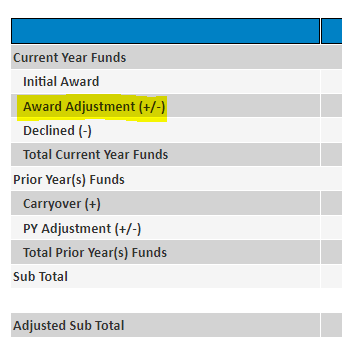
The final federal fiscal year (FFY) 2024/state fiscal year (SFY) 2025 award adjustments have been posted on the MDE ESEA Title Programs webpage and loaded into the Minnesota Education Grants System (MEGS). Local educational agencies (LEA) will see either an increase (+) or decrease (-) in funds on the "Allocations/Transfers" tab in the "Award Adjustment" row for each program, depending on the final calculations, as compared to the preliminary awards loaded in May 2024 ("Initial Award" in MEGS).
Some users will need to follow the on-screen directions in MEGS to view the newly loaded funds if the application is in a locked status (Locked, Consistency Check Passed, Submitted for Local Review, Submitted, or Final Approved). Unlocking the application or creating an amendment will update the "Allocations/Transfers" tab.
Districts should plan to make adjustments to their budgets before April 30 at 3 p.m.
Contact mde.esea@state.mn.us with questions about the final FFY24/SFY25 allocations.
|
Requirement Reminder: Documented support for personnel costs
Records of completed employee work activity (also known as time-and-effort) are required for personnel costs to be allowable charges to federal funds.
Federal grants management regulation 2 CFR 200.430(g) states that “Charges to Federal awards for salaries and wages must be based on records that accurately reflect the work performed.” The regulation details specific requirements which apply to any federal fund, no matter what source or program (ESEA Title, special education, Perkins, etc.).
In brief, the LEA must be able to demonstrate that the federal funds drawn and paid to an employee are based on records documenting
- all actual work performed by the employee during a specified calendar period,
- the distribution of work between federal and non-federal cost objectives, and
- verification by an onsite supervisor as an internal control.
Budget estimates determined before work is performed do not qualify as final support for charges to federal awards. Records of actual, eligible work performed must be used to confirm or adjust the amount charged to a federal fund.
Upcoming Training Opportunities
Join the MDE Student Access and Opportunity staff for upcoming trainings. All links to join can be found on the MDE Calendar. There is no need to register unless otherwise noted.
Foster Care POC Network Office Hours
Providing Districts and Charter Schools POC a space to come and find answers for their questions.
English Learner Coordinator Webinar
The English Learner (EL) Coordinator webinars are monthly web events for new and experienced EL program leaders and coordinators in Minnesota. Monthly topics vary and are based on timely information from MDE. Participants will have an opportunity to ask questions to EL Education specialists and others from MDE during each webinar.
New to ESEA Title Programs Networking Session
Each meeting will cover all things related to the implementation of activities funded by the Elementary and Secondary Education Act (ESEA). Each session will include new learning and ample time for questions, answers, and networking.
Back to Top
Time-and-effort documentation required for federal programs
Records of actual work performed (also known as time-and-effort) are required for personnel costs to be allowable charges to federal funds. Federal regulation 2 CFR 200.430(g) details specific information that must be documented regardless of the fund, job or activity. This session will explain what’s required and provide examples.
Developing a Title I, Part A Schoolwide Program, Part 2 of 3, Developing and Drafting Your Plan
This workshop will explore further how effective school leaders engage and guide staff, families and students in the process of change and provide the school’s teams with tools, strategies and a framework to develop a comprehensive school improvement plan which is informed by the results of the completed Comprehensive Needs Assessment. Best practice strategies will be identified and examined. Teams will learn how to establish specific, assignable SMART goals and begin to develop their plans to implement the Schoolwide program.
Refugee and Immigrant Education (RIEN) Network
We invite school and district partners, community leaders, refugee resettlement organizations, and state agencies to attend the first convening of the Refugee and Immigrant Education Network (RIEN). This network is dedicated to strengthening collaboration on educational programs and services that support refugee and immigrant families in Minnesota. RIEN’s mission is to highlight the experiences of students and families within K-12 public education and multicultural communities, addressing challenges and finding solutions together. The network shares resources and explores opportunities to improve education for all refugee and immigrant families. Minnesota has long been home to thriving immigrant communities. RIEN was established in response to the resettlement of and Ukrainian refugees and will continue to focus on all refugee-experienced and immigrant communities across the state. Join us as we work to improve educational outcomes and supports for these students and their families!
Back to Top
Title Tuesdays
Learn about topics that apply to many ESEA Title programs.
Title IV, Part A Overview and High Quality Program Design
This interactive training will share guidance on how to develop high quality Title IV, Part A programs in both public and nonpublic settings. The session will provide an up-to-date overview of Title IV, Part A, including the special spending rules, the needs assessment, community consultation, and the three categories. Participants are encouraged to bring any questions about Title IV, Part A to the training.
Secondary LIEP Network Part 2: MnMTSS for Secondary Multilingual Learners
For 2024-25, MDE is offering a network for district and charter school leaders to explore best practices for providing support for multilingual learners at the secondary level. Part 2: MnMTSS for Secondary Multilingual learners: Reviewing best practices at the secondary level. Participants will discuss using WIDA resources and standards and innovating program models and language instruction educational programs (LIEPs) and providing access to grade-level content across all classrooms in tier 1.
McKinney-Vento Guidance Document and Forms
MDE has developed a McKinney-Vento (MV) guidance document and forms to assist LEAs in implementing their MV program. This training will walk the attendees through the document highlighting information and resources available.
Language Access Plan
The Minnesota Department of Education will host a series of training sessions for district and charter schools during the 2024-25, school year. Based on changes in state law, districts and charter schools are required to adopt a Language Access Plan that specifies the district's process and procedures to render effective language assistance to students and adults who communicate in a language other than English. This Language Access Plan must be available to the public and included in the school’s handbook. District and charter school leaders should identify a team who will write the Language Access Plan for their district or charter to attend these training sessions.
Back to Top
|