Special Education Division
Department of Education
- Graduation Rates Continue to Rise
Board of School Administrators
- Comments on Possible Amendments to Rules Governing School Administrators
Academic Standards Division
- Read Well by Third Grade Data and Plan Upload Site
- English Language Arts (ELA) Standards Reviewers
School Safety Technical Assistance Center
- Bullying and Harassment Investigation Training
- Learn How to Use Restorative Practices in Schools
Special Education Division News
Director: Robyn Widley
May Special Education Directors' Forum
The last Special Education Directors' Forum of the school year will be held Friday, May 3, beginning at 9 a.m. in Conference Center B, Rooms 15 and 16, Minnesota Department of Education (MDE), 1500 Highway 36 W., Roseville, Minnesota 55113. The May Forum will feature updates and information from the Special Education Division, Minnesota Administrators for Special Education, legislation, fiscal monitoring, funding, school safety, administrative licensing, sign language proficiency interview results and graduation data. The forum will be available for remote viewing courtesy of MediaSite. Watch the Special Education Directors' listserv for more information. We look forward to seeing you.
For more information, contact Eric Kloos, 651-582-8268.
Reading and Spelling Implementation Project
MDE is looking for one or two districts interested in partnering on an implementation project with Language Essentials of Teachers of Reading and Spelling (LETRS). If your district has two or three schools training cross-disciplinary staff in LETRS, we’d like you to consider joining us in an implementation project. The project will last three to five years and engage both of our organizations in documenting and action planning from installation to full implementation of the evidence-based practices included in LETRS.
A meeting exploring the initiative, commitment and expected outcomes will be held May 22, 2019, from 10 a.m. to 12 noon in Conference Center B, room 16 at MDE. Please bring at least one school administrator, literacy/instructional coach, district administrator with responsibilities for professional development and special education administrator. Other staff may include a school psychologist, ADSIS staff, Title I staff, etc.
For more information or to join this project, contact Vicki Weinberg.
Two webinars in May will provide information on practical strategies to support students’ social, emotional and behavioral skill development within a multi-tiered system of support framework (MTSS). The series highlights best practices based on current research from the Office of Special Education Programs (OSEP) Technical Assistance Center on Positive Behavioral Interventions and Supports (PBIS). Voices from the field will be highlighted to illustrate applied examples from Minnesota schools for Minnesota educators and MTSS teams who support social-emotional and behavioral skill development of students, or who are responsible for building systems to support these practices within an educational setting.
Erin Farrell, Autism Spectrum Disorder (ASD) specialist, is a board certified behavior analyst and Janet Christensen, Emotional Behavior Disorder (EBD) specialist, is a former special education teacher and school administrator. Both Erin and Janet have practical experience and behavioral expertise in a variety of K-12 schools from inclusive general education settings to the most restrictive in general and special education, and charter schools. They are a part of the PBIS management team at MDE.
For more information, contact Erin Farrell or Janet Christensen.
Tuesday, May 7, 2019, 9 a.m.: Thinking about behavior functionally
Join the May 7 session on WebEx.
Thursday, May 23, 2019, 11 a.m.: Behavior intervention plans using positive behavior supports
Join the May 23 session on WebEx.
Dyslexia Spring Webinar Series
Three webinars in April and May will cover information on dyslexia, its identification and instructional strategies.
Part 1: How Does Skilled Reading Develop? How to Identify and Meet the Instructional Needs of Struggling Readers
April 29, 2019, 3:30-4:15 p.m.
Join the meeting on WebEx. Meeting number (access code): 805 891 301; meeting password: Success1! Join by phone: 206-596-0378 (U.S. toll).
This session will provide an overview of how skilled reading develops and where it can break down for struggling readers and students with known or suspected dyslexia. We will review the neuroscience of reading including how the neural networks of reading develop through instruction in phonemic awareness, orthography and phonics to support meaning-making and comprehension. The classroom application of models including Scarborough’s Reading Rope, the Simple View of Reading and the Four-part Processing Model will also be discussed.
Part 2: Dyslexia Screening and Identification in Minnesota
May 6, 2019, 3:30-4:15 p.m.
Join the meeting on WebEx. Meeting number (access code): 802 474 718; meeting password: Success1! Join by phone: 206-596-0378 (U.S. toll).
This session will review current dyslexia efforts in Minnesota and at MDE. Participants will learn about MDE guidance on screening and identification in the schools, what skills to measure when identifying characteristics of dyslexia and the list of screeners created by MDE. The discussion will include a review of the list of screeners, process MDE used to develop the list and how identification of dyslexia fits into both an MTSS framework and the statutory requirement.
Part 3: Evidence-based Instructional Practices
May 20, 2019, 3:30-4:15 p.m.
Join the meeting on WebEx. Meeting number (access code): 804 621 153; meeting password: Success1! Join by phone: 206-596-0378 (U.S. toll).
This session will review the components of systematic, explicit and multisensory instruction to support struggling readers and those with identified or suspected dyslexia. There will also be a focus on data-based decision making to intensify instruction for students who are not making adequate reading progress.
Minnesota Assistive Technology Teams Project
MDE has completed our seventh year of the Assistive Technology (AT) Teams Project. To date, more than 50 district teams have participated in the three-year project. The project includes monthly professional development activities focusing on the Quality Indicators for Assistive Technology (QIAT) for students with disabilities from birth through high school graduation. AT Teams Project participants will increase their ability to identify and implement quality AT practices; make AT consideration, provision and implementation more consistent; build local capacity to address students' AT needs; establish teams of local coaches, mentors and supports for educators implementing AT; and make better and more accepted AT decisions.
Our primary trainer for 2019-20 is Dr. Joy Smiley Zabala, the creator of the Student, Environment, Task, Tools (SETT) Framework for consideration of AT and Director of Technical Assistance at CAST. Topics for 2019-20 include QIAT and AT consideration, assessment of AT needs, including AT in the Individualized Education Program (IEP) and evaluation of AT effectiveness.
Learn more and complete an application for AT Teams Project 2019-20 at SurveyGizmo. Application deadline is May 1, 2019. Districts will be notified of the status of their application on or before May 20, 2019. For more information, contact Kursten Dubbels.
June 1 Deadline for State Fiscal Year (SFY) 2020 Deductions for State Services for the Blind (SSB)
Districts have until June 1, 2019, to authorize MDE to withhold funds for the State Services for the Blind (SSB) on their federal special education application cover sheet for state fiscal year (SFY) 2020. Absolutely no changes can be made after June 1.
MDE has an interagency agreement with SSB to provide published accessible educational material in braille, digital and audio formats. This agreement with SSB runs through June 30, 2020. The purpose of these funds is to provide braille textbooks/materials and audio materials that are needed by the districts participating under this agreement for students who are blind or visually impaired that require these materials as part of their education.
The districts that grant permission to MDE to withhold SSB dollars will not receive invoices for the services provided by SSB. Therefore, there will be no expenditures to enter on the Special Education Data Reporting Application (SEDRA). The spreadsheet that will be posted to the web after the SFY 2020 federal allocation has been loaded into the State Educational Record View and Submission (SERVS) will indicate the actual amount of funds that are being withheld from the district’s Federal Part B Section 611 funds, Uniform Financial Accounting and Reporting Standards (UFARS) Finance Dimension 419. Districts will need to log into SERVS Financial under “Manage allocations/competitive awards” and adjust the award amount.
Districts that do not choose to participate in the agreement are responsible for providing and paying for accessible materials. Look here for a list of Accessible Media Producers (AMPs) is available from the American Printing House for the Blind (APH).
Questions regarding the agreement can be directed to Aaron Barnes at 651-582-8592. Questions concerning the adjustment to your Federal Part B Section 611 funds UFARS Finance Code 419 can be directed to Michelle Jones at 651-582-8577.
The Minnesota Mentor Program
The Minnesota Mentor Program (MMP) will continue in the 2018-19 school year to provide research-based support to special educators.
Of the 60 educators who benefited from mentorship through the MMP in the first three cohorts (2015-16, 2016-17, and 2017-18), 95 percent were still teaching in Minnesota’s schools during the 2018-19 school year.
During the 2018–19 school year, 25 mentors and 38 protégés in licensure areas of ASD, Blind/Visually Impaired (BVI), Developmentally/Cognitively Delayed (DCD), Deaf/Hard of Hearing (DHH) and Physical/Health Disabilities (PHD) participated in the MMP.
Educators who are licensed, or who are seeking licensure in one of the five licensure areas listed above, are welcome to apply to the 2019-20 MMP. We need your help in identifying mentors and protégés to participate in the MMP next school year. Please pass on this information to the ASD, BVI, DCD, DHH, and PHD teachers in your district. Forward participant recommendations to Kanya Plaisted.
Mentor applicants must:
Protégé applicants can be:
- Current students or recent graduates of teacher preparation programs and working in Minnesota; or,
- Licensed in one of the included licensure areas for less than three years; or,
- A geographically isolated or experienced ASD, BVI, DCD, DHH, PHD teacher who has specific skill set needs.
Protégé applicants must:
Contact Becca Jackson for more information.
Accessible Education Materials Project
Any classroom teacher will tell you the importance of differentiating instruction and materials for students' diverse needs. It's also crucial that new digital learning tools introduced to the classroom are accessible to all students. Students with disabilities (cognitive, physical or learning) should be able to engage and interact with educational content in the same way, with the same ease of use, as students without disabilities.
The focus of the accessible educational materials (AEM) project is building the capacity of local educational agencies (LEAs) to develop, implement and refine a comprehensive and sustainable system of accessibility, and increase the use and integration of AT students with disabilities and their families.
Districts who are interested in learning more about and providing an accessible educational experience are invited to apply on SurveyGizmo to participate in the Accessible Educational Materials project.
For more information, contact Kursten Dubbels.
Parent Advisory Council Resources
Requests for Special Education Advisory Council (SEAC) parent advisory council resources were recently requested at the Booth Law Conference. See more information about parent advisory councils on the Minnesota Revisor of Statutes website. The Parent Advocacy Coalition for Educational Rights (PACER) has several SEAC resources on its website, including application and job templates for districts to use, ideas for interactive SEAC activities and agendas and a twelve-part training module that covers:
- Background and basics.
- Strategies for cooperatives, intermediate school districts, charter schools and correctional facilities.
- Who are SEAC members and what do they do?
- Recruiting and retaining members.
- Determining the SEAC’s mission and developing the mission statement.
- Strategies for providing information in the school district and community.
- Strategies for effectiveness within SEAC - what SEAC members need to know.
- Strategies for effectiveness within a SEAC - leadership and partnership.
- Funding.
- Operational guidelines (bylaws).
- Running a meeting.
- Prioritizing needs and setting goals.
For more information, contact Kristin Oien, Special Education Advisory Panel (SEAP) coordinator, at 651-582-8843.
Back to top
Department of Education News
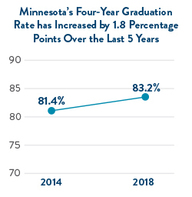
Graduation Rates Continue to Rise
More Minnesota seniors than ever before graduated in 2018, with 55,869 students—83.2 percent of the graduating class overall, the state’s highest graduation rate on record—achieving the honor and moving on to career and college. Additionally, 3,641 students from earlier classes also earned their diplomas in 2018, graduating five, six, or seven years after beginning high school.
“Graduating high school is a critical step on every student’s path to find their own success,” said Education Commissioner Mary Cathryn Ricker. “In Minnesota, we do not give up on our students. Behind every single data point in this year’s historic graduation rate, I not only see the unique stories of individual students, but also the hard work that educators, administrators, coaches and families put into supporting the needs of our students so they could reach this important milestone.”
Read the news release on the MDE website.
|
Back to top
Board of School Administrators News
Executive Director: Tony Kinkel
Comments on Possible Amendments to Rules Governing School Administrators
The Minnesota Board of School Administrators (BOSA) requests comments on its possible amendments to rules governing school administrators (Minnesota Rules, part 3512; Revisor’s ID Number R-04546). View a draft of the rules on the BOSA website.
The Board seeks to modernize outdated rules to conform with current practice, allow additional flexibility in licensure, strengthen oversight of professional development activities, abolish obsolete and antiquated regulations which impede the Board’s ability to respond to the needs of the public, upgrade decades-old administrator competencies required in university preparation programs, eliminate confusing, redundant and superfluous language and reformat rules from a passive voice to an active voice.
Interested persons or groups may submit proposals, comments or information on these possible rules in writing or orally for a period of 60 days. The board will not publish a notice of intent to adopt the rules until more than 60 days have elapsed from the date of this Request for Comments. The Board does not plan to appoint an advisory committee to comment on the possible rules. Any comments will go directly to the board for consideration. The public is also advised that, depending on the comments received, the Board may withdraw the proposed rules.
Written or oral comments, questions, requests to receive a draft of the rules and requests for more information on these possible rules should be directed to:
Dr. Tony Kinkel, Executive Director
Board of School Administrators
1500 Highway 36 West
Roseville, MN 55113
651-582-8236 (office), 651-797-1608 (fax)
Back to top
Academic Standards News
Director: Doug Paulson
|