|
Having trouble viewing this email? View it as a Web page.
August 3, 2026
August Weed of the Month: Tree of Heaven
Tree of heaven is fast growing and overtakes other species
By Emile Justen, Minnesota Department of Agriculture: Tree of Heaven (Ailanthus altissima), an aggressive tree that outcompetes native plant species, was confirmed in Dakota County for the first time in September of 2025. In addition to displacing native plant species, tree of heaven can damage important infrastructure like sewer lines, pavement, and building foundations.
Tree of heaven thrives in a wide range of soil types and conditions. It can be found along roadsides and fence rows, in floodplains, open woodlands, and disturbed sites. In urban areas, it can grow in tight spaces where other trees can’t. It prefers full sun and is intolerant of shade. As a fast-growing tree, it overtakes areas by producing abundant seed and sending up new shoots from the roots.
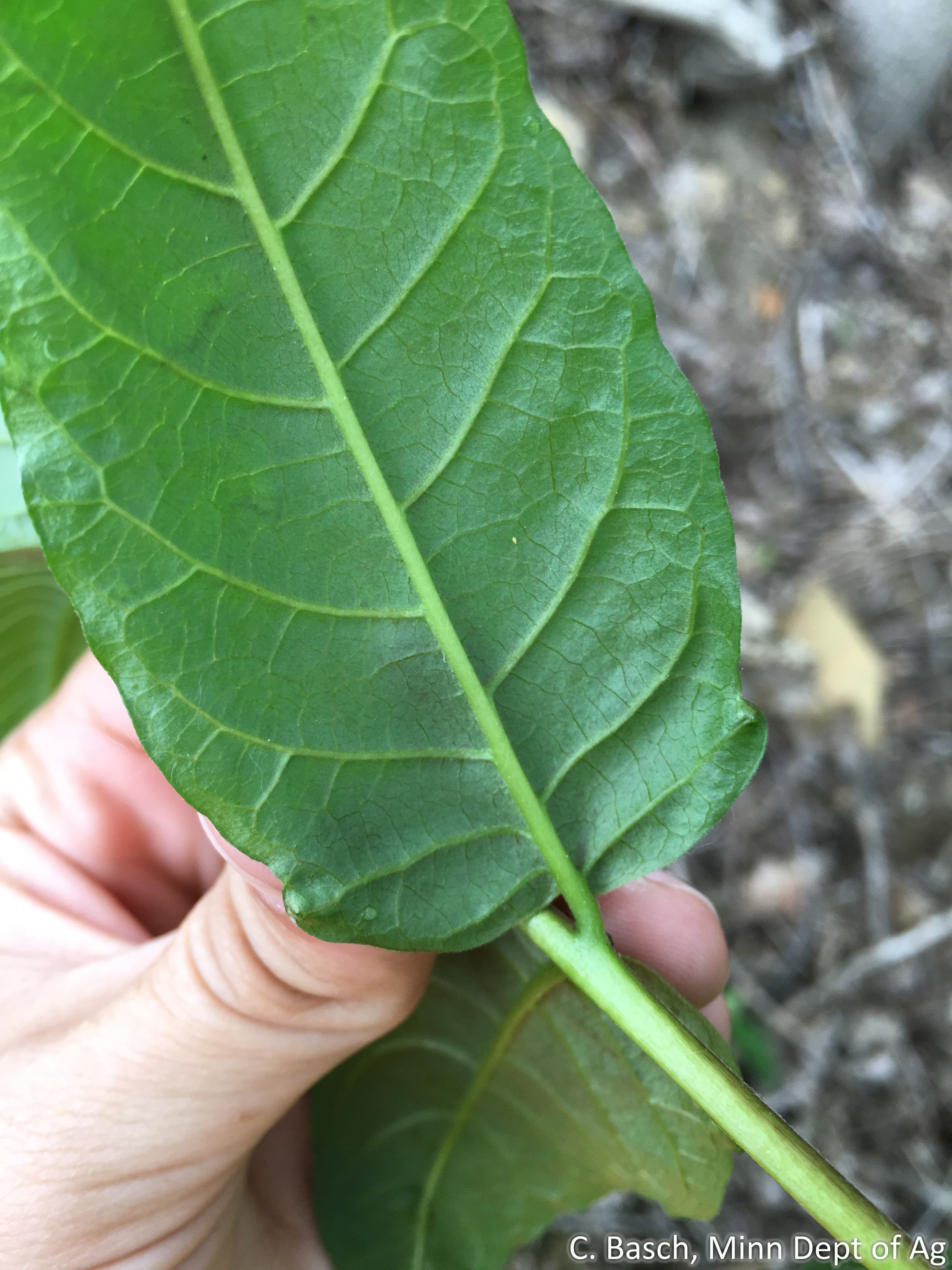
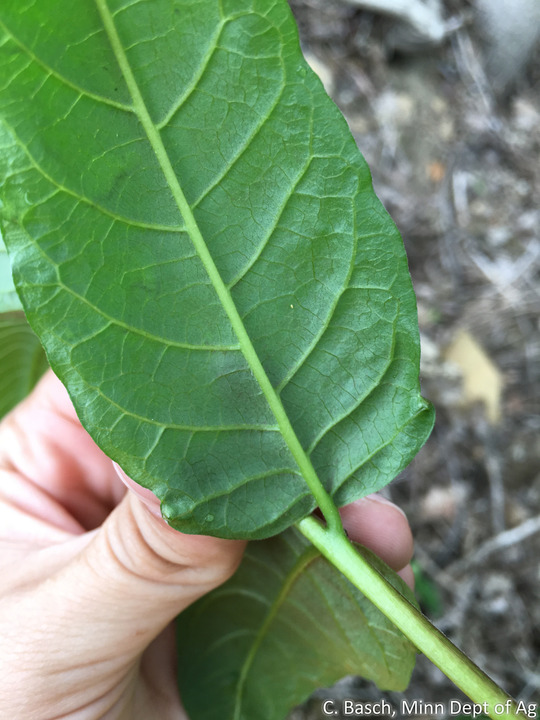 Tree of heaven leaflet has two lobes at the base of the leaf and smooth edges.
Several key characteristics help distinguish tree of heaven from other tree species:
- Leaves are large (1-4 feet long), alternate, and compound with 10-40 smaller leaflets.
- Individual leaflets are 3-5 inches long, with smooth margins and two lobes at the base.
- Flowers are small, yellowish green, and arranged in large, showy clusters at the ends of the leaves.
- Fruit are flat, twisted samaras that hang in long clusters.
- When crushed, leaves and all plant parts give a strong, offensive odor like rancid peanut butter.
- Twigs have V or heart-shaped leaf scars, and when the twigs are broken, the pith is spongy.
Tree of heaven is often mistaken for native plant species such as sumac or black walnut. A simple way to tell them apart is by looking at the leaf edges. Sumac leaves have serrated edges, and black walnut leaflets have fine serrations on the edges. Tree of heaven leaflets are smooth and have two lobes at the base of the leaflets.
Tree of heaven is listed as a Prohibited Eradicate Noxious Weed in Minnesota. This means all above and below ground parts of the plant must be destroyed, and transportation without a permit, propagation, or sale of the plant is not allowed. Thanks to early detection and rapid response, Minnesota successfully eradicated one other population of tree of heaven in the southeastern part of the state in 2019.
Management strategies for tree of heaven must include a multi-year plan. Cutting and mowing are not effective and will stimulate the plant to produce large amounts of stump sprouts and root suckers. Because of this, cut stump herbicide applications are not effective. Foliar herbicide treatments in mid-to-late summer can be effective. Basal bark herbicide applications are also effective. Repeated treatments and monitoring will be necessary to successfully eradicate tree of heaven.
Help stop the spread of tree of heaven. Report suspected tree of heaven sightings to the Minnesota Department of Agriculture through the online Report a Pest service or by email.
 |
|
To learn more, listen and subscribe to Smarty Plants, a podcast produced by the MDA that explores the invasive insects and noxious weeds that threaten Minnesota’s natural and agricultural resources. |
MEDIA: Contact Brittany Raveill, MDA Communications, brittany.raveill@state.mn.us
|