|
Having trouble viewing this email? View it as a Web page.
May 18, 2026
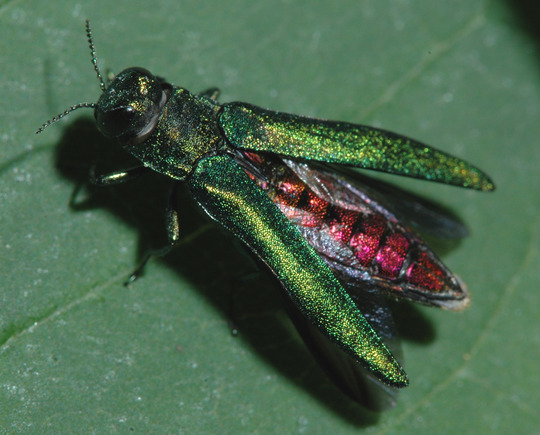 Adult EAB are small, metallic green, wood boring beetles about 3/8 to 1/2 inch long and 1/8 inch wide.
There are now 60 counties in Minnesota with known emerald ash borer (EAB) infestations. So far in 2026, EAB has been confirmed in Todd County, along with new community level detections in Aitkin, Kandiyohi, McLeod, Pine, and Stearns counties.
Through follow-up on reports received from citizens and natural resource professionals submitted to Report a Pest, EAB infestations were discovered in 21 new communities within regulated areas, as well as in six new counties, in 2025. All known EAB-infested areas and pest quarantine boundaries can be viewed on the Minnesota Department of Agriculture (MDA) EAB Status Map. The MDA issues quarantines for counties where EAB is confirmed to reduce the risk of spreading this tree-killing insect. The quarantines limit the movement of firewood and ash materials within Minnesota and out of infested counties.
Survey
Early detection efforts are being planned for communities located along the leading edge of infestation and high-risk travel corridors beginning in fall 2026. Additionally, EAB early detection and management workshops will be offered to the public at several locations around the state during winter 2026-2027. These workshops offer attendees the opportunity to see examples of standing, infested ash trees and learn from experts firsthand in a small group setting.
These efforts are funded through grants from the United States Forest Service and the Environment and Natural Resources Trust Fund, as appropriated by the Legislative-Citizen Commission on Minnesota Resources.
EAB Biological Control
With support from the U.S. Department of Agriculture (USDA) EAB Parasitoid Rearing Facility in Brighton, Michigan, the MDA released 19,058 parasitoid wasps in 2025 at four sites: Elk River, Lindstrom, Isanti, and Chippewa National Forest. The Elk River and Lindstrom sites will receive additional parasitoid releases in summer 2026, along with three new sites: St. Croix State Park, Rice Lake State Park, and Myre-Big Island State Park. Since this project began in 2010, over 700,000 wasps have been released at 56 EAB-infested sites across 19 counties and tribal lands in Minnesota.
Two parasitoid species, Oobius agrili and Tetrastichus planipennisi, have been used since 2010. A third species, Spathius galinae, was introduced in 2016. All three species have documented establishment in southeast Minnesota, Twin Cities Metro Area, and Duluth.
Additional parasitoid recovery efforts, in partnership with the USDA Animal Plant Health Inspection Service – Plant Protection and Quarantine (APHIS-PPQ), are planned for summer 2026 at sites in Carver, Goodhue, Mower, and Rice Counties.
To learn more about emerald ash borer biological control efforts in Minnesota, visit Biological Control of EAB.
EAB Biological Control Impact and Research
The MDA continues to work with the USDA on research surrounding EAB biological control. Staff have worked for multiple years on a study titled Persistence and Efficacy of EAB Parasitoids as Agents of Biocontrol. The project evaluates the persistence and effectiveness of two larval parasitoid wasps — Tetrastichus planipennisi and Spathius galinae.
The study aims to determine whether these parasitoids can persist as EAB populations decline and to assess their efficacy across a north–south temperature gradient, which influences EAB development and parasitoid success. The project also examines ash tree health and regeneration along this gradient.
Ultimately, this work will provide critical insights into the long-term viability of parasitoid-based biocontrol and guide USDA decisions on where to prioritize releases for maximum impact, protecting ash trees while optimizing the use of public resources.
For additional updates on emerald ash borer and other invasive pests affecting Minnesota’s forests and landscapes, read the 2025 Status of Invasive Forest and Landscape Pests in Minnesota Report.
EAB Grant Opportunities
Firewood Rules and Regulations
Firewood is a regulated article and is defined as:
- Any non-coniferous species cut to 4-foot lengths or less
- Split or unsplit
- Intended for commercial or personal use
|