|
November 12, 2025
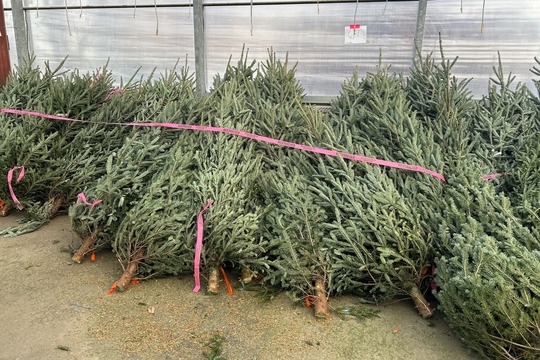
Holiday trees held from sale due to elongate hemlock scale
Insects and diseases can hitchhike into Minnesota on trees and holiday greenery brought from other states. The Minnesota Department of Agriculture (MDA) inspects these products for elongate hemlock scale, boxwood blight, round leaf bittersweet, spongy moth, and other pests.
Learn more about how to properly dispose of holiday greens on the MDA’s Holiday Greenery Best Management Practices webpage.
If you notice signs of any of these or other pests on your holiday greenery, please report them to the MDA.
Elongate Hemlock Scale
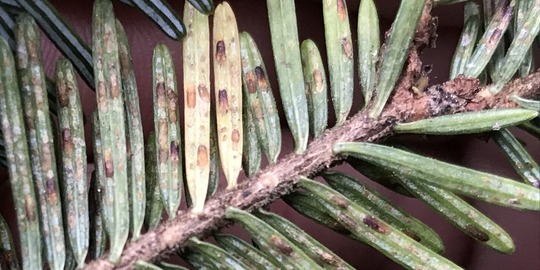
Elongate hemlock scale (Fiorinia externa) is a tiny insect found almost exclusively on the undersides of conifer needles. The female, which is typically seen when an infestation is present, is dark brown, longer than it is wide, and can be difficult to distinguish from dirt or debris due to its small size and inconspicuous appearance. These insects are challenging to detect, but signs of infestation include yellow banding on the tops of needles, premature needle drop, and thin-looking tree crowns. Learn more.
Tree needles showing signs of elongate hemlock scale.
Round Leaf Bittersweet
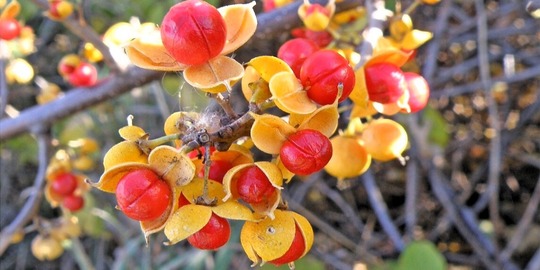
Round leaf bittersweet (Celastrus orbiculatus, formerly known as Oriental bittersweet) vines have been used in holiday decorations and other crafts for many years. The fruiting branches, with their red berries and yellow capsules, make wreaths attractive but can easily spread seed. Round leaf bittersweet is listed on Minnesota’s Noxious Weed List and cannot be sold or grown in the state. If craft arrangements, such as wreaths, are placed outdoors, birds may eat the fruit and disperse the seeds to new locations. Learn more.
Round leaf bittersweet is classified as a prohibited control noxious weed in Minnesota.
Spongy Moth
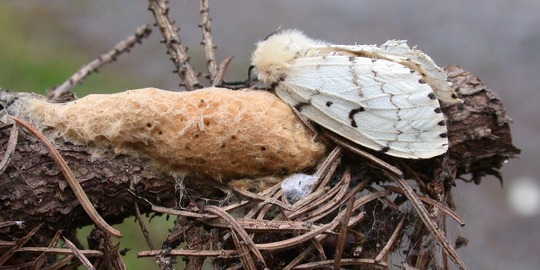
Spongy moths (Lymantria dispar) lay their eggs in protected areas on both natural and artificial surfaces. Christmas trees can have egg masses on their trunks and branches. These quarter-sized, fuzzy, tan-colored masses each contain 500 to 1,000 eggs. Learn more.
Spongy moth with egg mass on a conifer tree.
Boxwood Blight
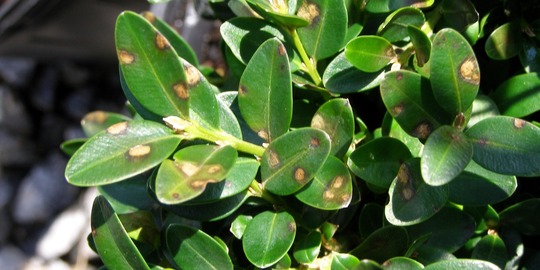
Holiday wreaths, garlands, and planters often include shoots from boxwood plants. Boxwood is an evergreen shrub with dark green, rounded leaves. Boxwood blight, caused by the invasive fungus Calonectria pseudonaviculata, can lead to leaf spots, stem lesions, and leaf drop in boxwoods. Learn more.
Boxwood blight leaf spots.
Spotted Lanternfly
The spotted lanternfly (Lycorma delicatula White) lays eggs from late September through early December on almost any surface, including:
-
Christmas trees and other plants
-
Smooth building materials such as brick, stone, and metal
-
Vehicles, trailers, and freight
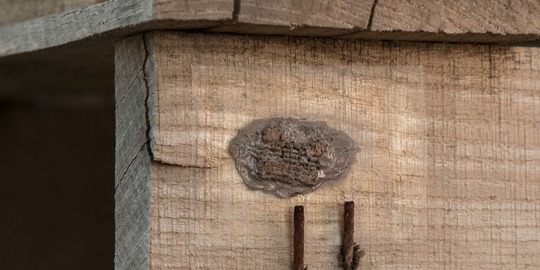
The yellowish-brown egg masses are covered with a gray, waxy coating, making them difficult to spot. Because adults are poor fliers, the most common way this pest spreads to new areas is through the accidental movement of materials that contain egg masses.
Although the spotted lanternfly has not been detected in Minnesota, it has been found in neighboring states, including Iowa, Illinois, and Michigan.
Learn more.
Spotted lanternfly egg mass on pallet. Photo by the U.S. Department of Agriculture’s Animal and Plant Health Inspection Service.
Minnesota Grown Directory
The Minnesota Grown Directory is a great resource to find local Christmas trees, holiday greenery, and more. Visit minnesotagrown.com to learn more. |
|
 |
Seasonal Spotlight: Episode 5 of Smarty Plants - Unwanted Holiday Pests
Smarty Plants is a podcast exploring invasive insects and noxious weeds that threaten Minnesota’s natural and agricultural resources.
Making the holidays extra festive with Christmas trees, wreaths, and other greenery is something many of us enjoy. However, invasive insects and noxious weeds can hide in our beautiful décor. Learn about these harmful pests and how to prevent spreading them into Minnesota’s environment with insights from three experts at the Minnesota Department of Agriculture.
Subscribe to Smarty Plants today so you don’t miss an episode!
In the Field: Fall Surveys for Potato Cyst Nematode
MDA staff surveying for PCN in Norman County, Minnesota.
Each fall, the Minnesota Department of Agriculture (MDA) checks potato fields across the state for a tiny pest called the potato cyst nematodes (PCN). The MDA has conducted these surveys since 2006 to protect Minnesota’s potato industry and support farmers who export seed potatoes to Canada.
During the survey, MDA staff collect and dry soil samples from many different fields, then test them for PCN. A negative test result is required for seed potatoes intended for export to Canada and several other countries.
Nematodes are microscopic, worm-like organisms that live in soil. PCN feed on the roots of potatoes, tomatoes, eggplant, and other plants in the Solanaceae family. Even though PCN are less than a millimeter long, they can cause up to 80% crop loss in heavily infested fields. The pest spreads easily on soil stuck to potatoes, farm equipment, or plant roots. Wind and floodwater can also move PCN to new areas.
Female nematodes can produce hundreds of eggs, which are protected inside tough shells called cysts. These cysts can survive in soil for 20 years or more, even without potato plants, making them very hard to get rid of once they’re present.
Currently, PCN are only known to occur in parts of Idaho and New York and has not been found in Minnesota. If it were ever detected here, state and federal rules would go into effect to prevent its spread and to remove or control the pest.
The MDA’s annual surveys help keep Minnesota’s fields PCN-free and support farmers who export seed potatoes to Canada and other countries.
Learn more about how the MDA’s early detection surveys help protect Minnesota by identifying invasive species before they spread and cause significant harm.
November Weed of the Month: Prioritizing Invasive Plant Control
Focus on the future you are managing for
By Maya Sarkar, Minnesota Department of Agriculture - As the growing season winds down, it’s a good time to take a break and reflect on the larger picture of invasive species management – what was accomplished, what to prioritize next, and long-term goals. Earlier this year, Weed of the Month covered making a weed management plan. To accompany that article, here is a short quiz to help your overall planning efforts. A weed management plan can be as simple or complex as you want, but either way, this is an easy place to start.
Read more
Help Protect Minnesota Forests from Invasive Pests
Look for the MDA certified logo.
Moving untreated firewood can spread harmful pests like emerald ash borer, spongy moth, and Asian longhorned beetle; species that have destroyed millions of trees across the United States. Even native pests like carpenter ants and bark beetles can hitch a ride on firewood and cause problems for homeowners.
Help stop the spread:
- Buy firewood where you burn it! Locally sourced wood is less likely to carry invasive pests.
- Use MDA-certified firewood with the official seal. View the list of Certified Firewood Producers in Minnesota.
- Avoid transporting hardwood firewood across county or state lines. It is illegal to move hardwood firewood out of Minnesota quarantined counties unless it is MDA certified. Violations can result in fines of up to $7,500 per day.
Visit the MDA's Buying Firewood webpage for more information.
|