|
September 8, 2025
Fire Blight in Minnesota (UMN Extension)
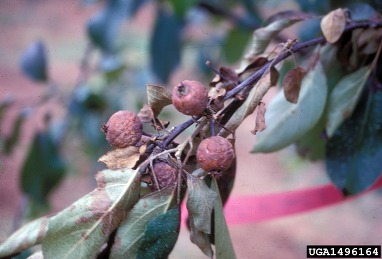
Photo by University of Georgia Plant Pathology , University of Georgia, Bugwood.org.
When it comes to disease risk within an orchard, fungal disease like apple scab tend to be a top priority for Minnesota apple growers. During years with milder winters and warm spring temperatures however, one disease caused by a bacterial pathogen can become problematic—this disease being fire blight (Erwinia amylovora).
Fire blight can sometimes feel like an automatic death sentence for trees when growers who are new to learning about the disease. But growers and researchers who have witnessed fire blight in Minnesotan orchards often observe that it has a tendency to be less persistent than it is in warmer regions in the U.S.
Read more
New Episode of Smarty Plants - Emerald Ash Borer Biocontrol
Smarty Plants is a podcast exploring invasive insects and noxious weeds that threaten Minnesota’s natural and agricultural resources.
In this episode of Smarty Plants, host Jennifer Burington is joined by Jonathan Osthus and Chris Mallet from the Minnesota Department of Agriculture (MDA) to tackle one of Minnesota’s most destructive invasive pests, the Emerald Ash Borer (EAB). Since its discovery in Minnesota in 2009, EAB has devastated ash tree populations across the state. Learn how the MDA, in partnership with the United States Department of Agriculture, is using biological control to limit EAB populations. Discover what biocontrol really means, how it's being applied in Minnesota, and what it could mean for the future of our ash trees.
Read more about biological control of emerald ash borer.
A Bit More on Emerald Ash Borer
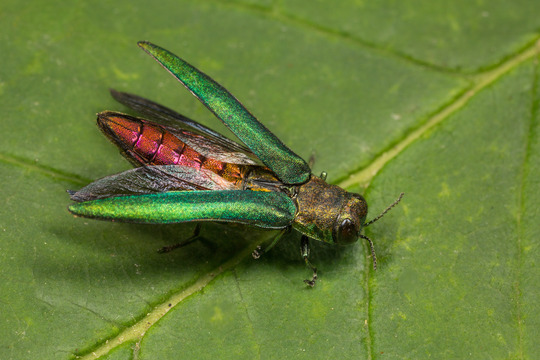
Adult emerald ash borers are small, metallic green wood boring beetles about 3/8 to 1/2 inch long and 1/8 inch wide.
In July 2025, the Minnesota Department of Agriculture (MDA) confirmed the presence of emerald ash borer (EAB) in Itasca County for the first time. With this detection, there are now 59 counties in Minnesota with known EAB infestations.
To slow the spread of this destructive, tree-killing insect, the MDA issues quarantines for all counties where EAB is found. These quarantines restrict the movement of firewood and ash material both into Minnesota and out of infested counties. See the quarantine map for details.
The MDA held a virtual informational meeting for residents and tree-care professionals in Itasca County. A recording of this session, along with previous informational meetings, is available on the MDA’s YouTube channel.
When a county is quarantined for EAB, ash wood and related waste cannot be moved outside the quarantine area. This helps reduce the risk of spreading EAB. Residents should check with their county or city for local yard waste sites, landfills, or dumps that accept wood for proper disposal.
Learn more about the lifecycle and identification of emerald ash borer.
Current Oak Wilt Risk: Use Caution
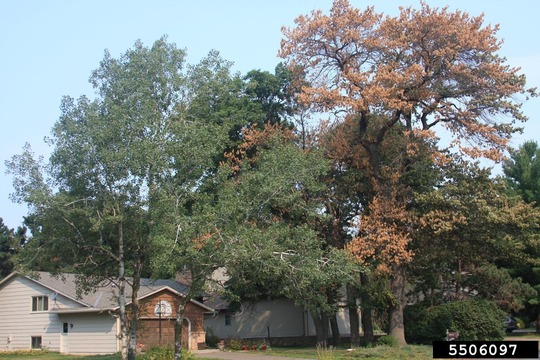
Photo by Steven Katovich, Bugwood.org.
Oak wilt is a serious disease of Minnesota oak trees. In recent years its range in the state has expanded, making it important that more landowners are aware of the early signs and importance of rapid management. In general, the risk level in Minnesota is low, but use caution when managing oak trees from August through October. Risk levels can vary considerably based on seasonal weather and location. Always check the oak wilt risk status for your date and location before pruning or wounding oaks. Immediately treat pruning wounds, stump surfaces and other wounds.
In the Field: What MDA Staff Are Seeing
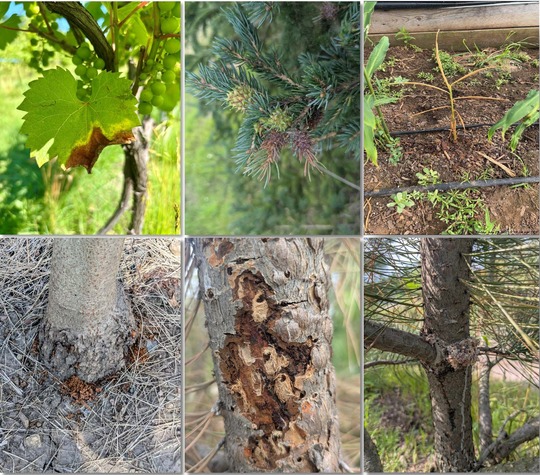 Top row, left to right: angular leaf scorch on grape leaf; eastern spruce gall adelgid; ginger wilt; linden borer frass at trunk base; white pine weevil chip cocoons; Zimmerman pine moth borer damage to trunk.
MDA staff have found several invasive pests and diseases across Minnesota over the past month:
Angular leaf scorch – A disease that causes yellow or red leaf spots, premature leaf drop, and dried-up flower clusters, was found on a grape leaf in a vineyard.
Eastern spruce gall adelgid - An insect that causes small, pineapple-shaped growths on new Norway and white spruce shoots, which start green in spring and turn brown by late summer.
Ginger wilt - A bacterial disease affecting ginger, turmeric, and related plants, causing wilting and rhizome rot; spreads through contaminated seeds, soil, or water.
Linden borer - An insect whose larvae tunnel into trunks, branches, and roots of littleleaf lindens and basswood, thinning canopies, killing limbs, and sometimes the whole tree.
White pine weevil – An insect that kills the top shoots of Eastern white pines and other pines or spruces, causing wilting and bushy growth; larvae create distinctive “chip cocoon” chambers in the wood.
Zimmerman pine moth – An insect that infests all pine species, causing downward-curving shoots with pitch and sawdust-like frass, which can weaken branches and cause breakage.
Keep an eye out for these pests in your area and report any sightings using the Report a Pest online form. Early detection and reporting help protect Minnesota’s landscapes.
Help Protect Minnesota Forests from Invasive Pests
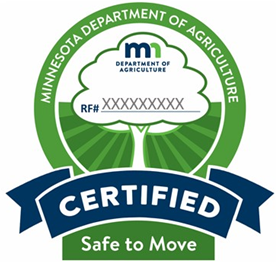
Look for the MDA certified logo.
Moving untreated firewood can spread harmful pests like emerald ash borer, spongy moth, and Asian longhorned beetle; species that have destroyed millions of trees across the United States. Even native pests like carpenter ants and bark beetles can hitch a ride on firewood and cause problems for homeowners.
Help stop the spread:
- Buy firewood where you burn it! Locally sourced wood is less likely to carry invasive pests.
- Use MDA-certified firewood with the official seal. View the list of Certified Firewood Producers in Minnesota.
- Avoid transporting hardwood firewood across county or state lines. It is illegal to move hardwood firewood out of Minnesota quarantined counties unless it is MDA certified. Violations can result in fines of up to $7,500 per day.
Visit the MDA's Buying Firewood webpage for more information.
September Weed of the Month: Invasive Species Art as a Voice for Science
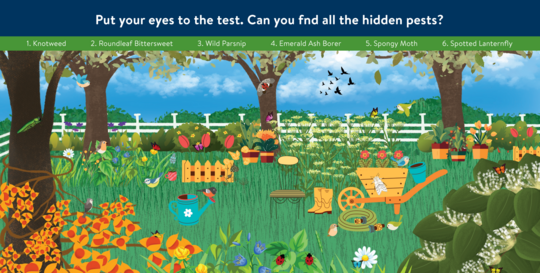
“Look and Find” invasive species reading rail by Kabao Her (Minnesota Department of Agriculture).
Art can connect with others in a way that numbers don’t
By Maya Sarkar, Minnesota Department of Agriculture - As we enter late summer, we may notice art in nature around us – from the subtle hues of big bluestem to the bright yellows of goldenrod in full bloom. Nature can inspire art, and we can use art as a voice for nature, including conversations around invasive species.
Read more
|