Legislative Updates
 Food Licensing Modernization - New Model
State lawmakers signed revisions to the law regarding MDA food licensing on May 23, 2025, and it went into effect on August 1, 2025. Changes affect all new food businesses, and will impact existing food businesses as they renew their licenses. A summary of the changes follows. For more info, please see House File 2446, lines 78.13 through 89.5.
Key licensing changes:
- Multiple existing license classifications have been simplified into one “Food Handler” license.
- Most licenses will be moved to a January 1 through December 31 license period, except mobile food businesses and those operating only at the state fairgrounds.
- The license fee schedule is based on gross annual food sales and food safety risk (i.e., higher risk businesses pay a higher fee), which may be modified by the MDA based on inflation once every five years.
- All new businesses applying for a license will pay an initial $50 application fee.
- Small businesses (<$50,000 gross annual sales) may operate up to three business locations under a single license.
What does not change:
- Licensing modernization does not change who needs a license or when one is needed.
- Food safety regulations have not changed.
- The license and permit technology surcharge (MINN. STAT. 17.033) remains in effect.
Timeline for Licensing Modernization Implementation:
-
August 1, 2025: All new food businesses must now apply for a Food Handler license, which includes a new $50 application fee.
-
January 1, 2026: All renewing Manufacturer/Processor licenses will be converted to Food Handler licenses.
-
April 1, 2026: All renewing Mobile Food licenses will be converted to Food Handler licenses.
-
July 1, 2026: All renewing Retail and Wholesale licenses will be converted to Food Handler licenses at a six-month, prorated fee.
-
January 1, 2027: Converted Retail and Wholesale licenses will renew starting January 1 for the full calendar year.
You will receive reminders of the changes and additional instructions as your food license renewal date approaches. If you have any questions, please contact MDA Licensing at mda.licensing@state.mn.us or 651-201-6062. For more information, refer to the Food Licensing Modernization webpage.
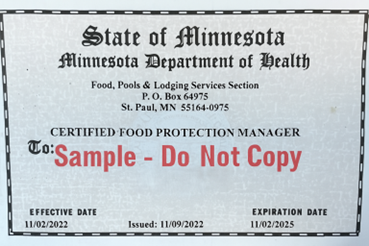
Keeping Food Safe in Minnesota: What You Need to Know About CFPMs
In Minnesota, most food businesses—like restaurants, grocery stores, and school kitchens—are required to have at least one Certified Food Protection Manager (CFPM). A CFPM is responsible for making sure food is handled safely. They lead food safety efforts by training staff, watching for risks, and making sure the business follows Minnesota’s food rules.
To become a CFPM, you must take an approved food safety course and pass a state-recognized exam. After passing the exam, you must apply online for your Minnesota CFPM certificate. You’ll get your CFPM card in the mail after applying, just make sure your exam certificate is no more than six months old when you apply. Paper applications are no longer accepted. All certificates for Certified Food Protection Managers (CFPM) must be requested through the Minnesota Department of Health Licensing System. This includes new certificates and renewals.
Once certified, your CFPM status is valid for three years. To renew, you must complete at least four hours of approved continuing education before your certification expires. You will then have up to six months to submit your renewal application and certification fee, along with your continuing education course certificates, or you’ll have to retake the exam.
Visit the Minnesota Department of Health for a list of approved training providers, continuing education options, and tools to search for CFPMs by name or certificate number. You can also contact them by phone at: Phone: 651-201-4500, Toll-Free: 1-800-383-9808 or email: health.foodlodging@state.mn.us
|
Minnesota Food Safety and Defense Task Force
The Governor's Food Safety and Defense Task Force has continuously met since 1990 to discuss issues affecting Minnesota's food system. The task force is composed of 17 members, 10 of whom are appointed by the Governor's office, representing food regulatory agencies, agricultural industries, food related nonprofit associations, and the University of Minnesota.
The Task Force's mission is to continuously improve the safety and defense of the food supply by providing a forum for public and private professionals to present emerging research, discuss current issues, sponsor critical training, and advise on food safety and defense systems to enable a risk-based approach to protect public health.
Meetings of the task force are held quarterly and are open to anyone interested. Feel free to reach out to Natasha Hedin if you have any questions about the Task Force.
|

Mushroom Product Safety for Retailers
In recent years, mushroom-containing products have increased in popularity. Though a variety of mushroom products are being marketed, further research to confirm their effects, safety, and dosage is needed. It is important that retailers ensure that any mushroom products sold are legal and have proper labeling to allow consumers to make informed decisions about purchasing these products, and to remain compliant with Minnesota laws. Review the Mushroom Product Safety for Retailers Fact Sheet (PDF) for important product considerations.
|
Security Update: Phishing Email Sent to Operator
We want to inform you of a recent phishing incident that involved an email being sent to an operator claiming to be from the FFSD. The unauthorized email disguised as a legitimate communication included inaccurate information regarding upcoming events and inspections. We have reported the incident to the Minnesota IT Security Operations Center so they can log, track, and watch for patterns.
Here's what you can look for:
- Check the sender's address. It It is more likely to be a legitimate sender address if it ends in @state.mn.us or @public.govdelivery.com.
- Be suspicious if the email creates a sense of urgency, includes a threat, offers a discount or something for free, or requests you respond with information or funds.
- Review links and attachments. Hover the cursor over links and attachments to see where they are trying to lead you.
Unfortunately, these types of phishing attempts are becoming more and more common. If you suspect a suspicious email, please report it to your local inspector.
Retail Food Program Staffing Update
You will be seeing some new names and faces in the Retail Food Program this year.
- Two Agricultural Specialist/Advisor (Retail Food Inspectors) positions have been filled in the past year, one in the metro area and one in Southern Minnesota.
- The onboarding program that the new retail food inspectors undergo includes online studies, classroom work, and a series of Joint Training Inspections (JTI) with senior-level inspectors. As a result, you may have two or more retail food inspectors present during your inspections throughout the year.
Three more Agricultural Specialist/Advisor (Retail Food Inspector) positions are vacant. Check the State of Minnesota Careers website frequently for position openings.
FFSD Staff Shine at National Conference
In July 2025, our Retail Food Program team attended the National Environmental Health Association's Annual Educational Conference in Phoenix, Arizona. They presented on various topics, including a new mentoring program for new inspectors, effective data storytelling, and food safety collaboration. The team also shared their work on training and building local networks using a grant from the FDA. Their efforts are helping to improve food safety and support new employees in our community.
FFSD Staff Host Legislative Staff for Food Safety Tours
FFSD Program staff hosted legislative visit tours with Minnesota Senate staff at several MDA food businesses in July. The team shared insights into how the food system operates in Minnesota and our role in keeping food safe.
Contact Us
Food & Feed Safety Main Line
651-201-6027 MDA.FFSD.Info@state.mn.us
Licensing & Registration Food & Feed Safety
651-201-6062 MDA.Licensing@state.mn.us
HACCP/Variance Questions & Plan Review
Retail HACCP and Variance: MDA.HACCP.Variance@state.mn.us
New Construction or Major Remodels: 651-201-6194 MDA.Plan.Review@state.mn.us
Licensing Questions New Business: 651-201-6081 MDA.FoodLicensingLiaison@state.mn.us
Emergency (Fire, Flood, Natural Disaster, etc.) or Complaints
Food complaints: 651-201-6064 or after hours 651-201-6027
Reporting Foodborne Illness: 1-877-FOOD-ILL
Food Emergencies State Duty Officer: 1-800-422-0798
|