Future Plans of the Produce Safety Program
The Produce Safety Program will be seeking input from produce growers to help identify ways to ensure all produce growers in Minnesota have access to relevant food safety knowledge and services. We hope to identify what additional support the agency can provide for produce growers that would promote a feasible business model while enhancing food safety standards and locally grown produce. Over the next few months efforts will occur to collect this information through surveys or one on one phone calls. We hope you will provide your valuable insight. Feel free to reach out directly to us at ProduceSafety.MDA@state.mn.us or 651-539-3648.

Upcoming Trainings
Registration is now open for two Produce Safety Rule Grower Trainings hosted by the University of Minnesota (UMN) Extension and the MDA Produce Safety Program. This regulatory course meets the training requirements of the Food Safety Modernization Act (FSMA) Produce Safety Rule (PSR) for farms fully covered by the rule, and features experienced farmer trainers.
-
February 27, 2024. In-person (Minnesota Farmers Union in Saint Paul). Full day; lunch included. $25
-
March 7, 2024. Virtual training. Full day. $25.
Find registration and more info on our website. Additional food safety trainings, on Good Agricultural Practices (GAPs), are available from Extension.
|

Grower Questionnaire Updates
The MDA has historically sent out a grower questionnaire each year asking produce farmers to confirm their farm status under the FSMA PSR. Growers received an official farm status letter after responding. We continue to revise this process in hopes of simplifying and improving the experience.
In 2024, we are sending questionnaires only to farms that have responded in recent years. If a farm has responded at any point prior, we hope to have that prior information pre-populated for a more streamlined response process.
We know farms’ PSR status may vary annually due to business changes and inflation adjustments. If you make changes to how much or the types of crops you’re selling, or the types of customers to whom you sell, please contact the Produce Safety Program to ensure you know your farm’s current status and legal requirements.
|
Inspections Spotlight: Detergent
Cleaning and sanitizing continue to be common challenges observed during food safety inspections on produce farms.
|
COMMON ISSUES OBSERVED
|
GUIDANCE FOR ADDRESSING ISSUES
|
|
Not cleaning at all
|
Food contact surfaces must be cleaned.
|
|
Not cleaning before sanitizing
|
A dirty surface cannot be sanitized. For sanitizer to work, the surface must be cleaned first with a detergent/soap.
|
|
Not using appropriate detergent
|
Detergent is soap like you’d use for washing dishes in your kitchen, and must be approved for food contact surfaces. Detergent / soap works to remove filth, especially when scrubbed.
|
|
Not cleaning frequently enough
|
If it’s visibly dirty, additional cleaning is needed. If it’s scored and cannot be cleaned adequately, plan to replace the equipment.
|
|
Not adequately documenting the cleaning activity at the time the activity was completed
|
Records for farms covered by the PSR must include all food contact surfaces, the actions taken to clean it, the date and time it was completed, and initials of the person who conducted the cleaning.
|
What is detergent, and why use it?
Detergent and soaps are used to dislodge foreign matter from soiled surfaces since pure water cannot remove organic materials alone. Detergents and soaps bind to the soil. With scrubbing or agitation, the detergent is able to pull the grime away from the surfaces to be rinsed away. Without a detergent the soil, debris and microscopic bacteria will not effectively be removed from the surface.
What is an appropriate detergent to use?
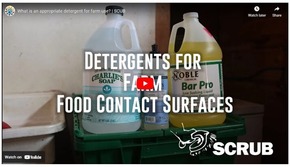
An unscented dye-free dish detergent is generally approved for use on food contact surfaces. Always check the labels to be sure. Laundry detergent is not approved to be used on food contact surfaces. For more information check out Detergents for Farm Food Contact Surfaces, created by UVM Extension Ag Engineering specifically for produce farms.
Additional resources to help address proper cleaning:
|

Current Grant Opportunities
-
Minnesota Grown: Did you know that Minnesota Grown now offers two cost-share programs? In addition to the Labeling and Signage Cost-Share, members can now reach additional consumers through a new cost-share to support e-commerce and digital marketing. This can support costs associated with website design, e-commerce, digital advertising, and digital marketing consulting and training, reimbursing 50% of eligible expenses up to a maximum of $3,000 per member per fiscal year. Become a member.
-
Minnesota Transition to Organic Cost-Share Program: This cost-share program assists farmers to work with an organic certifying agency while they transition to organic. Applications must be postmarked by February 14, 2024.
-
AGRI Good Agricultural Practices (GAP)/Good Handling Practices (GHP) Certification Cost-Share: Provides cost-share for growers and handlers certified to USDA GAP/GHP standards by an accredited certifier between May 16, 2023 and May 15, 2024. Submit your application by May 31, 2024.
Information about the next cycle of the Produce Safety Mini-Grant will be released and shared in a newsletter later this winter.
|
Recent Produce-related Outbreaks
-
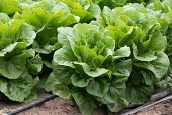
Don’t pick produce with poop on it. No Minnesota farms were part of a summer 2023 outbreak where 11,000 pounds of romaine lettuce were recalled, but the company that processes the lettuce is based in Minnesota. What went wrong? This outbreak was caused by an animal intrusion and poor harvesting practices when feces were present. What can you do? Ensure workers that are harvesting are trained to avoid any crops that appear to be contaminated and create a perimeter around the contamination. If contaminated crops are accidently harvested, the problem can grow exponentially when combined with other crops. Learn more about Preventing Produce Contamination- Identifying Animal Intrusion.
|
-
Wash your hands after using the bathroom and again before touching produce. Several E. coli cases were associated with consuming unpasteurized cider from a Minnesota orchard in fall 2023. What likely contributed to this outbreak were poor hygienic practices in the preparation of the cider. Hand washing is one of the most important steps you can take to reduce the risk of contaminating produce with illness causing pathogens. Learn when to wash hands and train employees on hand hygiene especially after handling livestock. Be sure to provide enough hand washing stations that are fully stocked for both customers and employees. Learn how to build a low-cost handwashing station for food safety on the farm.
|
Upcoming Events
It's conference season! Find Produce Safety Program staff, along with many other resources, at the following upcoming events:
Have an event you'd like us to participate in? Let us know!
Survey - metro ag land use and preservation
The MDA and the Metropolitan Council are working together to learn more about the needs of farmers in the 7-county metro region. This includes Anoka, Hennepin, Ramsey, Washington, Dakota, Scott, and Carver counties. The information gathered will be used to inform two things: 1) the Metropolitan Council’s agricultural and land use policies in its upcoming Regional Development Guide, and 2) farmland preservation work at the MDA.
If you are a farmer in the metro region, we invite you to share your thoughts with us on land policies through this 6-question survey. The survey will be open until January 24th.
If you have questions about the survey, please contact Michael Zastoupil (michael.zastoupil@state.mn.us) or MacKenzie Young-Walters (mackenzie.young-walters@metc.state.mn.us).
|
|