|
Having trouble viewing this email? View it as a Web page.
November 21, 2019
We Need Your Help
- Inspect all holiday greenery for elongate hemlock scale
- Distribute this pest alert to all business locations
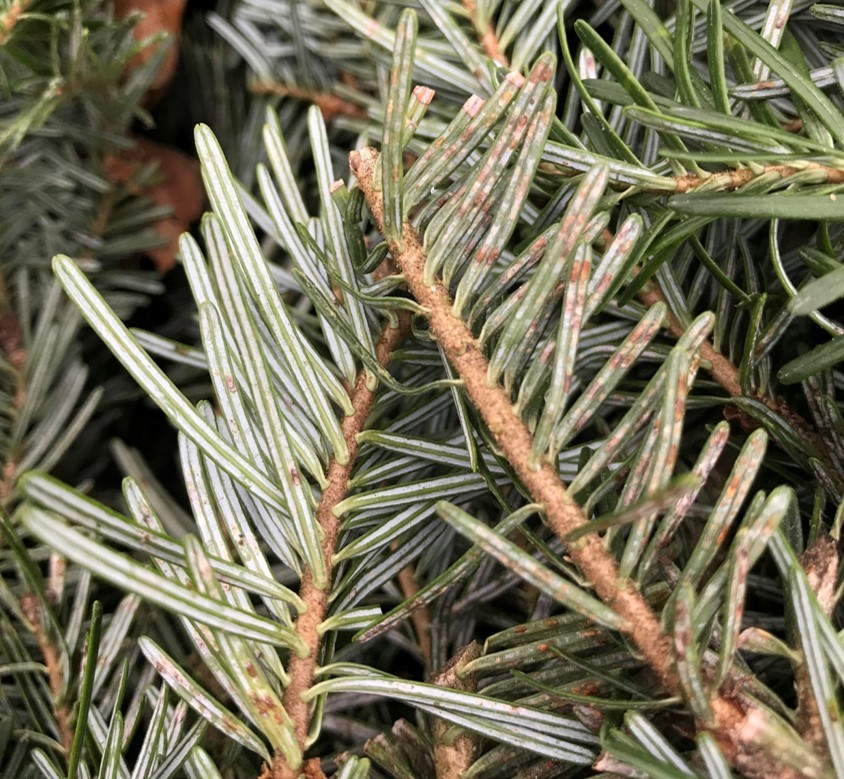
A fir branch infested with elongate hemlock scale. Lightly infested needles on the left and moderately infested needles on the right. Notice the "dirty" appearance of the moderately infested needles.
Elongate Hemlock Scale
Elongate hemlock scale is an invasive pest introduced into the United States from Asia. It feeds on a wide variety of conifers besides hemlock, including fir and spruce. To date, it has not been found in Minnesota forests or nurseries. However, infested Fraser fir trees and wreaths have been intercepted from a state on the eastern seaboard.
Once established, scale insects are difficult to control as they are protected beneath the scale covering most of their life. The use of chemical insecticides is possible; however, application timing is critical because only certain life stages are susceptible. Controlling this pest using chemical insecticides is possible for nursery stock and ornamental plantings but is not practical in naturalized settings such as a forest.
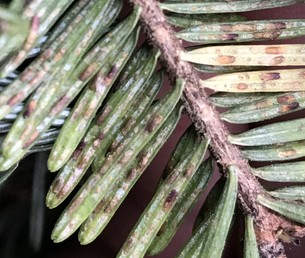
How to ID Elongate Hemlock Scale
Elongate hemlock scale is found almost exclusively on the underside of conifer needles. Given their small size and inconspicuous appearance, the elongate hemlock scale may appear to be dirt or debris to the untrained eye.
|
How You Can Help
- Visually inspect holiday greenery that was harvested from the Eastern United States. If you suspect an elongate hemlock scale infestation, remove the product from sale and contact the MDA immediately for an inspection.
- Inform suppliers that holiday greenery that is suspected to be infested with elongate hemlock scale will not be accepted.
- Distribute information to consumers on proper disposal of holiday greenery. A variety of consumer resources are available on the MDA website.
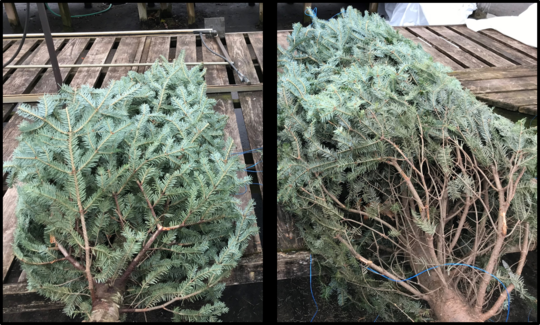 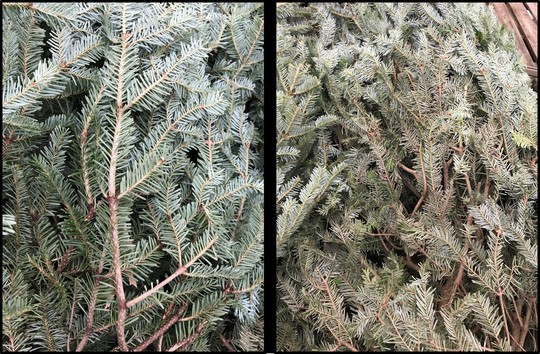 Left fir tree is not infested, right fir tree is infested with elongate hemlock scale. Notice that the coloration of the lower half of the infested tree on the right stands out compared to the top half.
Contact the MDA Nursery Program
Steven Shimek
Nursery Program Coordinator
steven.shimek@state.mn.us
651-201-6619
|