|
November 28, 2018
Palmer Amaranth Update
In 2016, Palmer amaranth was confirmed for the first time in Minnesota on newly established conservation plantings that were tied to a pollinator seed mix contaminated with Palmer amaranth seed. After all of the plantings associated with this seed mix were identified and management plans implemented by the Minnesota Department of Agriculture (MDA), to date no additional Palmer amaranth has been found at these locations. Extensive surveying and help from both the land managers and the Conservation Corps of Minnesota and Iowa has made a huge difference for the successful eradication of the plant.
Over the past five years, extensive outreach has helped spread the word about Palmer amaranth, including what the plant looks like, what to do when you come across the plant and who to contact. As the 2018 harvesting season was about to start, farmers in Redwood and Jackson Counties were scouting their bean fields for weeds and noticed plants that looked different than your typical water hemp and redroot pigweed. This was brought to the attention of both the University of Minnesota Extension (U of M) and the MDA. Both the MDA and the U of M sent staff out to investigate the suspect plants and to figure out possible pathways. Tissue samples were collected from both counties and genetically tested for species composition and herbicide resistance. The samples came back positive as Palmer amaranth and were found to be resistant to the active ingredient glyphosate.
These two new finds are the first field crop confirmations for Palmer amaranth in Minnesota. The Redwood County find resulted in four plants being found all in one general location and the Jackson County location only resulted in only one plant. MDA also intensively surveyed around the confirmed locations for five miles in each direction and no other Palmer plants were discovered. All plants were hand-pulled and destroyed early enough to prevent any seed production from occurring at either location. Currently MDA is investigating potential pathways and the U of M is providing increased outreach to growers in these areas.
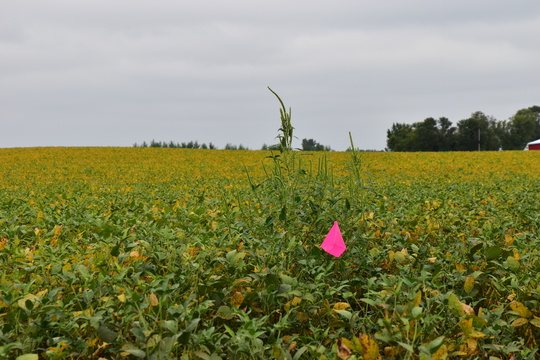 Palmer amaranth in soybean field
|