Monitoring for invasive woodborers
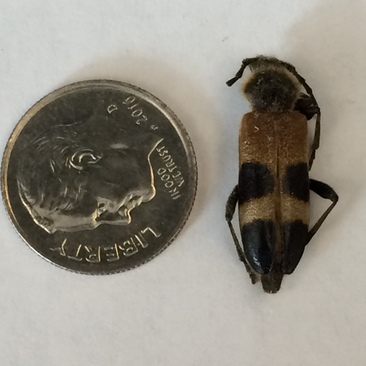
During the last year, a number of invasive woodborers have been detected by the MDA in wooden furniture and other products, including the brown fir longhorned beetle (Callidellum villosulum), the velvet longhorned beetle (Trichoferus campestris) and most recently the China fir borer (Semanotus sinoauster - see image below).
As a result of these detections, the MDA, with support from the USDA, is monitoring for invasive woodborers in and around urban areas of Minnesota during 2017. Since these species have been shown to move through retail pathways, the areas at greatest risk for introductions are likely those with the greatest densities of consumers, i.e., cities. As a result, a variety of insect traps are being monitored in cities throughout Minnesota for a suite of invasive woodborers.
The MDA is also monitoring intensively near the Minneapolis / St Paul airport for the velvet longhorned beetle (Trichoferus campestris). The USDA has captured this beetle during each of the last three years near the airport during regular monitoring work. As a result we are concerned that this insect may have a reproducing population in the area.
We have placed traps for velvet longhorned beetle throughout this area, and are also working with cities in the area to sample potential host trees in decline for presence of velvet longhorned beetle. This beetle has a potentially broad host range but fruit trees such as apples and mulberries may be preferred.
Read More
China fir beetle (Semanotus sinoauster) next to dime for scale. Photo by MDA.
Supported by the Environment and Natural Resource Trust Fund, 2016 was the third year that the MDA has implemented trap-based monitoring for BMSB. Trapping in 2014 yielded a single BMSB and in 2015 only three individuals were captured. However, during 2016 more than 200 adult BMSB were captured - all in the greater Twin Cities area. Moreover, many nymphs were captured at five sites as well (Chisago, Dakota and Ramsey Counties), conclusively demonstrating reproducing populations rather than hitchhikers from infested areas to the east.
During spring 2017, the MDA is monitoring sites with known or suspected established populations in order to identify periods of activity over the growing season. So far no traps have caught bugs this year, but residents in infested areas have described seeing BMSB active in their homes. The MDA will be expanding monitoring over the summer and fall to keep tabs on the distribution and abundance of this insect in Minnesota.
Read More
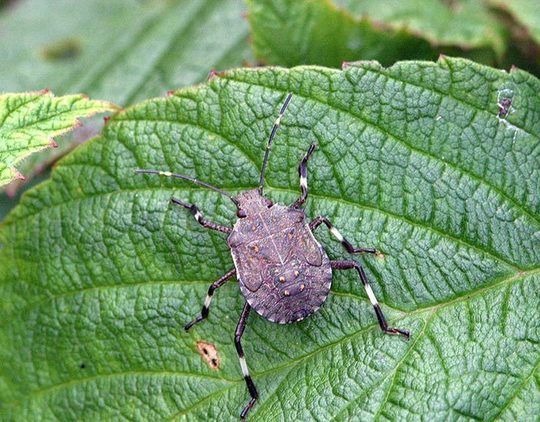 Brown marmorated stink bug nymph. Image by Gary Bernon, USDA APHIS, Bugwood.org
MDA’s EAB biological control
program is set to begin parasitoid wasp releases for the 2017 field season this
week. Three types of parasitic wasps, two that attack the larval stage and one
that attacks the eggs, are supplied to state cooperators by the USDA EAB
Parasitoid Rearing Facility in Brighton, MI. There are eight active biological
control release sites for the 2017 field season located in the southeast, Twin
Cities, and northeast Minnesota. Visit the EAB
biological control webpage for more information or contact Jonathan Osthus,
EAB Biocontrol Coordinator, jonathan.osthus@state.mn.us
(651-201-6248).
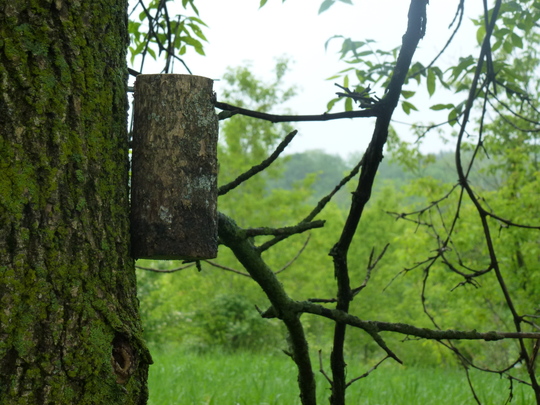 Ash bolt containing Tetrastichus planipennisi, a parasitoid of EAB. When T. planipennisi emerge from the bolt they begin parasitizing EAB in the area. Image by MDA.
White fringetree (Chionanthus virginicus) is a small tree native to the southeastern U.S. and also planted and grown in Minnesota as it can be hardy to zone 4. In 2015, research in Ohio determined that EAB was infesting and sometimes killing white fringetree as well as ash (Fraxinus spp.). This was big news since no other non-Fraxinus hosts have been documented in the U.S. despite extensive testing. For Minnesota, the main concern with EAB continues to be the impact to ash (Fraxinus spp.) trees. However, it is worth keeping in mind that white fringetree could also be affected by EAB before planting them in the landscape.
Read more
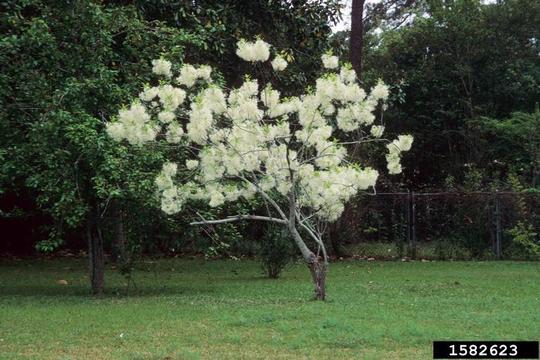 White fringetree. John Ruter, University of Georgia, Bugwood.org
The MDA is in the
process of redesigning its website. We would be very interested in hearing from
you about our current site and would appreciate it if you could take this brief
survey.
External User Website Survey Please complete the survey by Friday, May 26.
 |
|
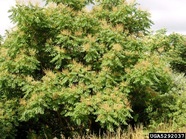
The May Weed of the Month is Tree of Heaven. Read about this species at the MDA website. |
|
The Minnesota Department of Agriculture has certified five firewood producers in the state of Minnesota for heat treatment of firewood. Look for the logo when purchasing firewood. It means the firewood is safe to move and is free of emerald ash borer.
Certified firewood producers:
- Emily Forest Products
- JN Firewood
- Minnesota Firewood LLC
- Paul's Fireplace Wood
- Price Firewood
- Sunset Firewood Company
|
|
 |
|