|
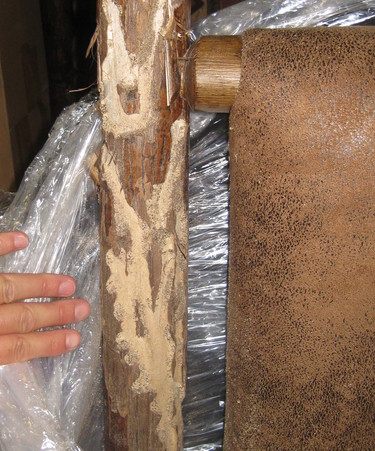
Insect tunneling on rustic log chair.
The Minnesota Department of Agriculture (MDA) asks Minnesotans who
may have bought rustic log furniture to look for signs of insect damage.
Insects can live in this type of furniture for two years or more.
In 2016, the MDA investigated two separate incidents of rustic log
furniture harboring invasive insects. The brown fir beetle (Callidiellum
villosulum) was found in rustic pine log furniture imported from China
into Minnesota. The velvet longhorned beetle (Trichoferus campestris)
was discovered in rustic walnut log furniture – described as hickory –
also imported from China into Minnesota. The MDA, as well as other
states where furniture was sold, and the USDA have worked with the
importers and customers at various retailers to collect and destroy
infested furniture, but it is possible that some infested furniture has
not been located.
Consumers that have rustic log furniture which was manufactured out
of the country should look for several signs of insect infestation.
-
Sawdust around the furniture – This may be a sign that insects are active in the wood.
-
Visible exit holes – Small round tunnels suggest that insects were in the furniture and have burrowed their way out.
-
Suspect wood damage – Loose bark with tunneling underneath may indicate that the wood was infested at some time.
The MDA urges customers who suspect they have purchased infested
furniture to contact the MDA’s Arrest the Pest line at 888-545-6684 or arrest.the.pest@state.mn.us.
Find more information on this issue at http://www.mda.state.mn.us/plants/insects/clhbeetle/detectingpresence.aspx.
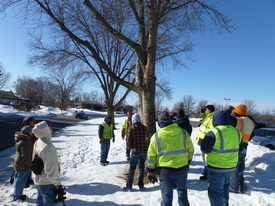
Minnesota Department of Agriculture staff will be leading
FREE emerald ash borer (EAB) field workshops in Rochester February 21-24, the
Twin Cities Metro area February 27-March 3, and the Duluth area March 7-9. The
hour-long workshops will begin each day at 9 am, 10:30 am and 1:30 pm. The
workshops will provide an opportunity to get a firsthand look at EAB-infested
trees and will help attendee's become familiar with early detection.
General EAB biology, distribution, management and regulations will
also be covered. Workshops are provided free of charge with support from the US
Forest Service.
You can sign up using the online registration form, by
e-mail Jennifer.Burington@state.mn.us,
or by phone at 651-201-6097. Maps and instructions will be provided with
registration confirmation.
|
Recent finds of EAB include forested areas south of Lake City (Wabasha County) and the City of Maple Grove (Hennepin County). Keep tabs on all the places where EAB is known to be present at the MDA website.
Users of the online map may have noticed the addition of a green boundary which helps to describe EAB-infested areas. The boundary is created by a function that buffers infested trees on the map and consolidates them into an infested area. The more infested trees in an area the larger the buffer that is created.
Whenever possible, please report suspected EAB-infested trees to the MDA. This is particularly important in areas that are not yet known to be infested, but is also helpful in known infested areas to better describe the degree of infestation.
An easy way to report EAB-infested trees is with the Great Lakes Early Detection app. You can also report trees to Arrest the Pest.
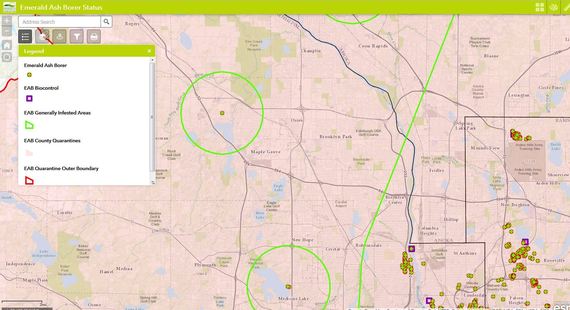 Screenshot from online EAB map showing location of infested area border and infested trees.
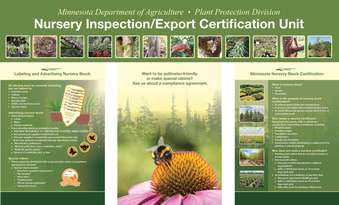 Nursery Inspection staff had a display at the Northern Green Expo, held
at the Minneapolis Convention Center on January 11-12. Inspectors
provided information on questions about nursery stock labeling,
pollinators and insecticides, plant hardiness and findings from the
previous year's inspections. The Expo is a great opportunity to maintain
positive working relationships with nursery certificate holders and
growers that ship nursery stock into the state. The Minnesota Department
of Agriculture Nursery Inspection Program has been part of this annual
show since 1988.
|
MDA Export Certification staff participated in a nationwide program
review with USDA recently regarding the phytosanitary certification process.
Phytosanitary certification is a critical step in exporting agricultural
products to other states and countries which typically require certain
factors be met regarding the condition of the product and verifying
pest-free status. Of particular note in the review was the process of allowing Federal Grain Inspection Service authorized companies to inspect grain for export. This is a critical component of meeting certification requirements during high volume export periods. During 2016, the MDA issued 3,625 phytosanitary certificates for 1.8 billion pounds of agricultural products. Find out more about the export certification process at the MDA website.
|