|
DODGE COUNTY - An emergency
quarantine was declared for Dodge County after emerald ash borer (EAB) was confirmed in the City of Kasson in early September. An EAB beetle
was found on a USDA trap and a follow up visit by MDA staff identified an
infested ash tree in the area. A public meeting will be held in the City
of Kasson on October 3 and a public comment period regarding the regulations
is open through October 21, 2016.
Dodge County Meeting
Monday, October 3, 2016
6:30-8:00 p.m.
Kasson-Mantorville Elementary School
606 16th Street NE
Kasson, MN 55944
ST. LOUIS COUNTY - Emerald ash borer was also
confirmed in a new area of Duluth near Hartley Nature Center in mid-September
after a report to MDA by a local tree service. As a result of the find, an emergency
quarantine was declared for the southeastern portion of St Louis
County. A public meeting regarding this find is scheduled for Wednesday,
October 12, 2016 at the Rice Lake City Hall and a public comment period will
be open until November 30, 2016.
St. Louis County Meeting
Wednesday, October 12, 2016
6:00-8:00 p.m.
Rice Lake City Hall
4107 W. Beyer Road
Duluth, MN 55803
The quarantine restricts the movement of wood that could
harbor EAB out of the quarantined area. This includes all species of ash
(Fraxinus sp.), nursery stock, ash logs, ash lumber, ash chips/mulch,
wood packing materials constructed with ash and all species of hardwood
firewood.
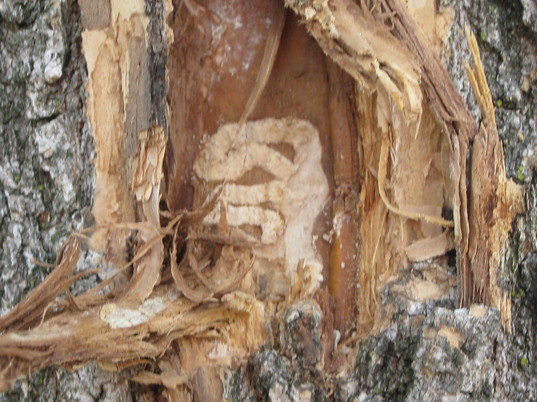
EAB larval gallery beneath bark
Cyst nematodes are tiny organisms that can harm plant health. Some nematodes are of particular concern due to the threat they pose to both production and market access for Minnesota crops. Seed potatoes are at particular risk due to the presence of two exotic cyst nematode species affecting potatoes (Globodera rosochiensis and G. pallida) in other areas of North America. Cysts can remain alive in the soil for 20 years and are spread by soil on seed tubers and machinery.
With funding from the USDA, the Minnesota Department of Agriculture samples seed potato fields on an annual basis to ensure freedom from these cyst nematode species as well as others. This is a critical function because seed potato producers who wish to export to other countries such as Canada need to demonstrate freedom from these nematodes through survey.
Read more about these nematode species and the Cyst Nematode Survey at the Minnesota Department of Agriculture website.
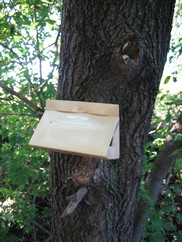 So far in 2016 the MDA has recovered 1,183 gypsy moth
from survey
traps which already surpasses the 2015 statewide total of 1,052
moths. Collections are complete for all gypsy moth survey detection
traps from
central Minnesota to the Iowa border, but Northern staff continue to
remove traps with the goal of finishing by late October. We expect
total statewide catch totals
to climb as the remaining 5,700 traps are removed in the coming
weeks.
Trap captures are down in
southern Minnesota compared to
2015 but are climbing in northern Minnesota. Populations crashed in
northern Minnesota after the polar vortex in 2013 / 2014 and traps
captured only
523 moths statewide in 2015 compared to over 71,000 moths captured
(mostly in northern Minnesota) during 2013. Final survey results for
2016 will be
available in late October-early November.
|
Soggy weather means that conditions are right for plant
diseases to flourish. Wet weather this
summer has had that effect with needlecast diseases on white and
Colorado spruce. Although needlecast is
quite common, the incidence and severity of infections are on the rise.
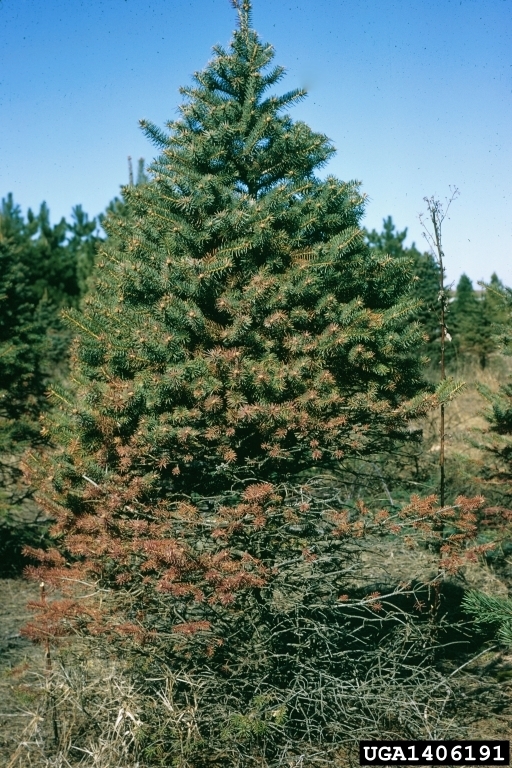
Rhizosphaera needlecast is caused by Rhizosphaera kalkhoffii and has been the most common needlecast disease and problem found during nursery inspections this year, resulting in the most trees restricted from sale in decades. Inspectors look for this
disease on the north side and low on the tree where humidity is greatest and
needles stay wet the longest. Weed
growth and close spacing between trees compounds the moist environment and promotes disease development.
Within the last few years, a new needlecast has been
identified. Stigmina Needle Cast is
associated with the fungus Stigmina
lautii and has signs and symptoms similar to Rhizosphaera. To distinguish between the diagnostic signs
of these fungi requires microscopic examination. Because of this it is possible that Stigmina
is more widespread and has been misdiagnosed as Rhizosphaera.
For more details, refer to North Dakota State University
(NDSU) Publication F1680, “The Old and the New:
Two Needle Diseases of Spruce in North Dakota”. https://www.ag.ndsu.edu/pubs/plantsci/trees/f1680.pdf
Spruce tree with Rhizosphaera needlecast. Picture by US Forest Service North Central Research Station. Bugwood.org

Don’t forget to register for the
Upper Midwest Invasive Species Conference (UMISC) in La Crosse, Wisconsin,
October 16-19, 2016. Fall colors should be at their peak just in time to enjoy a
scenic hike, bike ride, or paddle on the Mississippi River after learning about
the latest tools and state-of-the-art techniques to improve invasive species
management. Visit www.umisc.net
for more information.
|
Central territory
David
Simmons
As the season is shifting from summer to fall David has been focused on grower
inspections. His Inspection Reports
indicate many incidents of tree cankers and Rhizosphaera needle cast. Aside from powdery mildew David is also
finding rust and bacterial diseases in quaking aspen this season. Melampsora rust and Marssonia spot are two
diseases that are prolific when we have a rainy season.
Southern territory
Eric
Nooker
Trees in the southern part of the state are looking good this year. Aside from cankers, and wet season diseases
like anthracnose; Eric has been spotting pest like Zimmerman pine moth, and
bronze birch borer in nursery stock.
Eastern territory
Steven Shimek
In the eastern part of the state wet weather is promoting leaf and needle
diseases. Inspection data shows spruce
gall midges and adelgids are being found this time of year too. Uncommonly seen lirula needle blight was also reported by Steven in
the eastern part of the state.
Northern territory
Deborah Davis Hudak
Deb has shifted from growing inspections to
export related inspections. Needle
diseases in spruce and pine are still being found in the northern territory and
soon Deb will be inspecting Japanese beetle traps.
Metro territory
Josh Plunkett
Trees in the metro area are reported as being healthy this year. Tree liners are also showing good
survivorship. However, while plenty of rain is great for growing
trees Josh reports tree spades being less able to enter wet fields this
fall. Many reports of
Rhizosphaera needle cast have come Josh’s way this fall and he still continues
to see stock advertised as pollinator friendly.
 |
|
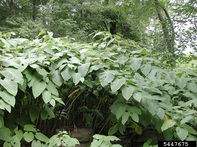
September's Weed of the Month is giant knotweed. Read all about giant knotweed at the MDA website. |
|