|
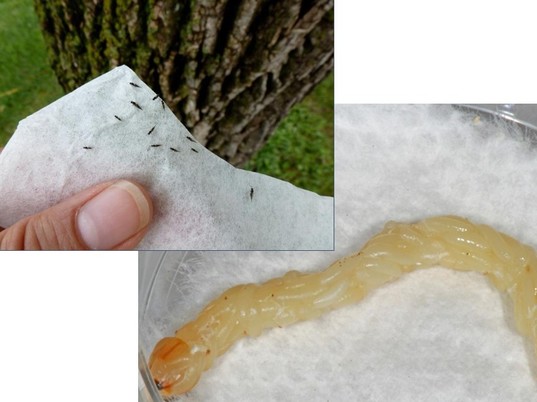
The Minnesota Department of Agriculture will begin releases of Tetrastichus planipennisi
in the next week. This parasitic wasp lays its eggs within EAB larvae
and the developing wasp larvae consume the EAB during their development.
The MDA has been releasing this species since 2010 and has been able to
document its establishment in southeastern Minnesota.
Image at top left is of adult Tetrastichus planipennisi. Image at bottom right is of a parasitized EAB larva.
While we are approaching the beginning of EAB emergence, the bulk of the population is still in larval development so this is a good time for this species to be released. As we get closer to peak emergence of EAB, the MDA will also begin releasing Oobius agrili which lays its eggs in EAB eggs. This species has also been released in Minnesota since 2010 and the MDA has been able to document parasitism occurring in both southeastern Minnesota and the Twin Cities metro.
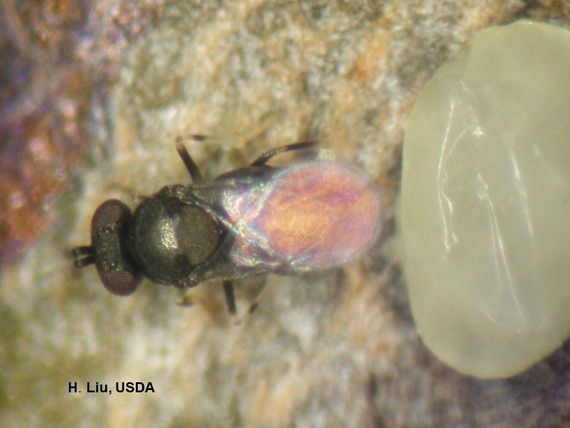 An Oobius agrili adult wasp parasitizing an EAB egg. For size reference, EAB eggs are about the size of a pencil tip.
The hope is that these species
will be able to suppress populations of EAB and slow the rate at which
trees are killed. This work is made possible by the USDA EAB Parasitoid
Rearing Facility in Brighton, Michigan who provide the wasps to
Minnesota and the rest of the EAB-infested states. EAB biological
control in Minnesota is supported by the State of Minnesota Environment and Natural
Resources Trust Fund as recommended by the Legislative Citizen Commission on Minnesota Resources.
More on EAB biological control:
http://www.mda.state.mn.us/plants/pestmanagement/eab/eabbiocontrol.aspx
Gypsy moth
detection survey will begin May 23 in southern Minnesota and June 6 in northern
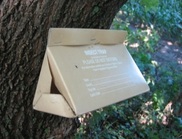
Minnesota. Nearly 18,000 survey detection traps (see image at left) will be
monitored by the MDA during 2016. Gypsy moth has been moving westward across
the U.S. since the late 1800's, but both the state and national gypsy moth
survey programs have been extremely successful at slowing their spread.
Currently only 1/3 of available host range within the U.S. has established
gypsy moth populations. The survey program identifies isolated gypsy moth
populations along the western edge of its range and targets aerial treatments
to slow the advancing front. To date, Minnesota has treated over 820,000 acres
slowing this devastating insect from spreading further into the state.
Currently gypsy moth is only established in Cook and Lake Counties in northeast Minnesota.
Treatments are scheduled to begin in early June. Treatments
target either the larvae or the adult stage of development. Based on 2015
survey results, there are five areas totalling 6,879 acres in Minnesota where
gypsy moth treatments are needed this year. Larval treatments will be
implemented in the Two Harbors and Ely areas during early June and a treatment
to disrupt mating by adult moths will be implemented in late June in Houston
County. For more information on 2016 treatments visit: www.mda.state.mn.us/gypsymoth
or call the Arrest the Pest at 1-888-545-MOTH (6684).
|
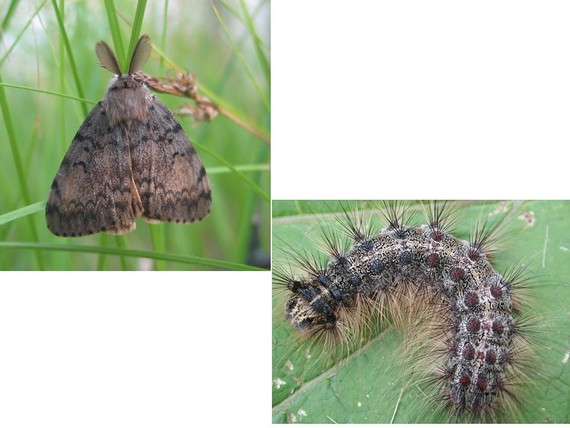 Image at top left is a male gypsy moth, image at bottom right is a gypsy moth larva.
 |
|
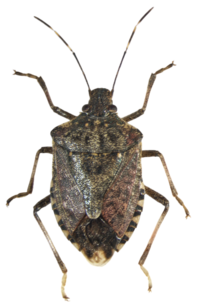
The brown marmorated stink bug appears to be getting a foothold in Minnesota. Since the beginning of 2015, there have been 29 confirmed finds of this species in Minnesota compared to 20 from 2010 through 2014. Many of these finds could have been hitchhikers from other states, but there have also been indications of reproducing populations in some parts of the greater Twin Cities Metro.
The MDA is monitoring for this insect through a variety of surveys in different systems and is encouraging residents to report possible sightings of the brown marmorated stink bug to Arrest the Pest.
Keep tabs on where this insect has been found here:
http://www.mda.state.mn.us/plants/insects/stinkbug.aspx
|
 |
|
May 1 through September 30 is considered the active season for emerald ash borer. Don't prune or remove ash trees in infested areas unnecessarily during this time to avoid spreading EAB beetles. |
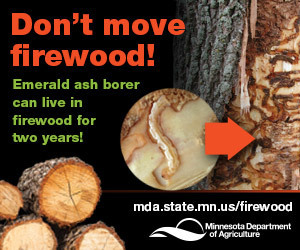
As emerald ash borer and gypsy moth populations increase in Minnesota and neighboring states, there is an ongoing need to remind people that these pests are often moved to new places in (EAB) or on (gypsy moth) firewood. During the summer recreation season, remember to pass on the message to others: always use local or MDA certified heat-treated firewood.
|