|
Monday, January 4, 2016
Emilie Justen,
Minnesota Department of Agriculture
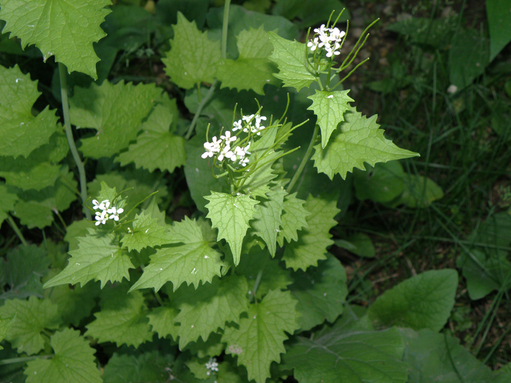
Flowers and leaves of garlic mustard.
January’s Weed of the Month is garlic mustard (Alliaria petiolata). Garlic mustard is
an edible, biennial herb that emits a strong garlic odor. It was brought to the
United States from Europe as a culinary herb. It has naturalized in many
eastern and midwestern states. In Minnesota, it is widespread in the southern
part of the state and is spreading north.
Garlic mustard is highly invasive. It grows in woodlands,
and along trails and waterways. It outcompetes native understory plants,
becoming detrimental to wildlife habitat and biological diversity. Garlic
mustard forms rosettes after seed germination in early spring. In its second
year, it forms upright stems that produce flowers in May and June. Seeds begin
to develop in slender pods shortly after flowering and are the plants’ primary
means of spread.
The plant has distinctive characteristics to distinguish it
from other woodland plants. In the rosette stage, the leaves are heart-shaped
with toothed margins. When it matures, the leaves along the stem are triangular
and the small, white, four-petaled flowers are produced in clusters at the tops
of the stems. The plant produces slender seed capsules. Seeds can be spread by
water and soil movement on boots and equipment.
Garlic mustard is a restricted noxious weed and cannot be
transported, sold, or intentionally propagated in Minnesota. It is recommended
that this species be prevented from spreading to new areas and that smaller
populations be eradicated.
Managing garlic mustard takes persistence and a focus on
preventing flowering, making timing a key component to management.
- Regular site monitoring for several years will be required to ensure that new seedlings are destroyed and the seedbank is depleted.
- Hand pulling may be practical for small infestations. Pull plants prior to flowering to prevent seed production. Flowering plants can continue to set seed following removal of soil.
- Mowing of bolted plants prior to flowering can prevent seed production. All equipment should be inspected and cleaned prior to moving into new areas.
- Foliar herbicide applications may be effective. If using herbicide treatments, check with your local University of Minnesota Extension agent, co-op, or certified landscape care expert for assistance and recommendations.
For more information on Weed of the Month, contact Allen Sommerfeld, MDA Communications, at allen.sommerfeld@state.mn.us or 651-201-6185.
|