Cesar Chavez Day in Minnesota (March 31)
 Representative Carlos Mariani (65B) gives speech on the Minnesota House floor on the impact Cesar Chavez had on the Latino and greater community.
March 31 is Cesar Chavez Day in Minnesota.
Click image to view video of Rep. Mariani's speech
Read statement presented to the House of Representatives below
 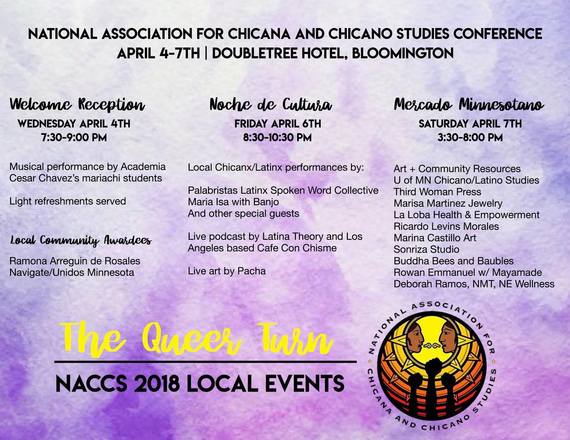 On Wednesday, Bloomington Minnesota will become the host of the 2018 National Association For Chicana and Chicano Studies Conference (NACCS).
Registration is still open and there are several events planned during the week that are open to the public.
Click on the image above for more information
Reads statement presented by Rep. Mariani to the House of Representatives:
Minnesota
Cesar Chavez Day
March
31
In 2014, the Minnesota
Legislature passed HF 1631/SF1509 designating March 31 as Cesar Chavez Day. It
is now coded as MN statute 10.555.
The law seeks to
provide the citizens of Minnesota the opportunity to learn about and appreciate
the Latino community and their contributions to our state. Furthermore, it
focuses on our state’s history of migrant farmworkers– the very people Cesar
Chavez committed his life to achieve social justice.
Each year, tens of
thousands of migrant agricultural workers are recruited to Minnesota for work
in farm fields and food processing plants. Most are permanent legal residents
of the United States from the border region of southern Texas and many are recruited
from Mexico and Central America.
Various Minnesota state
laws have been enacted to cover farmworker employment terms, work conditions,
health, education, housing, access and human rights. All are necessary to ensure
the dignity of farmworkers and the prosperity of our state’s agricultural
sector.
U.S. and Minnesota Farmworker History
Since its inception,
the United States’ economy has relied on migrant labor. Whether it was the
forced enslavement of Africans or the recruitment of Mexicans and Chinese, the
country depended on low-wage workers to bolster its agricultural and industrial
systems. During the early twentieth century, Mexican nationals and US citizens
of Mexican descent served as the foundation for migratory labor in the Midwest.
Mexican migrant labor
to the Midwest was fueled by the railroad, sugar beet and meat packing
industries. The first to initiate hiring Mexicans in Minnesota, railroad
companies often went into Mexico or Texas to recruit workers. The
housing arrangements provided by the railroad companies were atrocious.
According to a 1927 national housing survey, boxcars provided by the Burlington
Railroad Company in Inver Grove Heights, a St. Paul suburb, were the worst in
the entire nation. Even decades later, in 1946, a survey conducted by the
International Institute reported that of all St. Paul residents, Mexicans lived
in the poorest conditions.
The largest industry
to hire Mexican migrants was the sugar beet companies. The most
prominent company, American Beet Sugar, was founded in 1899 and changed its
name to American Crystal Sugar in 1934. American Beet Sugar recruited Mexican
workers, known as “betabeleros,” from neighboring states and along the
US–Mexico border with the promise of housing and credit at neighborhood stores.
Compared to other
Midwestern states, whose migrants were mainly single men, Minnesota early on
had a high concentration of women and child migrants. This changed the social
fabric of the state. Mexican women contributed to the
economy by working outside of the home and becoming positive role models for
their children.
Migrant workers most
often experience racial and class discrimination. Even if migrant workers are US
citizens, they are stereotyped as foreign because of their racial identity.
Workers’ families are also subject to discrimination. Children of migrant
workers who attend schools and participate in youth activities are not always
welcomed by their peers. Often, these experiences create feelings of isolation,
especially if families only stay in the area for the short growing season.
Like farm labor,
factory work bolstered migration. Urban Midwest cities saw migration growth due
to the expansion of the meat packing industry. After World
War I, meatpacking plants dominated employment of Mexicans in St. Paul. This
trend increased migration to urban areas, moving families away from farms to
the West
Side neighborhood. Meatpacking industry jobs were considered the most
stable and sought after because they were year-round. In the twenty-first
century, these positions continue to flourish and attract numerous migrant
workers to maintain the factories.
As a community
organizer and as an inspiration to workers in Minnesota, Cesar Chavez improved
the lives and working conditions of millions of Latinos nationwide. He
dedicated his life to advocating for labor rights, political representation for
ethnic minorities, environmental justice and registering voters.
Cesar Chavez
“The love for justice that is in us is not only
the best part of our being but it is also the most true to our nature.”
Born in Yuma, Arizona, to immigrant
parents, Chavez moved to California with his family in 1939. For the next ten
years they moved up and down the state working in the fields. During this
period Chavez encountered the conditions that he would dedicate his life to
changing: wretched migrant camps, corrupt labor contractors, meager wages for
backbreaking work and bitter racism.
As a student, Chavez
attended schools where Spanish was forbidden. He remembers being punished with
a ruler to his knuckles for violating the rule. He also remembers that some
schools were segregated.
He enlisted in the
U.S. Navy in 1946 and upon leaving the service he became a migrant farm worker.
Cesar’s introduction to labor
organizing began in 1952 when he met Father Donald McDonnell, an activist
Catholic priest. He read about St. Francis and
Gandhi and was introduced to the action of nonviolence as an instrument to
drive social change.
In 1962, Cesar founded
the National Farm Workers Association, later to become the United Farm Worker (UFW)
and was joined by the dynamic organizer, Dolores Huerta.
In designing the UFW Eagle symbol,
Cesar chose an Aztec eagle to evoke the cultural historical identity of Mexicans
as a way to animate action: “It gives pride . . . When people see it they know
it means dignity.”
A major turning point came in September
1965, when the fledgling Farm Workers Association voted to join a strike that
had been initiated by Filipino farm workers in Delano’s grape fields. Within
months Chavez and his union became nationally known. Chavez’s drawing on the
imagery of the civil rights movement, his insistence on nonviolence, his
reliance on volunteers from urban universities and religious organizations, his
alliance with organized labor and his use of mass mobilizing techniques (such
as a famous march on Sacramento in 1966) brought the grape strike and consumer
boycott into the national consciousness. The boycott, in particular, was
responsible for pressuring the growers to recognize the United Farm Workers.
The first contracts were signed in 1966
but were followed by more years of strife. In 1968 Chavez went on a fast for
twenty-five days to protest the increasing advocacy of violence within the
union. Victory came finally on July 29, 1970, when twenty-six Delano growers
formally signed contracts recognizing the UFW and bringing peace to the
vineyards.
Cesar made people aware of the
struggles of farm workers for better pay and safer working conditions and
succeeded through nonviolent tactics (boycotts, pickets and strikes). His work
centered on the importance and human dignity of all farm workers – and of
Latinos in general given their historical and heavy presence as workers in the
U.S. agricultural sector. As such, Cesar Chavez will be remembered as a major
American leader of the 20th century.
Sources:
https://www.history.com/topics/cesar-chavez
http://www.mnopedia.org/group/migrant-workers
|