In this edition:
-
Improving housing stability for survivors of domestic violence and sexual assault will be focus of March 4 MICH webinar
-
New agency webpages address misinformation and provide facts on programs and services
-
MICH is hiring for an Executive Assistant!
-
Overview of Minnesota’s fraud response on February 25 Office of Addiction and Recovery webinar
- Minnesota Housing Community Reviewer Program launch and info session notice
- Community Reviewers needed for crime victim services grants, applications due February 26
-
Submit proposals for the 2026 Office of Justice Programs Conference on Crime and Victimization by March 10
-
You helped reduce homelessness in Minnesota
Join us for the next MICH webinar on Wednesday, March 4 from 1 - 2 p.m. If you have any questions about your webinar registration, please email dan.gregory@state.mn.us
On the March 4 webinar, learn how the Office of Justice Programs is working with community to remove barriers to housing stability for survivors of domestic violence and sexual assault.
Though MICH webinars are not the ideal place to address individual circumstances, MICH is committed to following up if people do raise specific questions or concerns.
The beginning 10 minutes of each monthly webinar will be held to hear from the Speakers Bureau. Anyone who has lived experience of homelessness is welcome to sign-up to share through the Speakers Bureau. This is open time each month for lived experience experts to share ideas and feedback with the webinar audience.
The next webinar Speakers Bureau will be on Wednesday, March 4 at 1 p.m. There is a monthly prep session held the Tuesday before the webinar. The prep session will be Tuesday, March 3 from 11-11:30 a.m. Follow this link to join the prep session. This is an ongoing opportunity that happens each month. Sign up is required. Not able to make that time work, but still want to share on the Speakers Bureau? Please email dan.gregory@state.mn.us or call/text Dan at 651-983-9985 to schedule a conversation or with any questions.
Recent statements and actions by the federal government and other online sources have created uncertainty about public programs Minnesotans rely on every day.
Several MICH agencies have taken steps to push back on the amount of misinformation being perpetuated against essential services by launching webpages aimed at setting the record straight. These sites offer factual information to combat claims currently circulating online.
Click the links below to learn how agencies are addressing misinformation:
Join our team! The Minnesota Interagency Council on Homelessness is hiring an Executive Assistant, and we're looking for phenomenal candidates to support our efforts to move toward housing, racial, and health justice for people facing homelessness.
The deadline to apply is Monday, March 9. Click here for a position description, pay and benefits, and information on applying.
This role will provide executive-level administrative and operational support to the Assistant Commissioner/Executive Director and help coordinate the day-to-day operations of MICH. They play a key part in keeping interagency work moving smoothly by managing coordination, communications, and operational processes that support MICH’s mission.
We hope you'll apply or share this opportunity with your networks!
The next Office of Addiction and Recovery (OAR) monthly webinar will be held on Wednesday, February 25 from 11 a.m. to 12 noon.
The February session will include:
-
Updates from the Office of Addiction and Recovery
-
An overview of Minnesota’s fraud response with John Connolly, Deputy Commissioner - Minnesota Department of Human Services
-
MN Health Standards with Jennifer Dugan, Director - Minnesota Department of Education
These monthly updates share addiction and recovery initiatives with partners, highlighting important work happening inside and outside state government.
Minnesota Housing is launching their Community Reviewer Program on March 2, 2026! Applications are due by April 1. The Community Reviewer Program will compensate community members, especially those that have faced housing challenges, to serve as Community Reviewer Consultants in Minnesota Housing’s grant programs. Community Reviewers will work alongside state employees to read and score applications and help decide which entities should receive funding. This program prioritizes community engagement, partnership, and collaboration, and allows for more community-led decision making in their programs.
Minnesota Housing is limiting the number of applications for the Community Reviewer Program to no more than 500. Minnesota Housing will accept Community Reviewer applications until the April 1, 2026, deadline or until they receive 500 applications, whichever comes first. They encourage interested community members to attend a Community Reviewer Information Session and apply early if interested in this opportunity.
Our state is home to communities of all types with the expertise, insights, and commitment to take on the toughest housing issues. We are committed to including voices from these communities in our processes. Minnesota Housing recognizes that historical and institutional injustices have disproportionately created housing challenges and disparities for various oppressed communities. We recognize the importance of involving community in finding solutions.
To learn more, join an information session where Minnesota Housing will provide an overview of the program, how to apply, and answer questions.
Register to join an info session:
-
Wednesday, February 25, 2026, 11 a.m. to Noon: Register
-
Wednesday, March 11, 2026, 5:30 p.m. – 6:30 p.m.: Register
The Office of Justice Programs (OJP) is recruiting community reviewers for the 2027 crime victim services grant review process. They are interested in a broad range of individuals as grant reviewers, including those with backgrounds in crime victim services, youth services and other social services, public health, law enforcement, program evaluation, education, state government, and other community activities. Prior grant review experience is helpful but is not necessary.
Why be a grant reviewer? Serving in this capacity is a great way to help make decisions that support crime victim services across the state. It also offers unique insights into the grant-making process for those interested in expanding upon and improving their own grant-writing skills. Even if your organization will be applying for funds under this process, you may still be a reviewer.
As a bonus, reviewers who are interested and fully participate in the process could be eligible for a $200 payment – see below for required activities for reviewers.
-
Submit a conflict-of-interest form, declaring any conflicts with the proposals received.
-
Complete and submit necessary paperwork to serve as a state grant reviewer and receive a payment, if requested.
-
Attend the 30-minute virtual training about reviewing funding proposals (or watch recording).
-
Read, rate, and fill out comment sections for approximately 8 proposals on how well they responded to the RFP, (it is anticipated that each proposal review takes approximately 60 minutes).
Tentative Review Timeline:
-
March: Receive notification you have been chosen as a reviewer and provided information about next steps. (If you are not chosen, you will not receive notification). If you have elected to be paid for your complete participation, you will receive information about this process.
-
April: Participate in virtual reviewer training session.
-
May: Receive review materials and have about 2 weeks to review and score all applications.
If you are interested and available, please complete this Grant Reviewer Application by Thursday, February 26. You will be notified in March if you’ve been selected to be a reviewer.
There is time to send in your proposal for the 2026 Annual Office of Justice Programs (OJP) Conference on Crime and Victimization, an in-person, two-day conference to be held in the greater Twin Cities metro area on June 3 - 4, 2026. OJP is taking proposal applications until March 10, 2026.
The 2026 conference is designed to provide a forum for compelling topics, informed practice, and emerging responses, presented by subject matter experts in crime victim services and allied disciplines. OJP welcomes all professionals to learn, share, and engage with one other. All sessions will be offered in-person.
The schedule will feature 60-minute, 90-minute and plenary presentations, while still offering familiarities like the exhibitor fair and medallion hunt.
Additional details to note:
Please reach out to Joann Jones with any questions about a presentation, or the conference.
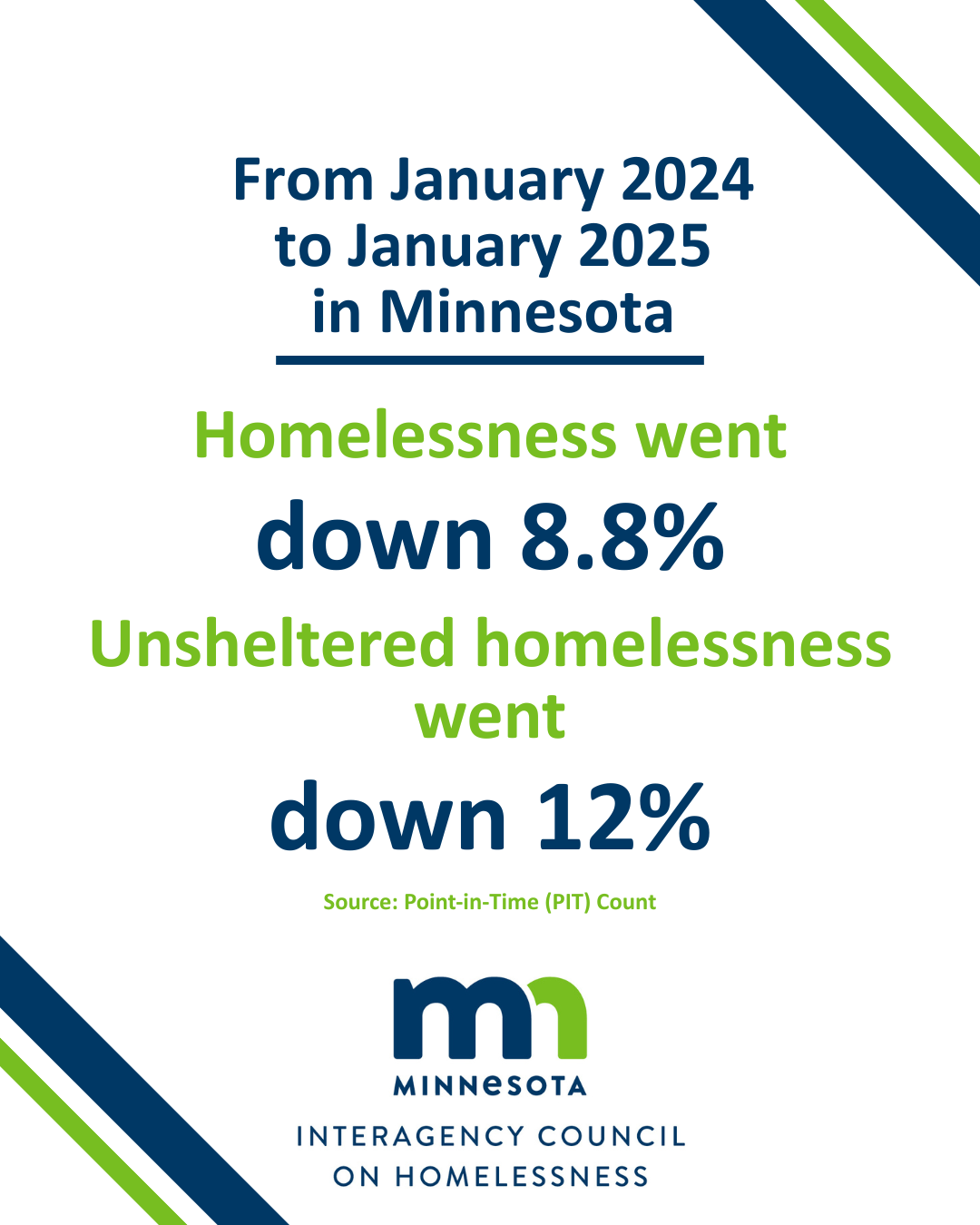
The annual Point-in-Time (PIT) Count conducted on January 22, 2025 reflects an 8.8% decrease in the number of Minnesotans facing homelessness compared to the year before, and a 12% decrease in the number of unsheltered Minnesotans.
We know it takes ALL of us working together to bring our neighbors home, so thank you for your dedication to housing, racial, and health justice for people facing homelessness.
Learn more about the 2025 PIT Count and Minnesota’s commitment to proven solutions to ending homelessness on our Facebook, Instagram, and LinkedIn posts.
|