In this edition:
-
The latest impacts of the federal shutdown on SNAP and MFIP from DCYF
-
Join the November 5 MICH webinar to learn more about homelessness among Native Americans in Minnesota
-
Listen to the MICH Council Meeting on November 4
-
Public comment period for Qualified Allocation Plans closes on November 14
-
Applications open for Distressed Building Program through November 19
-
Applications open for Property Owner Risk Mitigation Fund Program through December 5
-
NAEH: How HUD’s Delays Will Impact Local and State Governments
-
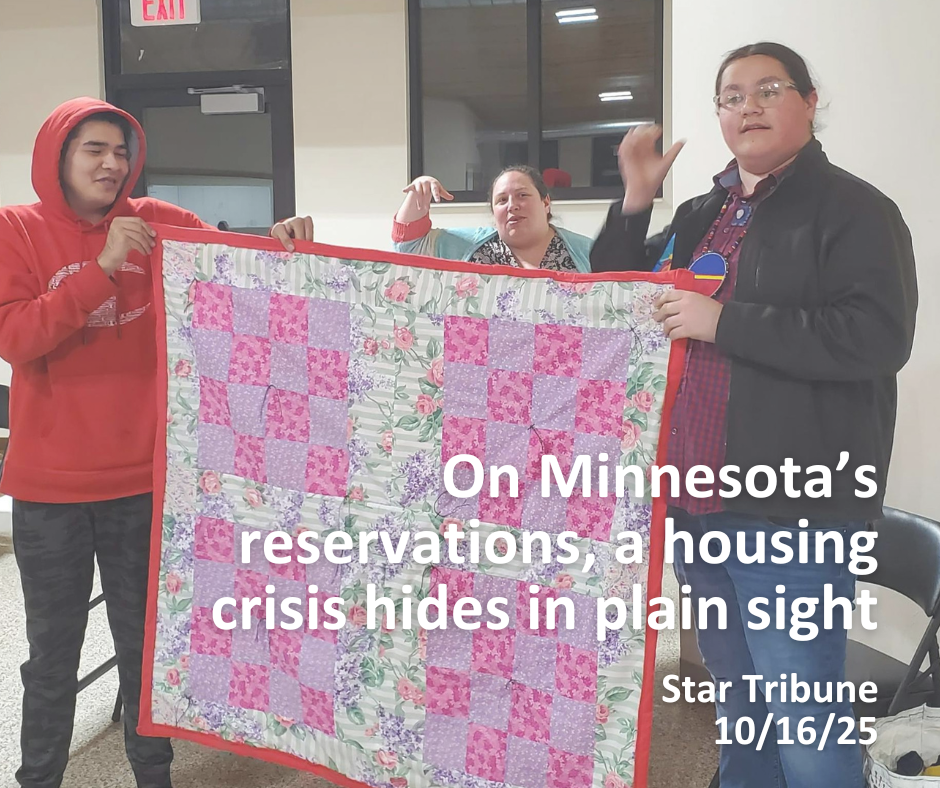
MICH featured in Star Tribune article, “On Minnesota’s reservations, a housing crisis hides in plain sight”
The Minnesota Department of Children, Youth, and Families (DCYF) is providing timely and transparent communications to partners. DCYF is providing these updates to keep their partners informed about the impacts of the federal shutdown on DCYF programs and services, and their work to mitigate those impacts on the people they serve across Minnesota. Their goal is to share what they know, when they know it, even when they have little information to share in an environment that is fluid and ever-changing. (Please note that at this time DCYF is only providing these updates electronically, so ensure your clients are either subscribed or hear from you via word of mouth.)
DCYF has been alerted of a text scam claiming that all Minnesota residents qualify for emergency food relief. The text asks recipients to click a link to claim funds. DCYF is writing information to include on their public website alerting readers about the scam. Additional information for partners will be posted on their PartnerLink website and sent in daily partner emails this week.
-
SNAP and Minnesota Family Investment Program (MFIP) food benefits will not be issued for November. MFIP cash benefits will continue to go out.
-
Each month, 440,000 Minnesotans access Supplemental Nutrition Assistance Program (SNAP) grocery benefits, 36% of which are children and 18% are seniors. It is a vital benefit supporting our neighbors in all 87 counties and tribal nations.
-
Commissioner Tikki Brown joined Governor Walz at a press conference to announce $4 million in funding for food shelves. Governor Walz issued a press release summarizing the announcement.
-
Fiscal year 2026 grant funding from the Minnesota Food Shelf Program and the Regional Food Banks Grants program and additional one-time funding for food shelves and food banks will also be distributed beginning in November.
-
This money will help provide some relief to local food shelves and food banks, but it cannot make up for the $74 million loss per month of federal funding through SNAP and MFIP food.
-
DCYF’s child support division provided guidance to county and Tribal child support staff regarding parents who owe child support and are federal employees affected by the shutdown.
-
DCYF received communication from the USDA confirming the impacts of the shutdown on November SNAP benefits. The documents are posted on their PartnerLink webpage toward the bottom of the page.
Join us for the next MICH webinar on Wednesday, November 5 from 1 - 2 p.m. If you have any questions about your webinar registration, please email dan.gregory@state.mn.us
On the November 5 webinar, go deeper on briefs about homelessness among Native Americans from Wilder Research’s Minnesota Homeless Study and Reservation Homeless Study.
Though MICH webinars are not the ideal place to address individual circumstances, MICH is committed to following up if people do raise specific questions or concerns.
Our next MICH Council Meeting is just around the corner! Tune in on Tuesday, November 4 from 12:30 – 2:30 p.m. to hear updates on the Crossroads to Justice strategic plan and the impact of federal actions on our efforts to provide pathways to housing, racial and health justice for people facing homelessness in Minnesota.
Register for the live-streamed event at https://tinyurl.com/MICHCouncilNov2025
While this meeting is open to the public and we hope you join and listen in to the Council’s discussion, there is no public testimony during the meeting.
Minnesota Housing is proposing amendments to the 2024-2025 Housing Tax Credit (HTC) Qualified Allocation Plan (QAP) and 2026-2027 QAP, including the 2026-2027 Self-Scoring Worksheet. These updates are intended to align with recent changes in federal and state law. Minnesota Housing is also proposing to extend the QAP by one year to be the 2026-2028 QAP so that it is also applicable to the 2027 Multifamily Consolidated RFP/2028 HTC funding rounds.
The proposed changes are outlined in the Summary of Proposed Amendments to the 2024-2025 Housing Tax Credit Qualified Allocation Plan and the 2026-2027 Qualified Allocation Plan.
You are encouraged to review the proposed QAP changes and provide comments on the changes before the public comment period ends at 5:00 p.m. Central Time on Friday, November 14, 2025. If you would like to comment by phone, please contact Kelly Winter at 651.297.5142. Written comments must be submitted by the public comment deadline. Email comments to htc.mhfa@state.mn.us or send by mail to:
Minnesota Housing
ATTN: Tamara Wilson
400 Wabasha St. N, Suite 400 St. Paul, MN, 55102
Minnesota Housing will review and consider feedback and public comments submitted during the public comment period. Presentation and final action on these amendments are expected to occur at Minnesota Housing’s board meeting in December 2025.
Minnesota Housing is accepting applications for the Community Stabilization: Distressed Multifamily Rental Building Program (Distressed Building Program) Request for Proposals (RFP).
Minnesota Housing is accepting applications for the Property Owner Risk Mitigation Fund Program. Applications are due by 4:30 p.m. Central Time on Friday, December 5, 2025.
Click here for application materials and eligibility.
The Property Owner Risk Mitigation Fund (RMF) Program is intended to reduce risks to property owners in efforts to expand housing opportunities for households with barriers to accessing housing or those unable to obtain housing without additional funding coverage or guarantees in place. Grant Proceeds are used to create or expand risk mitigation programs to recruit and engage property owners, reimburse property owners for damages or other eligible costs, link property owners and renter households to tenancy support services, and establish other strategies to support property owners serving eligible households.
Households served by property owners under this Program must be eligible under the Family Homeless Prevention and Assistance Program (FHPAP) guidelines outlined in the FHPAP Program Guide.
In a recent blog, the National Alliance to End Homelessness (NAEH) details how the U.S. Department of Housing and Urban Development (HUD)’s delays of the FY2025 Continuum of Care (CoC) Program funding will hurt communities:
On July 3, 2025, HUD unexpectedly announced to CoCs and recipients of CoC Program funding to expect a new competition for FY2025 CoC Program funds. This announcement disregarded the two-year planning process that communities already underwent last year, when HUD issued a two-year Notice of Funding Opportunity (NOFO) for FY2024 and FY2025 funds following Congressional approval.
Now, three months later, this new NOFO has still not been released. Due to the government shutdown, the NOFO will not be released until the government reopens. This inevitably means there will be significant delays in funding, which will cause homeless services providers to not be able to serve the people who need it the most.
Typically, it takes six months or more from the issuance of the NOFO to the awarding of funds. These resources are then awarded to more than 7,000 projects in nearly 400 local, regional, or statewide CoCs.
If HUD were to follow the same timeline for this current NOFO this late in the year, the earliest awards could be announced would be the end of May (or possibly even later, given the reductions in HUD staff). Some grants will begin expiring in January, with more set to expire each month thereafter.
MICH Implementation Consultant Sheri Snetsinger shared her story as part of a recent article from the Star Tribune about homelessness among Native Americans. The article examined two new issue briefs from Wilder Research’s 2023 Homeless Study and 2023 Reservation Homeless Study; find both studies here. (As a reminder, we will be going more in-depth on these briefs on the November 5 webinar!)
Chi-miigwech to Sheri and MICH’s Deputy Director Mary Riegert-Soyring for contributing to this important article and conversation!
|