In this edition:
-
See you on the July 9 webinar!
-
2025 State Legislative Summary on Housing Stability
-
Minnesota Tribal Collaborative honored with DHS Commissioner’s Circle of Excellence Award
-
Building Together: Black Men Working to End Homelessness
-
RFP due July 21: Create Social Service Access Hubs for New Americans Across Minnesota
-
Homeless and housing organizations in Bemidji support one another following devastating storms
Be sure to join the next monthly webinar tomorrow, Wednesday, July 9 from 1 - 2 p.m. If you have any questions about your webinar registration, please email dan.gregory@state.mn.us
Topics for the July 9 webinar include:
-
Heading Home Corps program
-
Presentation on Local Affordable Housing Aid from Department of Revenue
-
2025 Legislative Session overview
The Minnesota State Legislature completed the work to pass a two-year biennial budget during a special session on June 9, 2025. The session dynamics this year included a $456 million budget surplus for the FY 2026-27 budget, but a projected shortfall of $6 billion in FY 2028-29. The DFL and GOP split control of the House, 67-67, for only the second time in the state’s history, while the Senate DFL held a one-seat majority, 34-33.
Despite a challenging state budget outlook, state lawmakers and Governor Walz not only struck a budget compromise that takes substantial steps in managing Minnesota’s finances responsibly: they also protected, and in some areas increased, investments in housing stability.
Click here for a summary highlighting the increased investments in housing stability from the 2025 state legislative session.
Minnesota Department of Human Services (DHS) Deputy Commissioner Nikki Farago and Homelessness, Housing and Support Services Administration Assistant Commissioner Eric Grumdahl recently recognized the Minnesota Tribal Collaborative to Prevent and End Homelessness with a Commissioner’s Circle of Excellence Award.
The event, which took place on June 18 at Black Bear Casino in Carlton, Minnesota, also served as an opportunity for members of the collaborative to reflect on their accomplishments and results from their 11-year fight against housing instability within Tribal populations in the state.
The collaborative was praised for their work to forge and deepen partnerships to strategically build resources and culturally grounded solutions to address persistent problems. “You demonstrate what it means to unite in purpose, honor sovereignty and build the brightest future for each and every Minnesotan by showing that everyone deserves a place to call home, the dignity of stability, the opportunity to thrive,” said Farago.
In recent years, the group’s work has seen a ripple effect, even gaining nationwide recognition. Members of the Minnesota Tribal Collaborative partnered with Wilder Research to gather hard data for better understanding and documenting the prevalence of and circumstances leading to housing instability among Tribal members. Last April, leaders of the collaborative shared their expertise, including sovereignty advocacy, at the National Human Services Consortium.
They are key partners in the implementation of the Minnesota Interagency Council on Homelessness’ Crossroads to Justice Strategic Plan, which outlines key goals for housing, racial and health justice across state agencies and partners.
Pam Hughes, a collaborative member of Bois Fort Band of Chippewa, said about the Minnesota Tribal Collaborative, “we do this work, for our people, for our relatives. Our relatives have struggles, and we have struggles because of historical trauma.” She added that while housing instability is a longstanding systemic issue among American Indians, they are not without a sense of home — Indigenous land forever remains their home. “The lands run deep in our relatives. It’s our culture and traditions that start that healing process.”
Learn more about the Minnesota Tribal Collaborative to Prevent and End Homelessness at https://mntribalcollaborative.org/
A new national outreach and engagement campaign is seeking to connect Black men working to prevent and end homelessness with one another. Their goal is to advance opportunities for Black men to serve in leadership roles in the field and to inform the design and delivery of services for Black men experiencing homelessness. The initiative, “Building Together: Black Men Working to End Homelessness,” is asking Black men interested in learning more to complete an Interest Survey to join the conversation. Find the survey at https://www.surveymonkey.com/r/BMEH
The Minnesota Department of Human Services (DHS), through its Resettlement Programs Office, is seeking to Create Social Service Access Hubs for New Americans Across Minnesota. The goal is to establish a network of statewide service hubs that ensure access and support for new Americans to navigate available social services to meet basic needs during their process of seeking or maintaining legal status and authorization for employment.
Services funded through this RFP will focus on new Americans who do not have access to federally funded benefits or social services, with a particular focus on areas of the state where existing services are unavailable, insufficient or inaccessible.
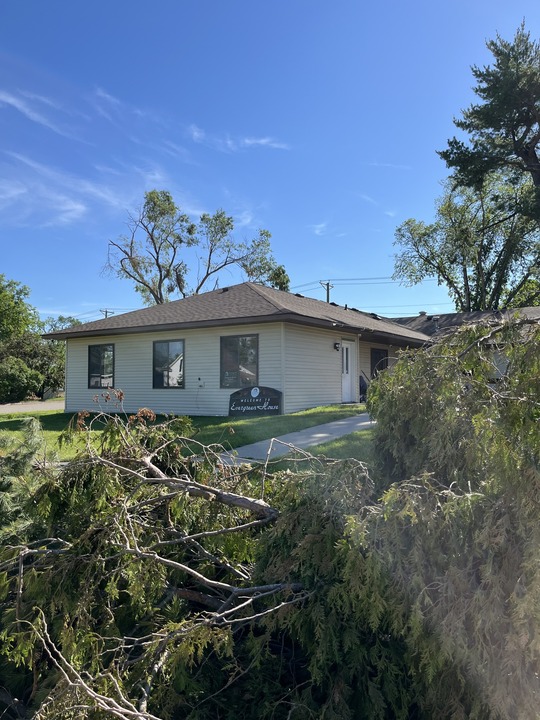
Straight-line winds pummeled Bemidji and the surrounding area overnight on June 21. Countless trees were downed, and hundreds of buildings were damaged – including those of local homeless shelters and transitional housing organizations.
When MICH staff joined Lieutenant Governor Peggy Flanagan for a visit and conversation with these organizations, we were able to see the damage firsthand. But what also stood out were the stories of a community well-practiced in collaboration and focused on resilience in the face of adversity.
|