|
Legislative Update
Now that the legislative session has concluded, I've enjoyed spending more time back home in the district connecting with residents, local businesses, and community leaders. While summer brings plenty of opportunities to celebrate our communities, it also gives me a chance to hear directly from constituents about the issues affecting their daily lives. One topic that comes up frequently is the state's financial outlook and whether government is spending taxpayer dollars responsibly. As we review the results of this year's session, I wanted to provide an update on the budget and some of the major decisions that were made.
|
|
Budget Update: Responsible Spending and Long-Term Stability
One of the biggest issues we discussed this session was Minnesota's long-term fiscal outlook. While the state entered session with a projected $3.7 billion balance due largely to stronger-than-expected tax collections, that positive balance does not change the fact that Minnesota is facing a structural deficit in the coming years.
A structural deficit means government spending is projected to grow faster than the revenue coming into the state. According to the February forecast, Minnesota is expected to spend roughly $2.3 billion more than it takes in during the 2028-29 budget cycle. If additional inflationary spending is added to programs where it is not automatically built into law, that gap could grow by another $1 billion. In other words, the surplus we have today does not solve the underlying problem. If we do not change course, future legislatures will be left with difficult decisions.
For that reason, I was encouraged that much of the spending approved this year focused on core government responsibilities rather than creating large new ongoing programs. We still had to make some important investments. One of the largest was support for HCMC and other hospitals that are facing significant financial pressures. More than $250 million of health and human services spending was directed toward hospital stabilization efforts, including funding for HCMC, critical access hospitals, and provider support. This funding came with strings of course, to ensure that the hospital will get back on the right track overall without the need for further bailouts. While I generally believe policy years should focus on policy rather than major spending increases, ensuring that Minnesotans continue to have access to healthcare services required action.
We also made investments to strengthen oversight and accountability. The Legislature approved approximately $32 million to establish and staff the new Office of the Inspector General. After years of fraud scandals involving taxpayer-funded programs, improving our ability to detect, investigate, and prevent fraud is essential. Additional savings and reforms were also included in human services programs to improve billing oversight, compliance, and fraud prevention efforts.
Many of the largest spending increases this year were not new initiatives but forecast-driven costs tied to public healthcare programs. Medical Assistance alone required more than $1.1 billion in forecast adjustments, while MinnesotaCare costs increased by nearly $250 million. These costs reflect rising healthcare expenses and enrollment trends that lawmakers have limited control over once they are built into statute.
At the federal level, discussions continue regarding human services programs and provider revalidation requirements. We all want to ensure taxpayer dollars are protected and that public programs serve the people they are intended to help. At the same time, legitimate providers should not be caught in unnecessary red tape. The revalidation process should be efficient, timely, and accurate so that qualified providers can continue serving Minnesotans while bad actors are identified and removed from the system.
The final fiscal spreadsheets are still being completed, so the official numbers may change somewhat in the coming weeks. Once those figures are finalized, we will have a better understanding of the full budget impact of this session.
|
|
Reminder: A Note about our Communications this Interim
Now that the legislative session is over, we have entered the interim period, when much of our work shifts away from daily activity at the Capitol and back into our districts through meetings, community events, and constituent outreach.
I want to make you aware of an important restriction that applies in even-numbered years. We are limited in sending unsolicited mass communications from our official capacity as legislators during the 60-day period before a general election. Because of that requirement, I will no longer be able to send these official email updates beginning July 17th.
During that time, I plan to continue sharing updates primarily through my Facebook page, and you are always welcome to contact me directly by email or phone with any questions, concerns, or ideas. It is an honor to serve our communities, and I look forward to staying connected throughout the interim.
|
|
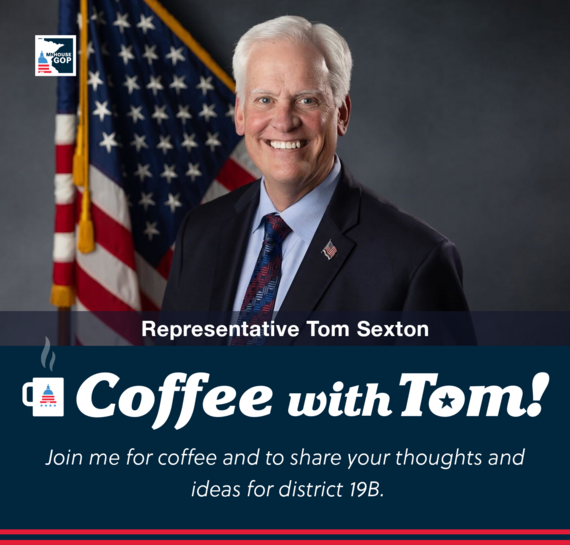
Coffee with Tom
Coffee with Tom will be at the Owatonna Chamber of Commerce on Friday, July 11th from 12:00pm –1:00pm (delayed one week due to the Independence Day holiday).
Coffee with Tom will be at the Waseca Chamber of Commerce on Friday (today), June 19th from 12:00pm –1:00pm and on Friday, July 17th from 12:00pm –1:00pm.
Thank you for your support and feedback, and please reach out if you need assistance in the meantime!
|
|
I want to hear you
I am always here to listens to concerns or ideas of my constituents. I can be reached via email rep.tom.sexton@house.mn.gov or phone 651-296-5368.
 If you would like to contact Rep. Sexton, DO NOT reply to this email. Please reach out directly to rep.tom.sexton@house.mn.gov.
|
|
|
|
|