|
Good morning!
The 2026 legislative session ended after a final push at the Capitol on Sunday night to complete our work for this year. With a tied House and a one-seat Senate majority, Minnesota had divided government in practice. That reality shaped everything that passed, and just as importantly, everything that did not.
It is worth being clear: if Democrats had full control of state government, many of the tax relief measures included this year would not exist.
Tax Relief for Minnesotans
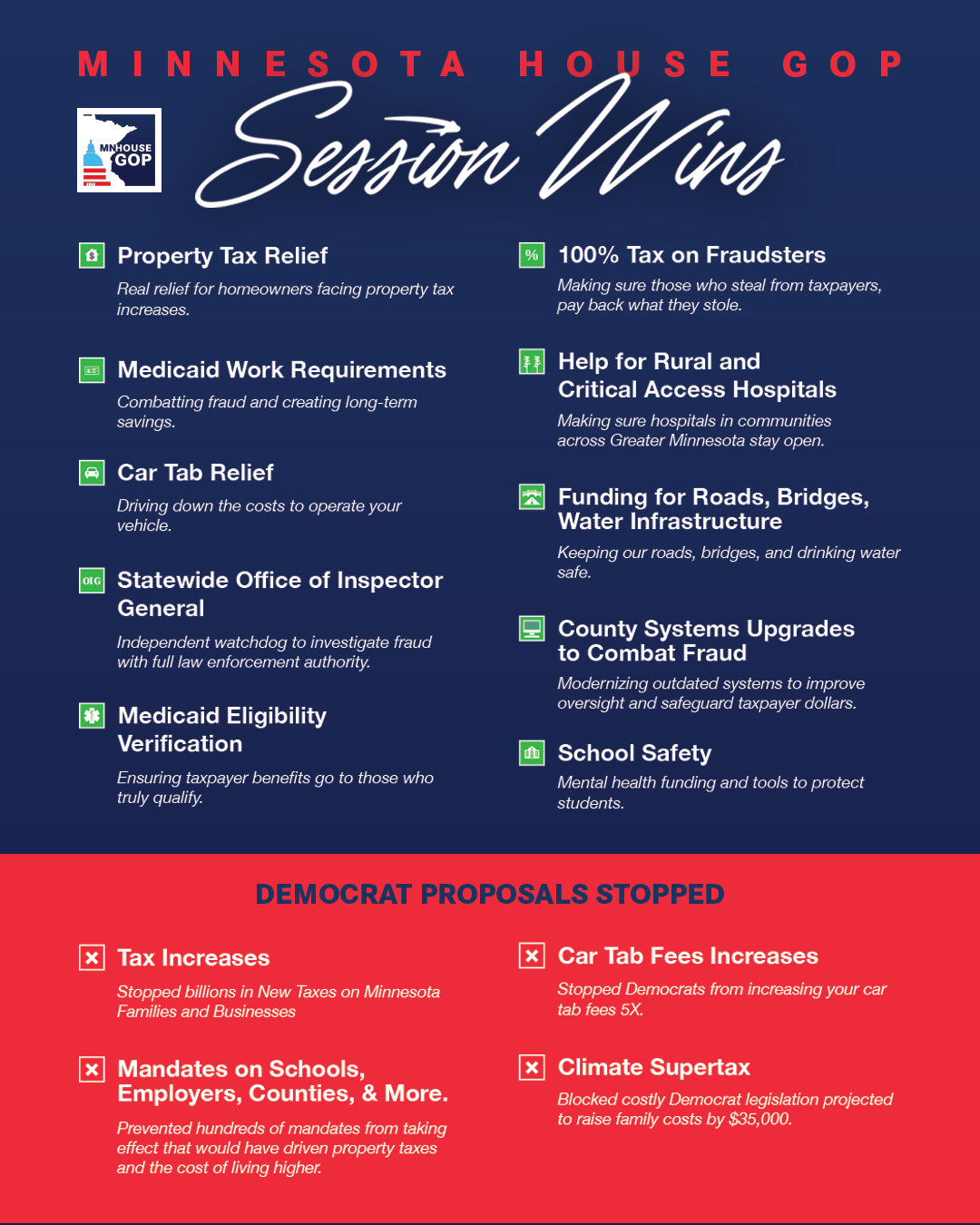
Republicans worked to secure targeted tax relief in a difficult political environment where every provision had to be negotiated line by line in a closely divided Legislature. We expanded the property tax refund, increasing relief for homeowners who have seen steady increases in property tax bills driven by rising home values, local levy growth, and broader cost pressures. This expansion helps more Minnesotans offset a portion of those costs and provides direct, practical relief tied to one of the most significant ongoing expenses for families and seniors. We also secured a one-time reduction in vehicle tab fees, delivering immediate savings for drivers across the state. With the cost of owning and operating a vehicle continuing to rise, this provides short-term relief for Minnesotans who rely on their vehicles for work, school, and daily life, especially in rural areas where transportation options are limited.
These measures are practical and focused. They are not broad restructurings of the tax code, but targeted changes designed to reduce pressure in areas where families are feeling it most right now. In addition, we supported investments to modernize county IT systems across Minnesota. Many of these systems are outdated and create inefficiencies, delays, and vulnerabilities in how local governments process services and manage data. Modernization improves speed and reliability for residents while also strengthening safeguards against fraud, reducing duplication, and helping prevent system failures that can cost taxpayers money.
Stronger Fraud Oversight
A major reform this session was the creation of an independent Office of the Inspector General, which has now been signed into law. This office is designed to strengthen oversight of state government by providing a dedicated office focused specifically on identifying, investigating, and addressing fraud, waste, and misuse of taxpayer dollars. Unlike traditional oversight structures, it is set up to operate independently from the Governor’s office, with its own authority and law enforcement powers to conduct investigations across state agencies and programs.
This is a meaningful step toward improving transparency and restoring trust in how government operates. At the same time, structure alone is not enough. The effectiveness of this office will ultimately depend on how it is implemented, how aggressively it pursues cases, and whether it is able to deliver real results in reducing fraud and improving oversight.
We will be watching closely as it begins its work. If it proves effective, it can become a key part of Minnesota’s accountability system. If it falls short, there will still be a responsibility to continue evaluating additional reforms to ensure taxpayer dollars are fully protected.
 Stopping Tax Hikes and Extreme Proposals
Republicans also played a key role in stopping a number of proposals that would have significantly increased taxes and overall costs for Minnesotans.
That includes a proposed new top income tax bracket, which would have raised rates on high earners and further increased Minnesota’s already-high standing among states with the highest income tax burdens. It also included a broad-based wealth tax on assets such as farms, small businesses, homes, investments, and other property. These types of proposals create ongoing uncertainty for families and business owners, since they are based on fluctuating asset values rather than actual income, and they can be especially difficult for agriculture and other asset-heavy industries where value does not match annual cash flow.
In addition, we stopped efforts to significantly increase vehicle registration fees. These increases would have added another recurring cost for Minnesotans at a time when households are already dealing with higher prices for housing, utilities, insurance, and everyday goods. For many families, especially in rural Minnesota, vehicle costs are not optional and are essential for work and daily life.
Taken together, these proposals would have increased financial pressure on working families, farmers, and small business owners while also adding new layers of complexity and uncertainty to the state’s tax system.
We also opposed extreme gun control proposals that raised serious constitutional concerns. These measures went far beyond reasonable regulation and would have placed new restrictions on law-abiding gun owners, including hunters and recreational shooters. In practice, they would have turned common activities and normal firearm use into potential criminal violations, which is why we opposed them and worked to ensure they did not become law.
Thank You!
This session showed how important it is to have engaged constituents who stay involved and make their voices heard. Your input and support help shape the work we do at the Capitol and keep us focused on practical priorities like tax relief, accountability, and protecting constitutional rights.
Thank you for your continued support and for the opportunity to represent you.
|