Legislative Update
 Dear friends,
Happy May! With just 14 days left until we adjourn sine die, it has been a race to the finish line—every conversation, every vote, and every late night on the House floor matters.
I am excited to share a few big updates with you, so let's dive in!
If "No Kings," Why the Mandates?
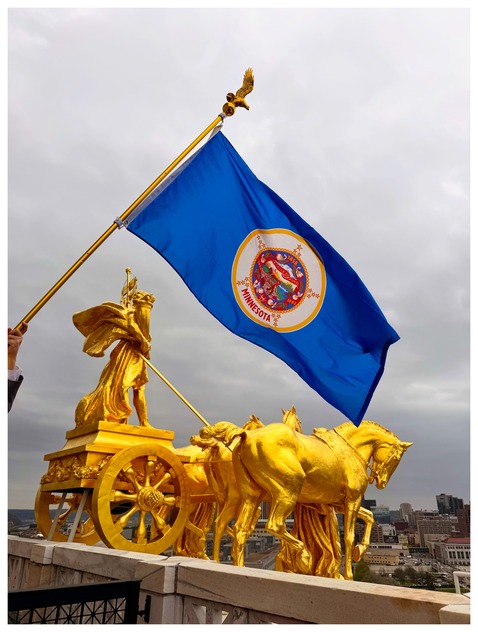
Above, we have Minnesota’s beautiful state flag, symbolic of rich with Minnesota's history and vast culture. Most of you will remember the sudden flag change that happened in 2024, selected by the 13-member State Emblems Redesign Commission. This commission, appointed by the governor, voted 11-1 to adopt the new flag.
Many Minnesotans across the state are fed up with the new design. They feel it doesn’t represent Minnesota at all, and many have pointed out how closely it models the official flag of the country of Somalia. And for something that represents all 5.7 million Minnesotans, the public never truly had a vote in the process—which understandably hasn’t sat well with a lot of folks.
And this week, things took an even more surprising turn.
Eight Minnesota DFL lawmakers have proposed a bill that would penalize cities and counties that do not fly the 2024 Minnesota state flag.
“The commissioner of revenue must reduce the aid to a county or city … ten percent if the county or city flies or otherwise makes use of a state flag other than the design of the state flag as certified in the report of the State Emblems Redesign Commission,” the proposal says.
In simple terms: fly the flag chosen by 13 people—or lose your local government aid.
This is an excellent example of just how far Democrats are willing to go. Not only is this a complete infringement on local control, it directly impacts the communities that can least afford it. Many townships in rural Minnesota rely heavily on that funding for roads, emergency services, fire departments, and police protection. Local government aid exists specifically to support smaller cities with lower tax bases so they can fund critical needs—and now, that funding is being used as leverage.
And here’s where the irony really writes itself.
We continue to hear loud “no kings” rhetoric—but this proposal essentially says if you don’t fly the flag chosen by a small, appointed group, you will be punished. That’s not collaboration—that’s coercion. When 13 people make a decision for 5.7 million, and then enforce it with financial penalties, it starts to look a lot less like democracy and a lot more like top-down control.
Representative Freiberg and others have signed onto this bill, seemingly comfortable with the idea that a decision made by a small commission should carry consequences for entire communities that simply disagree. That doesn’t reflect Minnesota values—it disregards them.
Let’s be clear: communities should not be punished for choosing to honor a flag that they believe represents their history. A flag that symbolizes unity, the blood, sweat, and tears of our forefathers, and the relationships built between settlers and Native Americans—working through difficult times at the beginning of our statehood to build something lasting together.
To cast that aside without giving Minnesotans a real voice? What a shame.
But here’s the bottom line: this bill is going nowhere.
We will stop this effort. We will stand up for our rural communities. And we will ensure that local governments are not bullied into compliance by having their funding threatened.
Because we do believe in “no kings.” And that means no mandates, no punishments, and no top-down decisions that ignore the voices of the people.
Putting Minnesotans First: A Tax Relief Plan That Delivers
 |
We continue working towards lowering taxes in the State of Minnesota. It is evident that people are moving out of the state—I have heard from many friends back home that thousands of people are packing up and leaving due to high taxes. And because of the 18 billion dollar surplus spent down during the Democrat trifecta, the 10 billion dollar tax increase, and continued government growth, Minnesotans are really feeling the squeeze.
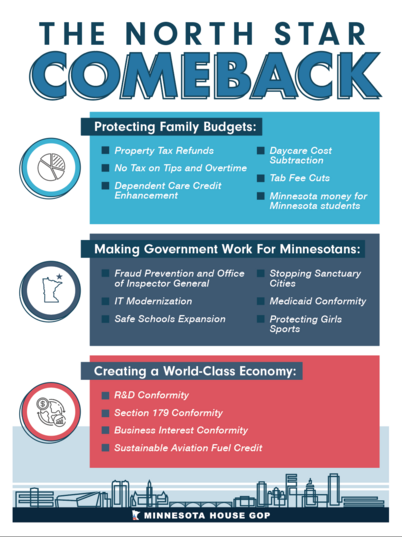
Since we are in a tied House, we are working hard to work with our Democrat colleagues in the House (we need their vote to pass any bills) to push our tax bill, which will be one of the largest tax cuts in Minnesota history. In a tied chamber, nothing moves without cooperation—so every negotiation matters and every vote counts. This year, House Republicans proposed the largest tax cut in state history: $3.8 billion as part of our North Star Comeback budget plan.
It’s a focused, practical approach to making Minnesota more affordable, getting government back on track, and strengthening our economy. The proposal reflects what we’re hearing from Minnesotans across the state—at kitchen tables, in small businesses, and in community conversations, and at the center of the plan is protecting family budgets.
Right now, families are feeling squeezed from every direction. Groceries, childcare, housing, insurance, and energy costs keep rising—basically everything except maybe your patience at the checkout line. People are working hard but still falling behind. Our plan is built to respond to that reality and deliver meaningful relief where it’s needed most.
It is a 3.8 billion dollar tax cut plan which includes: no taxes on tips/overtime, lowering childcare costs, car tab fee reduction, property tax refund, an independent Office of Inspector General to crack down on fraud, and creating a more competitive, world-class economy that actually works for the people who fund it.
We also aim to return budget surpluses to taxpayers, provide a one-time property tax refund, end the tax on Social Security, repeal the automatic gas tax increase, and repeal the delivery tax (because paying extra just to get your own package delivered has officially reached “enough is enough” territory).
I’ve been hearing from constituents across the district that this is exactly what the people of Minnesota need—and I will work tirelessly every day to get this across the finish line. At the end of the day, this is about one simple goal: making Minnesota more affordable so people can afford to stay, build, and thrive here—not feel pushed out.
22 Raids, Too Late? The Fight Against Fraud Continues
Another big breakthrough this week on the fraud front.
When I’m home in the district, people ask me all the time: “Joe, when are we finally going to get justice for the stolen funds and these fraudsters?” The truth is, it takes time. Federal prosecutors have to build their cases, and due process has to run its course—but this week, we finally got some answers.
On Monday, the FBI conducted raids on 22 sites across the Twin Cities. The concern, however, is that these raids came a little too late. Since the first reports of rampant fraud began flooding in across Minnesota, there has been time for evidence to be moved, cleaned up, or lost in the shuffle. In my view, this is exactly why timing matters so much in these cases.
That said, as a legislature, our job is not law enforcement—it’s lawmaking. And that distinction matters. We operate in the legislative branch, not the judicial or executive branches. So while we can’t conduct raids or prosecutions, what we can do—and must do—is tighten the laws so this never happens again.
That’s exactly what we’re focused on in our fraud committee work: closing loopholes, strengthening oversight, and making sure taxpayer dollars are protected from the start.
House Republicans have made stopping fraud a top priority this biennium, and we’re continuing that work every step of the way.
We’ve introduced House File 1, the Office of Inspector General (OIG) bill, which remains a cornerstone of our accountability efforts. It already passed the Senate 60–7, showing strong bipartisan recognition that fraud is a real problem that needs real enforcement tools.
We also recently introduced the Fraud Isn’t Free Act, which would create real consequences for agencies and commissioners who allow fraud to go unchecked, as well as legislation to establish clearer statutory safeguards for programs that are at high risk for fraud.
Because the bottom line is this: departments that enabled fraud in the first place cannot be the same ones trusted to simply “clean it up” without stronger guardrails in place.
And it’s worth remembering, this isn’t theoretical. The most recent Office of Legislative Auditor report documented employees backdating and even fabricating documentation, something the OLA says it hadn’t seen in over 30 years. And as far as we know, no meaningful consequences have followed.
That’s exactly the gap we’re trying to close.
Fraud accountability shouldn’t depend on headlines or hindsight, it should be built into the system from day one.
Capitol Countdown: Let’s Get It Done
As we head into the final two weeks of session, I’ll keep you updated on all the happenings at the Capitol—and you can follow me on Facebook for regular updates!
In the meantime, I’ll keep doing what I’ve always done: fighting for smart, responsible solutions, standing up for our communities, and making sure your voice is heard at the Capitol. The work isn’t over—but I’m ready to roll up my sleeves, keep pushing, and get it done.
Thanks again for allowing me to serve. Let’s finish strong!
All my best,
— Rep. Joe McDonald
|