|
Legislative Update
We continued to work towards great solutions for Minnesotans this week, and every week, as we focused on greater affordability, safer schools, and more. I’m sure money is at the top of mind for many of you this week as Tax Day was on Wednesday. Filing taxes is an annual reminder of how much the state budget grew in 2023-24. Legislative decisions made several years ago are being implemented now and we all are feeling the impact. As families try to make ends meet, small businesses, veterans, seniors, and other taxpayers also have to balance their personal budgets. While our work remains challenging in the tied House, I want to outline a few measures we are pursuing to improve affordability for Minnesotans.
|
|
Working to Lower Taxes and Fees
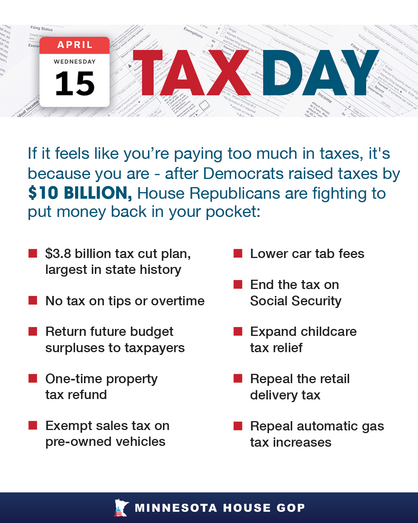
We have quite a few proposals this session that will provide meaningful financial relief to our hard-working taxpayers. I have discussed several of them in previous newsletters, but I want to take this opportunity to outline them all together in one place, so you have a clear picture of what we are negotiating for on your behalf. As a reminder, this is not an exhaustive list, but rather a highlight of some of the bills I am most excited about and that I believe will make a real difference for families and individuals across our district.
HF495: Providing a Subtraction for Day Care Costs
-
Child care costs have skyrocketed in recent years, placing an enormous strain on working families. This bill would allow taxpayers to subtract qualifying day care expenses from their taxable income, putting more money back in the pockets of parents who are simply trying to work and provide for their children.
HF4906: One-Time Special Property Tax Refund
- Property taxes have climbed steadily, and many homeowners are feeling the squeeze. This one-time special property tax refund would offer direct, immediate relief to qualifying taxpayers by returning money they have already paid.
HF3562: Modifying Motor Vehicle Registration Tax to Pre-2023 Levels
-
Minnesotans saw their vehicle registration taxes increase significantly in recent years, and this bill would roll those rates back to pre-2023 levels. This reduction would put real dollars back in your wallet every single year and permanently re-establish the tab renewal fee structure that is familiar to all vehicle owners.
-
Workers who put in extra hours to help their fellow team members and support their families deserve to keep more of what they earn. This bill eliminates the state income tax on overtime pay, rewarding hard work rather than penalizing it.
-
Service industry workers rely heavily on tips to make ends meet, and this bill would ensure that those earnings are no longer subject to state income tax. This is a commonsense measure that provides direct relief to the many workers who depend on gratuities as a core part of their income.
It is worth noting that the last two bills, No Tax on Tips and No Tax on Overtime, are federal conformity measures, meaning they align our state tax code with recent changes at the federal level. Beyond the direct financial benefit, conforming to federal law simplifies the filing process for those who qualify, reducing paperwork and confusion at tax time. Taken together, these proposals represent a strong, commonsense agenda focused on one simple principle: taxpayers deserve to keep more of their own money. I will continue to advocate for these bills and keep you updated on their progress throughout the session. Please do not hesitate to reach out if you have questions or want to share your thoughts.
|
|
Safe Schools
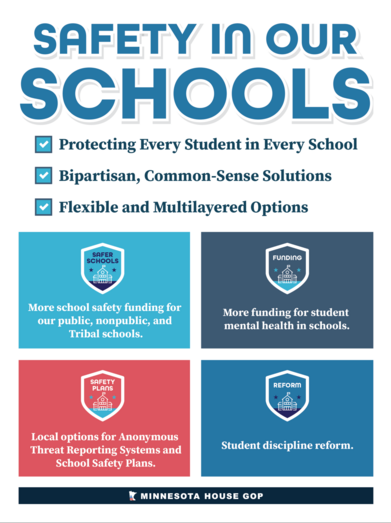
Another priority we have been focused on this session is keeping our students safe and our schools strong. Every child deserves to walk into school ready to learn, and every parent deserves peace of mind knowing their child is protected. That is why we are proud to support the Safety in Our Schools initiative, which focuses on bipartisan, common-sense solutions that protect every student in every school.
This package takes a flexible, multilayered approach to school safety and includes four key areas. First, it increases school safety funding for public, nonpublic, and Tribal schools, ensuring that no school is left behind when it comes to the resources they need. Second, it expands funding for student mental health, recognizing that a safe school is one that supports the whole child. Third, it gives local communities options for anonymous threat reporting systems and updated school safety plans, empowering schools to address potential dangers before they become tragedies. Finally, it includes student discipline reform to help create orderly, respectful learning environments where every student can thrive.
Unfortunately, despite these commonsense proposals, some legislators are blocking these efforts from moving forward. Our students, parents, and educators deserve action, not partisan gridlock. We will continue to fight to get this across the finish line because the safety of our children should never be a political issue.
 |
|
|
Clarifying the Homestead Market Value Exclusion
I recently got a question about the Homestead Market Value Exclusion at a Coffee with Tom meeting. In essence, the question is “Why has my homestead exclusion been reduced since previous years?’ Thank you to the constituent that brought this question forward.
Now, I am going to answer this question in two different ways, because Minnesota has both a Homestead Exclusion program and a Homestead Credit Refund program. These are very easy to confuse but I will explain common reasons why you might see a reduction in each program.
The Homestead Market Value Exclusion reduces the taxable value of your home before property taxes are calculated. If your homestead exclusion decreased from last year, there are a few common reasons why that may happen. The most common reason is an increase in your home’s estimated market value. In Minnesota, the homestead exclusion is designed to provide the most benefit to lower-valued homes and gradually decreases as home values rise. This means a higher home value can automatically reduce your exclusion. Changes to your property can also affect the exclusion. Home improvements, updated assessments from your county, or changes in how the property is used, such as renting part of the home, may reduce the amount excluded. It is also worth noting that the homestead exclusion phases out entirely for higher-valued homes. If your home value increased enough, your exclusion may decrease significantly or disappear.
On the other hand, the Homestead Credit Refund program provides property tax relief to homeowners whose property taxes are high relative to their income. If you have received this refund in the past and noticed your refund amount has decreased, there are a few common reasons why that may happen. The most significant factor is an increase in household income, which raises the threshold you must meet before the refund kicks in, increases the share of taxes you are required to pay out of pocket, and lowers your maximum refund amount. A decrease in your property tax bill, losing a qualifying deduction such as a dependent leaving the household, or changes in disability or age status can also reduce your refund. It is also worth noting that homeowners with a household income above $135,410 are not eligible for the program at all. If your refund looked different this year than in years past, one or more of these factors is likely the reason.
If you have additional questions on this topic or another, please reach out and I will work with my team to try to find an answer for you!
|
|
Passing SF2511 off the House floor
This week, the House passed SF2511 off the floor, a bill with several liquor provisions, one of which is affectionately called the "Granny Happy Hour Bill." This commonsense provision allows nursing homes, boarding care homes, and assisted living facilities to serve alcohol to residents and their guests without requiring a separate liquor license. Right now, these facilities face unnecessary regulatory hurdles that prevent them from doing something as simple as offering a glass of wine at a resident social event or a family gathering. This bill cuts through that red tape while maintaining important safeguards, ensuring that alcohol may only be served to residents and their accompanied guests, only at events held within the facility, and never sold for profit. It is a small but meaningful change that respects the dignity and quality of life of our seniors. They have earned the right to enjoy a happy hour with their friends and family without bureaucratic interference getting in the way.
|
|
Coffee with Tom
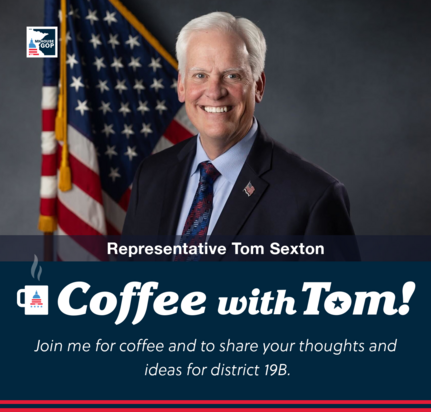
Coffee with Tom in Waseca will be on TODAY, Friday, April 17th from 12:00 – 1:00 pm at the Waseca Chamber of Commerce. This is a change due to Good Friday occurring on April 3rd, 2026, as we shifted the schedule back one week.
Please note that we will not host Coffee with Tom during the month of May due to our uncertain legislative schedule. As we move towards the end of session on May 18th, 2026, we could be in-session all seven days of the week.
Thank you for your support and feedback, I hope to see you there!
|
|
I want to hear you
I am always here to listens to concerns or ideas of my constituents. I can be reached via email rep.tom.sexton@house.mn.gov or phone 651-296-5368.
 If you would like to contact Rep. Sexton, DO NOT reply to this email. Please reach out directly to rep.tom.sexton@house.mn.gov.
|
|
|
|
|