Legislative Update
 Dear friends and neighbors,
I hope you all had a blessed Easter weekend! I was grateful to return to the Capitol this week and be greeted by sunshine and warmer temperatures. After the kind of Minnesota winter we just had, even upper 60s feels worth celebrating. I hope you’re able to get outside and enjoy it as we head into the weekend!
With just six weeks left in the legislative session, things are definitely picking up pace. The coming weeks will involve serious discussions about spending priorities and the direction of state government. And this session, there’s an added obstacle: the House is tied, which means no legislation moves without bipartisan agreement on both sides. That can slow things down, but it also forces more conversation, more negotiation, and hopefully more focus on finding solutions that actually work for Minnesotans.
This week, House Republicans rolled out our 2027–2028 “North Star Comeback” budget framework—a set of proposals focused on three big goals: making Minnesota more affordable, making government work better, and strengthening our economy for the long haul. These are proposals we would advance if we held the majority, but they also serve as a starting point for the conversations happening right now at the Capitol.
At the heart of it is a pretty simple idea: families are feeling squeezed, and they need relief. That’s why this package includes things like expanding property tax relief, eliminating taxes on tips and overtime, strengthening the dependent care credit, and providing additional help to offset childcare costs. It also includes lowering car tab fees—because I don’t know many people who look forward to that bill showing up each year.
We’re also focused on ensuring Minnesota taxpayer dollars are truly supporting Minnesota students by giving families more flexibility and control over education. Alongside that, we’re pushing to expand school safety funding so every student—whether in a public or private school—has access to a secure learning environment where they can focus, learn, and thrive.
The second pillar is making government work for Minnesotans again. That starts with cracking down on fraud by creating an Office of the Inspector General and modernizing outdated systems (some of which are over 40 years old) that counties rely on to administer programs like SNAP and Medicaid. If we’re serious about accountability, we need the tools to actually track where the money is going.
And finally, there’s a strong focus on growing Minnesota’s economy and keeping us competitive. That includes aligning with federal tax treatment for research and development, allowing immediate expensing for business equipment under Section 179, conforming business interest deductions, and supporting incentives like a sustainable aviation fuel credit. At the end of the day, these ideas are about encouraging investment, supporting job creation, and making sure Minnesota isn’t falling behind when it comes to opportunity—especially outside the metro.
As negotiations continue, the goal is pretty straightforward: find real solutions that make life more affordable, make government more accountable, and keep our economy moving forward. It won’t always be quick or easy, but there’s still time to get it right—and that’s exactly what we should be focused on in these final weeks.
Stay tuned, it's going to be a busy finish!
Level Playing Field: Standing Up for Fairness in Girls’ Sports
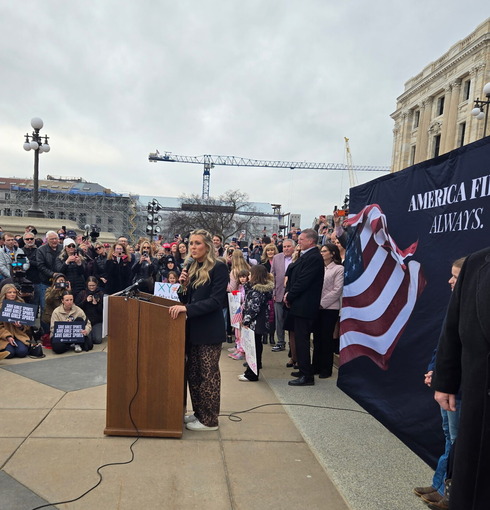 |
On Tuesday, we brought urgency to the House floor on three pieces of legislation aimed at preserving safe and fair athletic competition for biological females across Minnesota. Unfortunately, all three proposals were blocked by the DFL.
This is no longer just a Minnesota debate—it’s part of a much larger national and even international conversation. The U.S. Department of Justice is currently suing Minnesota over concerns related to girls’ sports and women-only spaces. At the same time, the International Olympic Committee has announced that beginning with the 2028 Los Angeles Games, athletes who have gone through male puberty will no longer be eligible to compete in women’s events.
Across the country and around the world, institutions are beginning to recognize what many Minnesotans already understand: girls deserve a fair shot to compete on a level playing field—something generations of women have fought hard to achieve.
You may also remember last year’s visit from Riley Gaines, who came to Minnesota in support of Rep. Peggy Scott’s House File 12. That conversation hasn’t gone away—in fact, it’s become even more relevant.
We reintroduced that effort this week through the Preserving Girls’ Sports Act (H.F. 12), and the concept is about as straightforward as it gets: girls’ sports should be for girls. It’s about protecting opportunity and preserving the hard-fought progress that made women’s athletics possible in the first place under Title IX.
Here in Minnesota, though, the legal landscape has made things more complicated. The Minnesota Supreme Court ruled last fall that excluding males from female sports could be considered public accommodation discrimination, and the Minnesota State High School League has chosen not to comply with federal guidance. Those decisions don’t stay on paper—they show up in real life. Last spring, a male-born pitcher led a girls’ softball team to a state championship in dominant fashion, leaving athletes, parents, and coaches asking very real questions about fairness on the field.
During debate this week, we even heard claims that biology itself is up for interpretation. Most Minnesotans aren’t buying that. Biology isn’t a debate—it’s reality. And pretending otherwise doesn’t level the playing field; it only puts female athletes at a disadvantage
Public opinion reflects that too. A New York Times poll found that 79% of Americans—and 67% of Democrats—support limiting girls’ sports to biological females. Parents across the state are overwhelmingly asking for the same thing: fairness, clarity, and a safe, even playing field for their daughters.
At the end of the day, this is about protecting what Title IX was always meant to do—expand opportunity for women and girls, not blur it. I will continue working to make sure female athletes in Minnesota get exactly that: a fair chance to compete, and a real chance to win.
Let's Stay Connected!
As we head into the final few weeks of session, your thoughts, questions, and ideas matter more than ever. If you have questions about legislation, ideas for improving our state, or concerns you want to share, please don’t hesitate to reach out.
You can always connect with me by phone at 651.296.4237 or email at rep.paul.novotny@house.mn.gov.
It’s an honor to represent you, and I’m grateful for the opportunity to serve our community every day at the Capitol. Together, we can keep working toward a stronger, more affordable Minnesota.
Take care!
—Representative Paul Novotny
|