Legislative Update
 Dear friends and neighbors,
Week four of the legislative session didn't hold back on any surprises—though at this point, some of them are starting to feel a little predictable.
The week kicked off with the Walz administration continuing their ongoing accountability hiatus. When the House Fraud Prevention and State Agency Oversight Committee convened Monday morning to ask some fairly straightforward questions about fraud in state programs, the administration simply… didn’t show up.
Just last week, they at least sent staff to the Judiciary Committee—unfortunately, those staffers couldn’t answer questions about the extensive redactions in the Optum fraud report. This week, they took a new approach: send no one at all.
But here’s the part that you just really can't make up: The very same DHS staffers who apparently couldn’t make time for the Fraud Committee hearing showed up in the exact same committee room just minutes later… to ask the Ways and Means Committee for more funding.
So to recap: no time to answer questions about fraud, but plenty of time to request more taxpayer dollars.
Funny how the calendar clears up when there’s money on the agenda!
Minnesota’s Affordability Problem—By Design
This week in the House Taxes Committee, we heard several proposals that would increase renter credits for individuals and expand property tax refund credits.
At first glance, that might sound like good news. Who doesn’t appreciate a little tax relief?
But when you take a closer look, these proposals start to feel less like relief and more like a policy bandage for problems the Legislature created in the first place.
Over the past few years, Democrats passed a number of costly policies and unfunded mandates—like the Paid Family and Medical Leave program—that push significant new expenses onto counties, cities, and local governments. When those costs get passed down, local officials often have little choice but to raise property taxes to cover them.
Now, instead of addressing the root cause of those rising costs, some lawmakers are proposing to increase refund credits after the fact.
In other words, government policies drive up the cost of living, property taxes rise to cover the mandates, and then the state steps in to offer a slightly larger refund check.
That isn’t real tax relief—it’s the government using taxpayer dollars to offset the very costs its own policies created.
Minnesotans deserve better than a system where the government raises costs with one hand and tries to hand a portion of it back with the other. If we want to make Minnesota more affordable, the focus should be on lowering the cost of government and reducing mandates that drive up property taxes in the first place.
You may have seen a video I posted on Facebook earlier this week about a comment made by one of my DFL colleagues during committee. During the discussion, she suggested she may introduce an amendment to quintuple Minnesota’s car tab fees in order to fund other projects.
Let’s put that into perspective.
Under that proposal, the tabs on a two-year-old $50,000 vehicle would cost roughly $3,650.
At that point, renewing your tabs starts to feel less like a quick stop at the DMV and more like signing up for a second car payment—except you don’t actually get another car.
Now, perhaps that was meant as a joke in committee. But for Minnesota families already trying to keep up with rising costs, it’s really not funny in the slightest.
Affordability is one of the most serious issues facing Minnesotans right now. Families are juggling higher grocery bills, rising childcare costs, expensive insurance premiums, and energy bills that seem to climb faster every year. Household budgets are already stretched thin.
And the pressure isn’t going away anytime soon.
Many Minnesotans haven’t received their upcoming property tax statements yet, but given the number of mandates and cost shifts pushed onto cities and counties in recent years, there likely isn’t a single local government in the state that won’t be forced to raise property taxes. Those increases don’t happen in a vacuum—they land squarely in family budgets.
Yet even in the middle of an affordability crisis, House Democrats continue advancing proposals that would make life more expensive. Just take a look at what’s already in the hopper:
-
HF 3945, a Climate Superfund-style proposal that would increase energy costs, fuel prices, and the cost of everyday goods.
-
More than a dozen new health care mandates that will drive up insurance premiums.
-
HF 2591, creating a new fifth-tier income tax, taking even more from Minnesotans.
-
Continued support for the retail delivery fee they created.
-
Continued support for automatic gas tax increases.
-
Opposition to efforts to lower car tab taxes—even while floating ideas to dramatically increase them.
-
Ongoing defense of the unfunded mandates and cost shifts pushed onto schools, counties, and cities that are driving record-breaking property tax increases.
-
New payroll taxes and business mandates that ultimately get passed directly on to workers and families.
And it’s worth remembering how we arrived at this moment.
Just two years ago, Democrats controlled the Legislature with an $18 billion surplus. Instead of returning that money to taxpayers or preparing for the future, they spent down the etire surplus, raised taxes by $10 billion and increased state spending by roughly 40 percent.
Now, in an election year, we are hearing a lot of talk about “affordability.”
But Minnesotans don’t need a rebrand. They can look at the policies themselves.
Because when the answer to every problem is another tax, another mandate, or another fee, the result is exactly what families across Minnesota are experiencing today: life simply costs more.
House Republicans will not stand for it. We will continue pushing for responsible budgeting, lower taxes, and policies that make Minnesota more affordable for the people who live and work here.
Minnesota has a big decision to make in November. We can continue down this path of rising costs and bigger government, or we can choose a new direction grounded in fiscal responsibility and common sense.
Minnesota, the choice will be yours.
From Glyndon to the Capitol
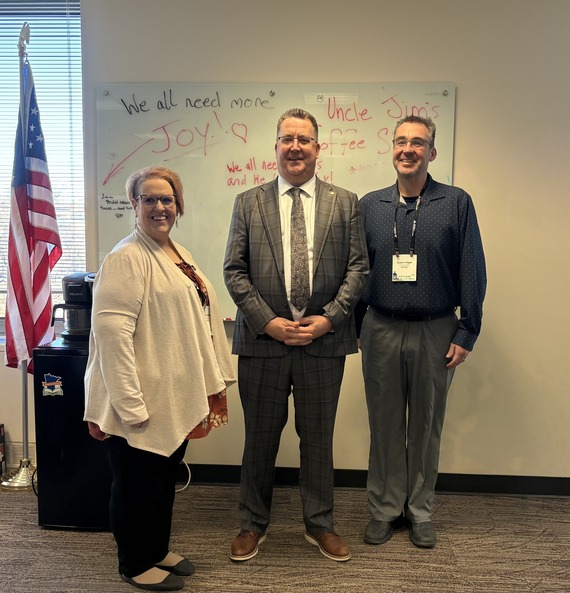
It's always a good day when folks from home make the trip down to St. Paul. This week I had the pleasure of visiting with City Administrator Vogel and Council Member Severson from the City of Glyndon, who stopped by the Capitol to talk about Glyndon’s priorities and what’s ahead for their community.
I’m always grateful when local leaders take time out of their busy schedules to bring a little Clay County common sense to the Capitol. Conversations like these help make sure the voices of our communities are heard loud and clear—because the best ideas usually start around the kitchen table back home, not a conference room in St. Paul.
Appreciate their dedication to keeping Glyndon moving forward, and I’m looking forward to continuing the conversation as we work together for our region.
Stay in Touch!
As always, my door is open. If there’s an issue on your mind, a question about legislation, or something happening in the district that I should know about, don’t hesitate to reach out. Hearing directly from you helps keep the work at the Capitol grounded in what matters most back home.
You can reach me anytime at 651-296-6829 or by email at rep.jim.joy@house.mn.gov.
Have a great weekend!
– Jim
|