MN Fraud Monitor — January 2026
Welcome back to another monthly edition of the MN Fraud Monitor. The start of 2026 placed Minnesota’s fraud oversight efforts under intense scrutiny at both the state and federal level, with major audits, congressional hearings, and direct federal law enforcement engagement once again keeping national eyes on the state of Minnesota.
Following viral attention generated by content creator Nick Shirley’s late-December content, Minnesota’s fraud oversight work moved onto a national stage. Following the allegations broadcasted by Shirley to millions on X, Minnesota House Fraud Committee members (Chair Kristin Robbins, Representative Marion Rarick, and Representative Walter Hudson) were called to testify before the U.S. House Oversight Committee to answer questions related to fraud in Minnesota’s Government, primarily the Department of Human Services and Medicaid programs they administer. (1)
Concurrently, Minnesota entered January amid a broader federal enforcement environment that evolved rapidly and became a focal point of state-wide and national attention. As Operation Metro Surge expanded and evolved, the critical issue that largely sparked the federal operation was effectively sidelined, the issue of fraud in Minnesota. While polarizing and important broader federal law enforcement debates continue, this issue of the Fraud Monitor attempts to focus specifically on developments related to fraud. (2) January 2026 was a month in Minnesota that won’t soon be forgotten. Hopefully this edition helps ensure that updates and developments on the central story of fraud aren’t forgotten, either.
Timeline
Early January: audit findings and governance concerns at DHS
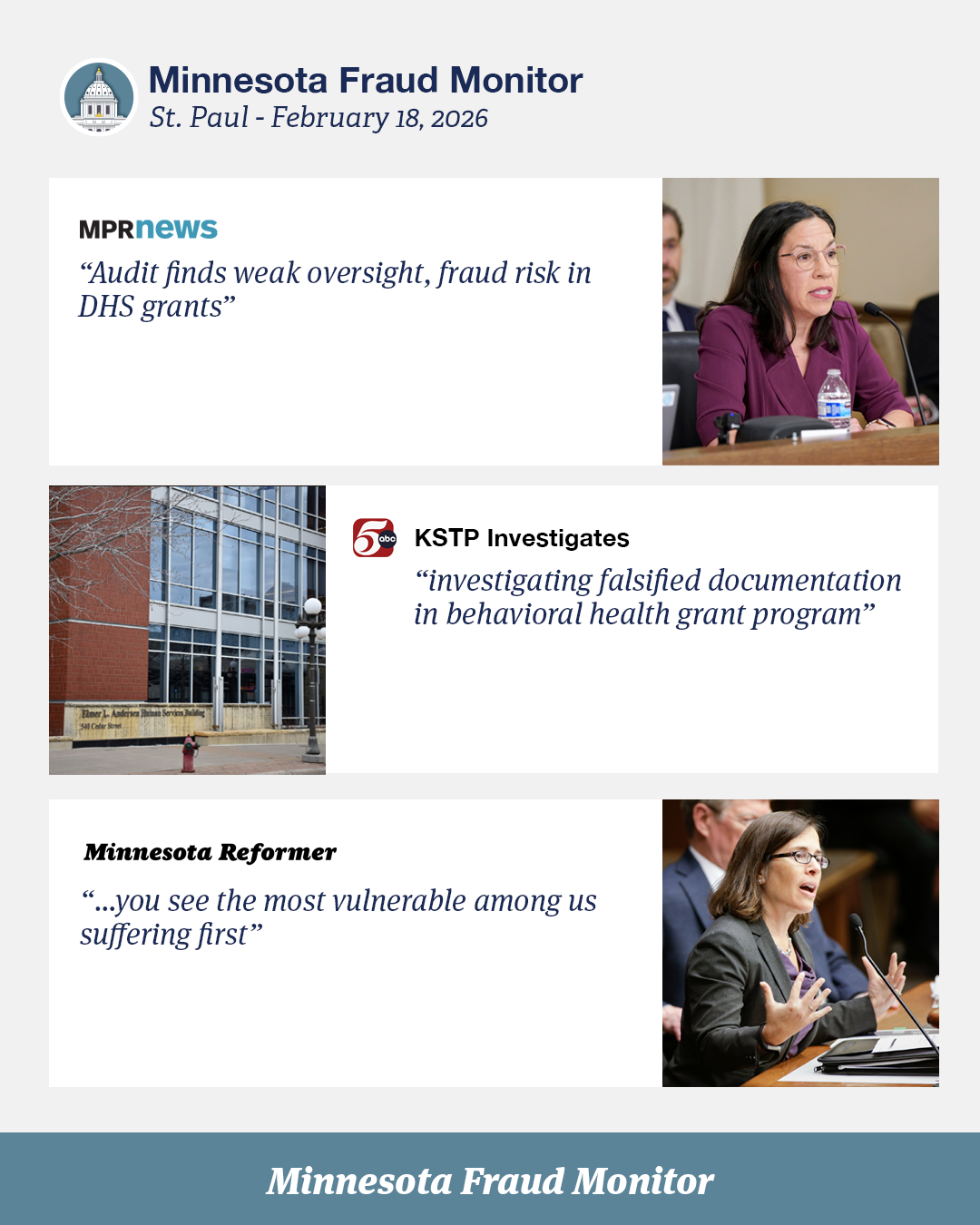
On January 6, the Office of the Legislative Auditor released a scathing performance audit of DHS Behavioral Health Administration grants. The audit identified 13 different Findings, including 4 cases of prior findings not being resolved, overpayments, payments to grantees prior to the completion of grants, negligible oversight, falsified/improperly sourced payments, even reports of DHS employees backdating and/or fabricating documentation, among other findings. The Findings summary, at the very least, is linked at the end of the newsletter and is worth reading. (3) The audit showed familiar themes that have plagued Minnesota’s Department of Human Services, negligence, an absence of oversight, cultural deficiencies, and overall major concerns with the agency’s administration. (4) (5) (6)
January 7: congressional testimony and national spotlight
On January 7, the U.S. House Oversight Committee held “Oversight of Fraud and Misuse of Federal Funds in Minnesota: Part I,” where three members of the MN House Fraud Committee provided testimonies and answered questions from the committee for roughly five hours. The testimonies of the State Representatives provided various analyses about the scope and nature of the fraud challenges plaguing Minnesota while adding increased scrutiny to the ways well-intentioned Medicaid programs can be coopted by bad actors, statutory shortcomings and administrative mismanagement. Following the hearing and spotlight on Minnesota’s (largely Medicaid-based) fraud, US Senator Joni Enrst introduced a federal bill to ostensibly better guard against fraud on the federal level. (1) (18)
Mid-to-late January: prevention tools move upstream, and the service impact becomes the story
On January 8, DHS announced further initiatives to address fraud issues. DHS stated they would coordinate with CMS to freeze new provider enrollment in the 13 high-risk Medicaid programs (the same programs subject to the October 2025 Executive Order requiring prepayment reviews). (7) The news continued DHS’s more proactive attempts to identify and address fraud in their Medicaid programs that largely ramped up towards the end of 2025. This freeze went into effect on January 27th.
As the month progressed, however, concerns about the consequences and execution of the pre-payment review process became pronounced. Service providers from across the state described DHS delaying payments to [Medicaid] service providers of the various high-risk programs. Many of the organizations that provide the services that the Medicaid programs in question are meant to operate almost exclusively based upon the reimbursements/payments from the state administered federal programs. In practice, these organizations largely break even financially; their reimbursements largely cover their expenses and thus depend on consistent and predictable payments to cover mandatory expenses like payroll. (8) (13)
Legally and ethically compliant service providers, having reduced and delayed reimbursements, caused several organizations to shut down their businesses, and many more to face intense and uncertain financial vulnerability. In many ways, this tragic and unresolved issue can make sense of the incredible difficulty and critically important task of effectively administering these programs (in Minnesota and across the country). Without accountable, effective, and attentive (among other requirements) administration of these large programs – that touch millions of people while using billions of dollars – it’s not difficult to understand how billions can be stolen in fraud through negligible oversight, while simultaneously numerous compliant/ethical service providers can be severely impacted by poorly administered increases in scrutiny and oversight. It’s not easy, but the stakes are incredibly high. (8) (13)
In response to complaint service providers being casualties of the pre-payment review process, on January 28 and January 29, Senate and House Human Services committees held a joint hearing to examine implementation and consequences of the prepayment review process. The joint committee heard from program participants, service providers, and DHS. The challenge and importance of navigating the complex and difficult duty to safeguard tax dollars by preventing fraud, while not penalizing those that follow the rules, was central. (13) (14)
Late January: convictions and legal determinations in Medicaid/DHS-related cases Feeding Our Future and related DHS-administered programs:
January reporting continued to surface court-stage developments tied to the Feeding Our Future docket and related Medicaid program-fraud matters, including guilty pleas already on file and ongoing restitution/forfeiture work in federal court. (19) (21)
Autism services (EIDBI) fraud:
One Medicaid-linked conviction-stage development that reappeared in January coverage was the guilty plea by Asha Hassan, who admitted to a $14 million Medicaid fraud scheme involving autism services and also admitted participation in Feeding Our Future-related fraud; Hassan agreed to nearly $16 million in restitution and remained out of custody pending sentencing. (19)
Home health billing fraud:
On January 14, Minnesota Attorney General Keith Ellison’s Medicaid Fraud Control Unit announced criminal charges alleging a home health agency billed Medicaid roughly $3 million for services not provided, underscoring that a meaningful share of the month’s Medicaid enforcement activity remained in charging posture (not yet adjudicated). (20)
Licensing actions tied to ongoing cases:
DHS also took or announced licensure actions tied to several defendants and provider entities connected to Medicaid-fraud investigations (including autism services and Housing Stabilization Services-related providers), illustrating how administrative determinations can move faster than criminal case resolution. (19)
January 13–15: wave of resignations in the U.S. Attorney’s Office
The US Attorney’s Office in Minnesota also was shaken in considerable and ominous ways in January when, just 13 days into the month, 6 members of the US Attorney’s Office resigned, including lead prosecutor Joe Thompson. One of the central forces attempting to hold fraudsters accountable and implore Minnesotans to pay attention regarding the scale and urgency of fraud challenges plaguing the state was US Attorney Joe Thompson and his team. Thompson was the lead prosecutor in fraud cases for most of 2025 and famously provided the estimated figure of at least $9 billion in fraud having occurred in Minnesota (in just the 14 high-risk Medicaid programs). The resignations occurred during the height of direct federal law enforcement operations in Minnesota, though no public statements have been provided by Thompson or members of his team as to the reasons. Regardless, the state lost a preeminent force against fraudsters and for accountability. (15) (16) (17) (22)
Conclusion
Fraud in Minnesota isn’t always headline news, but its reality, and its consequences, are felt daily by taxpayers, vulnerable program participants, and the frontline workers trying to deliver services the right way. This is our state, and we all have a role to play in restoring it to being one of the premier Midwest states: insisting on transparency, demanding competent administration, and supporting reforms that protect both public dollars and the people these programs are meant to serve.
Oversight works best when it’s grounded in what people are seeing on the ground, service recipients, frontline workers, providers, neighbors, local officials, and taxpayers who notice patterns that don’t add up. If you have concerns, questions, or firsthand insight, please reach out and share them.
If you find this update useful, consider forwarding the MN Fraud Monitor to friends, family, and neighbors who care about accountability and effective government. And if there are other topics you’d like to cover in a similar monthly format, I’d welcome your suggestions. To share tips or concerns related to suspected fraud, you can also use the House Republican fraud/whistleblower portal here: https://mnhouserepublicans.com/whistleblower-portal/
|